
Amazon has revised its fulfillment fee for the year 2026. Starting from the 15th of January this year, sellers must prepare themselves to pay a higher sum on Fulfillment by Amazon (FBA), Referral, and Multi-Channel Fulfillment (MCF) fees. In the notification to their sellers, Amazon mentioned, “In 2026, FBA fees will increase by an average of $0.08 per unit sold, or less than 0.5% of an average item’s selling price. This is on top of no increase in US Referral and FBA fees in 2025.” Additionally, they drew a comparison to the inflation rate rising to 5.9% in the previous fiscal year. Now, this needs to be studied and understood well to optimize the cost and make necessary adjustments to the price of the products. Let’s dig into it!
Amazon Fee Changes in 2026
Sellers will observe the alignment of costs in a relatively streamlined manner, depending on the item size, weight, and storage dynamics. This is where significant changes will happen as part of Amazon’s 2026 fee update:
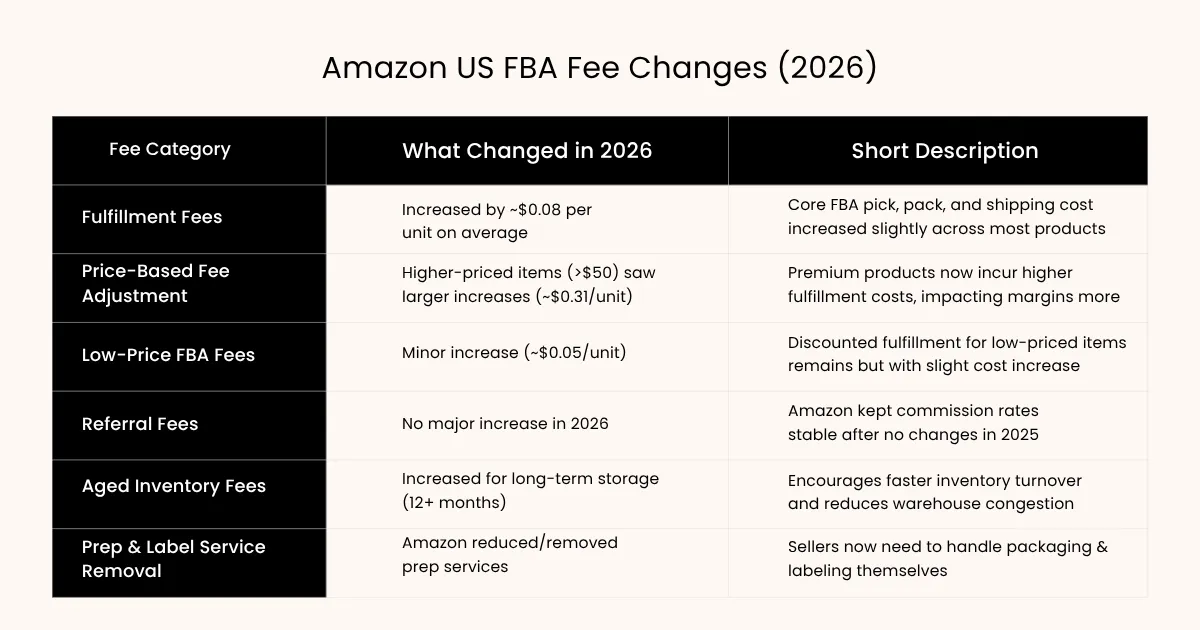
- Amazon FBA: The fulfillment fee, on average will see a rise of $0.08 per unit. To have a more specific view of this, sellers will have to check the detailed size and weight tiers and hence, determine the cost they will have to pay for the fulfillment.
- Buy with Prime: The Fulfillment fees under this heading are deemed to rise by approximately $0.24 per unit. This is to bear the cost of updates in storage, delivery speed, and return processing.
- Amazon MCF: The rise in this scenario is the maximum, as the hike will be around $0.30 per unit. Amazon has deliberately created a price disparity between the multichannel fulfillment of orders on its marketplace and other marketplaces.
A Detailed Breakdown of the Amazon Fulfillment Fee
Amazon has made an effort to improve delivery speed; hence, the price adjustments are such that the standard-size fulfillment fees are hiked while the inventory level fees are lowered. Here’s a detailed breakdown for you:
1. Standard-size products priced between $10-$50
In this price range, the average increase in fulfillment fees for small standard-size products will be $0.25 per unit. The average increase for large standard-size products will be $0.05 per unit.
2. Standard-size products priced below $10
The average increase in small standard-size product fulfillment fees in this price range will be $0.12 per unit. Fees for large standard-size products won't change. In comparison to standard-size products costing $10 or more, products priced under $10 will receive an additional fee discount of $0.86 per unit on average (up from $0.77 before).
3. Standard-size products priced above $50
Products over $50 will see an average increase in small standard-size product fulfillment fees of $0.51 per unit and large standard-size product fees of $0.31 per unit. Higher levels of service, such as additional handling, more features, and quicker processing, are needed for these products. Hence, the price bracket is on a slightly higher end.
4. Low-inventory-level fees will apply at the FNSKU level instead of the parent-ASIN level
This adjustment will assist in guaranteeing that Amazon has enough of the best-selling versions in stock. Now, groceries will be exempt. Slower-moving items may have limited nationwide availability or slower delivery guarantees, but they will still be free from low-inventory-level costs.
5. Inventory Related Fee Restructuring
Sellers need to note that for items that are 12 to 15 months old, the minimum aged inventory fees will rise by $0.15 per unit to $0.30 per unit each month. Monthly aged inventory fees for items older than 15 months are $0.35 per unit or $7.90 per cubic foot, whichever is higher. In addition, standard-size aged objects weighing less than 0.5 pounds will have their removal and disposal costs waived by $0.20 per unit.
Note: The increased fee of $0.30 per unit or the same $6.90 per cubic foot will continue to be charged, whichever is higher.
6. Fulfillment for Bulky Orders
For small bulk products, fulfillment costs will typically drop by $2.06 per unit, while for large bulk products, they will drop by $0.26 per unit. There will be a net fee reduction for most bulky products that currently use SIPP. Bulky goods, both small and large, that are not covered by SIPP will pay an average packaging price of $2.07 per unit.
The Impact of Amazon’s 2026 Fee
There are a lot of changes to be witnessed by the sellers in the coming year. There are definite effects of these changes. Have a look at the same:
1. Shrinking Margin
Increased fulfillment cost directly affects the seller's margin and profits. The slightest hike will have a massive impact on the overall business earnings. It is not just about fulfillment; the business has to bear multiple expenses like marketing, advertising, and, of course, the packaging material, which will cut down the profits further.
2. Cut Throat Competition
When the cost increases, the price flexibility is low for the seller. Beating the competition with a better price is no longer an option. Sellers need to be more innovative and more strategic with their selling techniques and they might even have to invest more in marketing and advertising.
3. Storage and Inventory Cost
Amazon keeps improving its inventory and storage procedures in addition to raising the fees per unit. Low-inventory-level surcharges, removal fees, and long-term storage fees are already in place. Sellers may incur additional expenses beyond the basic fulfillment price if they keep surplus inventory or ship to Amazon's network inefficiently.
4. Costly Multi-Channel Fulfillment
As mentioned above, the fulfillment cost hike for orders outside of Amazon Marketplace is even higher, almost double in comparison to Fulfillment by Amazon. This puts the seller in a difficult situation, as multichannel selling becomes even more difficult.
Strategies for Sustainable Growth Beyond a Single Channel
The growth plan should be such that it works in the long run and not just for today. So, here’s one such strategic plan for your ecommerce business to combat the price hike:
1. Multi-Marketplace Listing
Listing the business and its corresponding products on different marketplaces allows sellers to gain visibility and increase sales. Also, they can reach a wider audience and the company is hence able to gain momentum that lasts in the long run.
2. Fulfillment Flexibility
While some orders require experience and a vast network of Amazon, there are some others that can effectively be fulfilled through a third-party logistics (3PL) provider. Sellers can integrate their sales channels together with Amazon Fulfillment and a 3PL partner to manage their deliveries in a cost-effective manner.
3. Time Saver
Integration applications like MapMyChannel allow sellers to save time with automation, integration, and multichannel selling. This simple API Integration software gives way to effective business processing and error-free data transmission while providing consumers with top-notch customer service.
4. Scalability
While MapMyChannel manages order processing, inventory management, and 3PL integration, sellers can work on better marketing and scalability of the business. They do not have to work on day-to-day business processes and hence are able to use their time better.
.webp)
Conclusion
The year 2026 calls for automation and diversification. As a seller, if you are selling on Amazon only, make it a point to spread your wings and business to a broader range of sales channels to reach more people. Also, knowing the right inventory management system, fostering innovation, and automation are necessary as the competition gets tougher. MapMyChannel is the definite game changer which will bring shamelessness to your business while making sure that order, inventory and the overall business operations are in place.
If you are seller and want to expand your business presence across additional sales channels. MapMyChannel helps sellers list products, sync inventory, and manage orders across marketplaces from one place.
Get in Touch

.webp)
.webp)


