Most of the time, Amazon and Amazon Marketplace are used interchangeably, but as the title says, these two terms are very different. To lay down a base before we dig deeper into the topic, Amazon is the store that buys and sells products on its online store, and Amazon Marketplace is where sellers from all around the globe sign up and list their products to make sales. Amazon makes a profit from both sales and referral fees; in fact, 60% of the sales made on Amazon are attracted by independent sellers and not the channel itself. Either way, Amazon is able to maintain its dominant position in the eCommerce industry, and this blog is going to lay out clear distinctions between Amazon and Amazon Marketplace.
Basics: Amazon vs Amazon Marketplace
What is Amazon?
Amazon was founded in 1994 as an online bookstore, and in no time, Jeff Bezos realized that the platform could offer a lot more than just books. Hence, the channel was redefined as an online platform that sells products from multiple categories, ranging from pins to planes. Today, Amazon expanded its operations to streaming(Prime Video) and cloud computing (AWS), and digital payments. The channel takes care of everything from selling to fulfillment through Fulfillment by Amazon.
What is Amazon Marketplace?
While Amazon lists and sells products from all over the world, it also allows third-party sellers to list their products and make sales. Marketplace sellers can market their products on the sales channel effectively to grab the maximum traction from customers. Most people do not realize when they are buying from Amazon vs Amazon Marketplace, as the two are really tightly integrated. Amazon sellers need to go through a simple registration, but strict policies and compliance rules to be eligible to sell, so that no inappropriate products are sold on the channel.
Key Differences Between Amazon and the Amazon Marketplace
The base is set, and this is the section where you can draw a clear and broad line between the two terms explained above. Here’s how it works:
1. General Features
Amazon
Amazon Marketplace
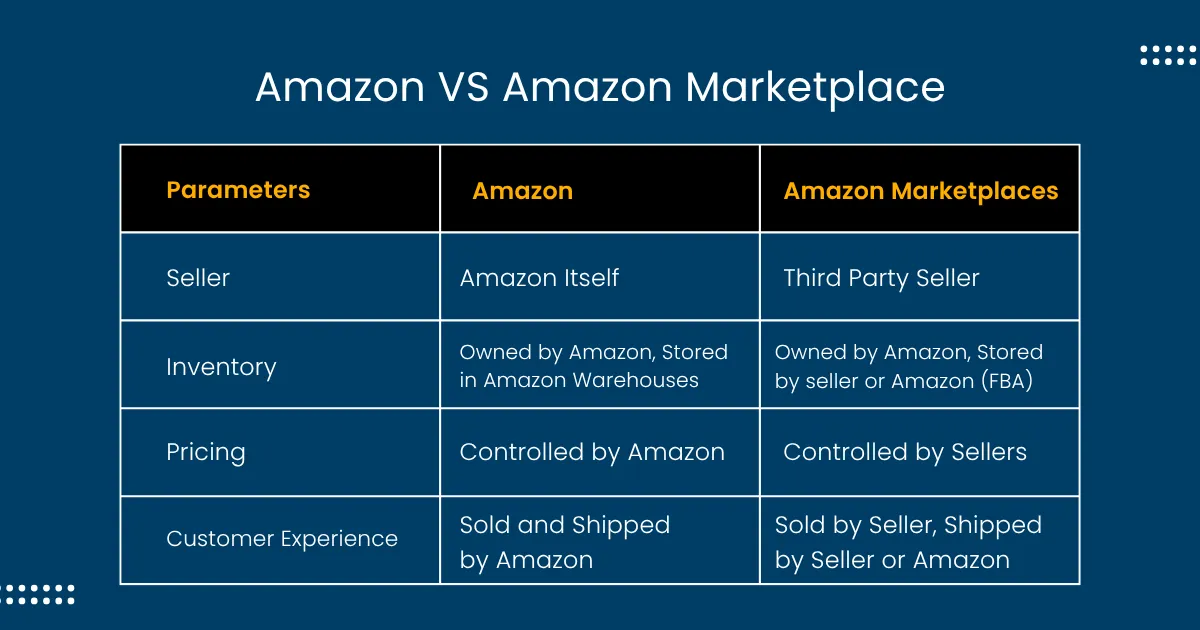
The platform has evolved into an online store that works on a customer-centric approach, updates its technology regularly, and has a global reach. Apart from this, it has expanded its operations to a cloud service provider with AWS (Amazon Web Services). Not to forget, Amazon Prime Video and Music are yet another growing arm of the brand, giving way to diversification and long-term scaling.
The marketplace sellers can easily sell their products to end-users. The platform facilitates a streamlined selling process through FBA (Fulfillment by Amazon), global order fulfillment, and marketing. It serves the sellers with all the possible assistance, like inventory management and customer support, to provide end customers with a high-end shopping experience.
Products being sold on Amazon are mostly new and are eligible for Amazon Prime benefits.
The products need not always be brand-owned and are not always eligible for Prime benefits. Also, used products are sold here following the Amazon Product Guidelines.
3. Seller Fees and Charges
Amazon
Amazon Marketplace
This does not apply here, as Amazon acts as the retailer and does not pay seller subscription or commission fees.
Amazon Marketplace’s sellers have to pay the fees in accordance with the Individual Plan and Professional Plan. Sellers on Amazon do not have to pay a monthly subscription fee under the Individual Plan. But a commission of $0.99 is paid on every item sold. Under the Professional plan, the seller has to pay $39.99 monthly as a subscription, but no commission on each sale. In addition to that, they have to pay closing fees (applied to media products); Amazon FBA fee (if used), referral fees, and more.
4. Inventory Management
Amazon
Amazon Marketplace
The inventory on this side is owned by Amazon only. The management of stock is all done in the house, so the delivery is generally faster.
The stock on this side is managed by the retailers. They can store the same in Amazon's warehouses, but the numbers have to be tracked by the seller themselves.
5. Fulfillment and Shipping
Amazon
Amazon Marketplace
The fulfillment and final delivery of the products, in this case, are all handled by Amazon-owned services. They provide fast shipping services with FBA and Seller-Fulfilled Prime Amazon Easy Ship for complete customer satisfaction.
Sellers can opt for Amazon FBM, 3PL (third-party logistics), or a mixture for efficient delivery and cost optimization. The better the delivery speed, the more chances for consumers to place an order with the sellers in this case.
6. Reverse Logistics
Amazon
Amazon Marketplace
Amazon’s return policies are formed in a manner that is consumer-friendly. Customers need to carefully read them before buying a certain product, and they will not face difficulty in returning the products or getting their refunds. Also, customer support is always there to help the consumers with streamlining of the process.
Selling on Amazon Marketplace, sellers need to manage the returns on their own unless they use FBA. They might add certain conditions to the existing policies of Amazon and then process the return and refunds, but the base has to be the policy framework laid out by the organization.
The basic difference and in-depth distinction are all laid out very clearly for the sellers. As a sales channel, Amazon offers a great deal of advantages to the sellers. From global expansion to an easy storage option, the channel offers it all at a nominal price. If you wish to combine the advantages offered by Amazon with some other sales channel, you can easily integrate it with the use of an Integration Application. Applications like MapMyChannel are designed to help the sellers integrate and manage their multichannel ecommerce efficiently on a centralized dashboard. In addition to a centralized dashboard, the API-based automation software allows inventory and order management for streamlined business functioning. There’s a lot more for you to explore in the application. So, go ahead Sign up with Amazon and integrate MapMyChannel today!
Grow your AliExpress sales while making the most of your existing Amazon inventory. WebBee connects your sales and fulfillment operations, helping you process orders smoothly and efficiently.
Start Free Access 🚀
Expand Your Business to AliExpress
One dashboard. Every marketplace. Total control.
You’re Now Part of the Growth Pass
You’ll receive an email shortly with your coupon code and links to all our
apps.


.webp)
.webp)


