
Every business has unique needs, hence the strategy for growth has to be different, depending on the nature of the enterprise. Building that strategy is time consuming and effort taking, especially when the business runs online. Ecommerce businesses have tougher competition to beat and a wider market to sell which requires innovation to attract customers and make sales. Ecommerce integration is a full proof strategy applicable for multiple online businesses. This blog will give you a wide and clear view of the multichannel integration so that you can formulate the flawless strategy for your business.
What comes under Ecommerce Integration?
Ecommerce integration refers to integration of front end ecommerce operation with back-end essentials like ERP systems, inventory, shipping and CRM software. Ecommerce integration platforms help with the integration of ecommerce operations with functions responsible for customer support and business handling. It acts as an ecommerce solution that allows easy data exchange for streamlined business operations, driving better customer experience. There are some common integrations opted by businesses on their track of growth:
- Inventory Management
- Order Management
- Customer Relationship Management
- 3PL for Shipping and Logistics
- Marketing and Analytics integration
Why Ecommerce Integration Matters For the Businesses
Ecommerce integration gives your ecommerce business the strength to grow bigger and better. It equips you with just the right assistance that not just simplifies your day-to-day working but also streamlines the overall business operations. It benefits the business in multiple ways:
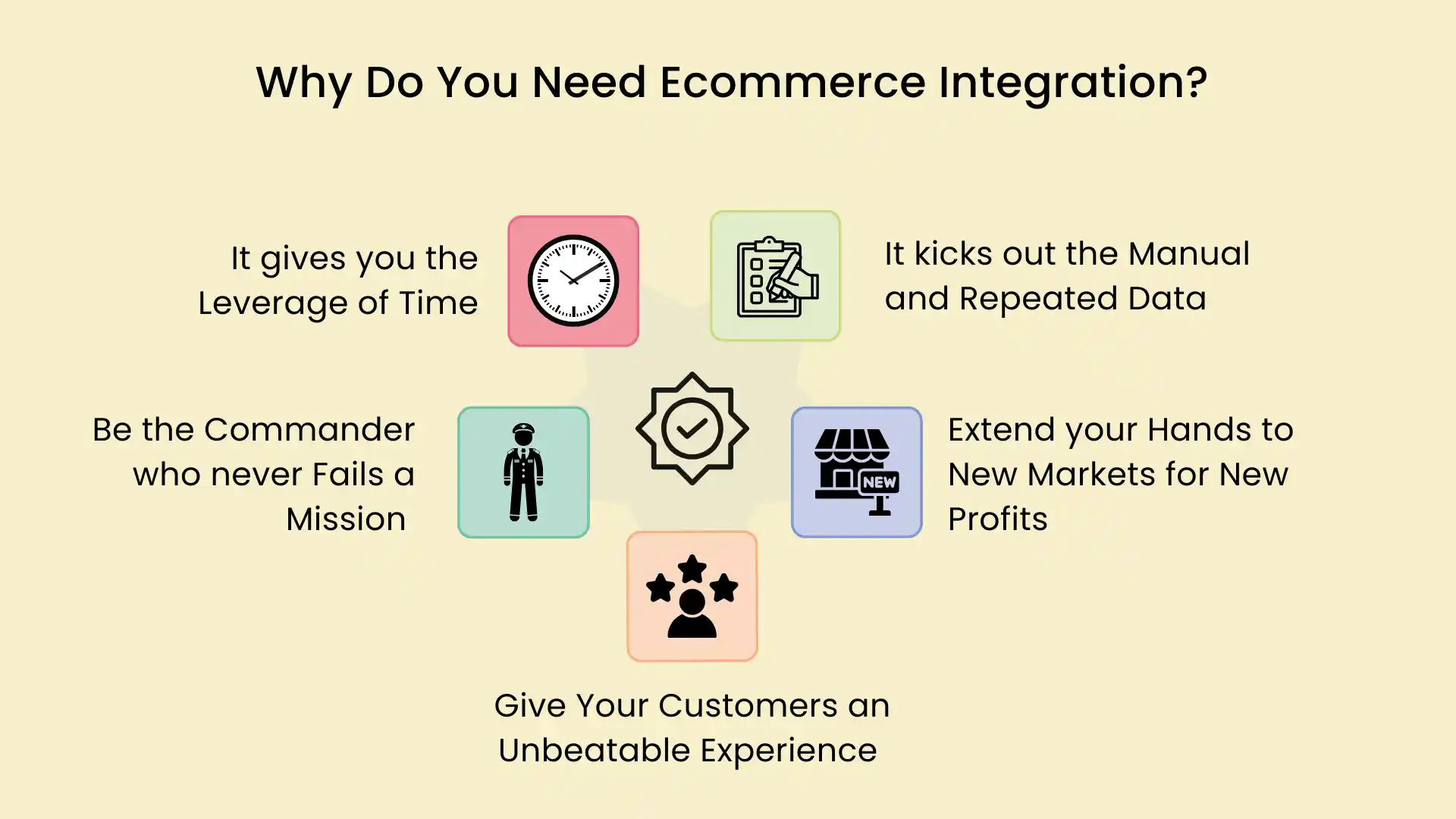
1. It kicks out the Manual and Repeated Data
Ecommerce integration opens the door to automation while eliminating the need for manual entry. Also, integration brings the different kinds of data stored in different places together on a centralized platform which helps to delete the replicated data. Also, accuracy of customer and product data is ensured with the virtue of automation. As manual data entry leaves the scene, the ratio of discrepancies also decrease keeping the data clean and reliable.
2. It gives you the Leverage of Time
According to a well known phrase - 'Time is Money' hence the right investment of the same is a must. Ecommerce linking gives the business the leverage of time by saving and optimizing the same. It allows the seller to streamline and automate the tasks carried out on a daily basis without the scope of errors giving another benefit of accuracy.
3. Give Your Customers an Unbeatable Experience
Only happy customers are the ones who come back to give repeat business to an entrepreneur. As the seller links different ecommerce operations, they step into a place where technology handles everything efficiently so that they do not work hard. Technology makes the business process transparent by putting an end to unnecessary tasks and repetition. Once, all this is done customers experience service that is packed with accuracy, effectiveness and convenience.
4. Be the Commander who never Fails a Mission
Making the right decision is ten times easier if you already know the results. Now, that is difficult and impossible. But data is something that gives the seller an idea of the results, through which decision making becomes simple and the chances of failure are much lower. While integrating the ecommerce operation, sellers can also get access to the compiled data of sales, growth, demand etc. giving the perfect insights for decision making.
5. Extend your Hands to New Markets for New Profits
Now, the most important part of ecommerce growth is expansion into new markets. Integration of ecommerce gives the seller the time to strategize and build a consumer base around the globe. Also, ecommerce integration gives the seller an option for multichannel selling which widens the horizon of selling. Also, ecommerce integration gives the sellers an ecommerce fulfillment solution to deliver in different corners of the globe.
Obstacles in Ecommerce Integration for Online Business
Knowing the benefits is not enough for you. You also need to know the challenges or the possible roadblocks on the way. Here's the list of problems that might occur on your way:
1. No Clarity Regarding Requirements
Many companies continue to operate with outdated, e-commerce incompatible systems. If you don't know what you require to connect or how to do the same correctly. The process can be difficult and time-consuming.
2. Obsolete Legacy Systems
It is necessary to replace legacy systems with more capable ones because they could not have the features required for an eCommerce website. These systems will continue to struggle with new technologies as they become available and take advantage of new features like social sharing choices and mobile buying if you don't have a plan to replace them.
3. Missing Multichannel ecommerce Integration
Multichannel selling is an integral part of businesses these days. If a seller is selling on multiple platforms and there is no multichannel integration solution that is managing the different platforms, this is the biggest challenge for ecommerce integration. This leads to discrepancies in data and order fulfillment of different sales channels. Also, the order management system fails if there is no ecommerce multichannel integration solution.
Essential Tips for Successful Ecommerce Operation Integration
Successful ecommerce integration is a bit tricky as it requires a certain procedure to be followed. Here's the pre-requisite needed for successful ecommerce connection:
- Identification of Weak Points: Firstly, the seller has to recognize the weak areas where there is maximum scope of errors, delay or inefficiency.
- Understand what your customer needs: Then the seller has to understand the needs of its customers so that you can understand what area needs the maximum improvement.
- Evaluation of Data Flows: Now, the seller needs to know the movement of information from ERP, CRM and accounting systems.
- Defining the Scope of Integration: Integrations can seep as deep as you require. Understanding the scope of integration includes pricing, product and inventory data. This definition will outline the consideration of orders and shipping information for customer data.
- Select Whats Best: Finally, seller just have to select what fits their requirement. The linkage must support multichannel integration, 3PL integration, inventory management, order management etc.
The Business Strategy for Sales Magnification
Ecommerce integration is the ultimate strategy that your business needs for growth and expansion. But you would require an ecommerce integration software that will seamlessly connect your ecommerce platform with other business systems. MapMyChannel is the ultimate ecommerce integration solution that can simplify ecommerce fulfillment, multichannel selling, inventory management, 3PL integration, product listing, pricing and customer support. MapMyChannel is carefully designed for easy ecommerce integration where all the supporting systems can be brought together on a centralized dashboard for efficient business management.
If you need help integrating your sales channel with fulfillment/ERP, please get in touch with us. Our team will consult with e-commerce solutions can help to reduce the manual error, inventory expansion, help with customer retention and improve user experience.
Get in Touch

.webp)
.webp)


