

Logistics and Supply Chain Management is to an eCommerce business what salt is to food. Everything else will still be irrelevant if this part of the business is not sorted. Artificial Intelligence (AI) is capable of simplifying and optimizing this process through carefully crafted algorithms and well-studied patterns. It brings sellers a competitive advantage and allows them to provide best-in-class service to consumers while growing the business at a faster pace. As consumers these days look for same-day delivery, real-time tracking systems, and other customized services, Artificial Intelligence in logistics is a must for your eCommerce growth. This blog brings out the real-life utility and benefits of AI in supply chain management while highlighting the use cases of one of the most popular platforms for a better understanding of the topic.
Understanding AI in eCommerce Logistics
AI in logistics refers to the application of AI technology in the logistics sector. It allows the automation and improvement of logistics operations and processes. AI technologies, such as machine learning and predictive analytics, enable task automation, allowing sellers to make well-informed decisions.
It comprises order management systems, e-commerce inventory management software, route optimization, AI-driven demand planning, and a lot more. Basically, it gives the seller the liberty to focus on sales and other business processes while taking care of the entire eCommerce supply chain optimization.
Real-World Insights of AI Changing Logistics & Supply Chain
Sales and logistics channels around the world are accepting and bringing Robotic Process Automation (RPA) to their platforms for better performance and support to sellers. Here are a few examples:
1. Amazon
Over 520,000 AI-powered robots are currently working alongside people in Amazon's warehouse robotics initiative. This has reduced the fulfillment costs by 20% while processing 40% more orders per hour. By increasing picking accuracy to 99.8%, their computer vision systems have virtually eliminated returns resulting from incorrect items, hence earning higher profits for the sellers.
2. DHL
DHL’s AI-powered forecasting technology has improved prediction accuracy to 95% while cutting delivery delays by 25% in 220 countries. Their "Smart Trucks" save 10 million miles a year with delivery optimization. All this happens with the use of machine learning algorithms to automatically reroute deliveries based on traffic, weather, and new pickup requests.
3. Walmart
By using AI inventory management systems at 4,700 locations, Walmart has been able to maintain 99.2% in-stock rates while cutting inventory expenses by $1.5 billion a year. To maximize restocking, their demand analysis algorithms examine more than 200 factors for each product.
4. UPS
AI is used by UPS for route optimization to determine the best delivery routes. It processes 30,000 routes per minute and saves 38 million liters of fuel every year. Every year, the system prevents about 100,000 metric tons of green gas emissions.
Core Technologies of AI Transforming Logistics
There are certain key areas where AI helps sellers manage their operational efficiency. Here’s what AI-powered fulfillment centers can do:
1. Predictive Analytics
AI software uses algorithms and historical data to predict the demand in different seasons. The data fed to the application enables it to identify trends and consumer behavior. With such predictions, sellers are well prepared for the sales in the upcoming season. There are low chances of dead inventory or out-of-stock situations.
2. Inventory Management Automation
With seamless tracking of product flows, flawless inventory management, and predictive analytics, sellers are free from the burden of storage management. It is allowing them to concentrate on core operations. AI-powered inventory management offers real-time insights into inventory levels and demand while automating the examination of several SKUs (current and historical sales data).
3. Route Optimization and AI
Using AI models, route optimization finds the most efficient way to move goods from one location to another. The result of the same is lower delivery time, distance, and traffic. With rapid evaluation of information gathered from traffic sensors, GPS tracking, weather forecasts, and road conditions, AI-driven optimize the route automatically.
4. Supply Chain Optimization with AI
When AI is used in supply chain optimization, data centralization makes supply chain management easier. Other than this, preventive risk management is made possible, and optimal inventory levels are guaranteed. Ethical sourcing ensures the right supplier selection, and robust supplier relationship management is facilitated.
5.Dynamic Pricing
Dynamic pricing is about modifying the prices of items based on the fluctuations in supply and demand and the competitor’s activity. By enabling logistics companies to provide customers with competitive rates and proposals, it maximizes profits while cutting expenses. In order to take advantage of revenue possibilities and obtain a competitive edge, AI makes it possible to alter prices based on demand, time, and segment.
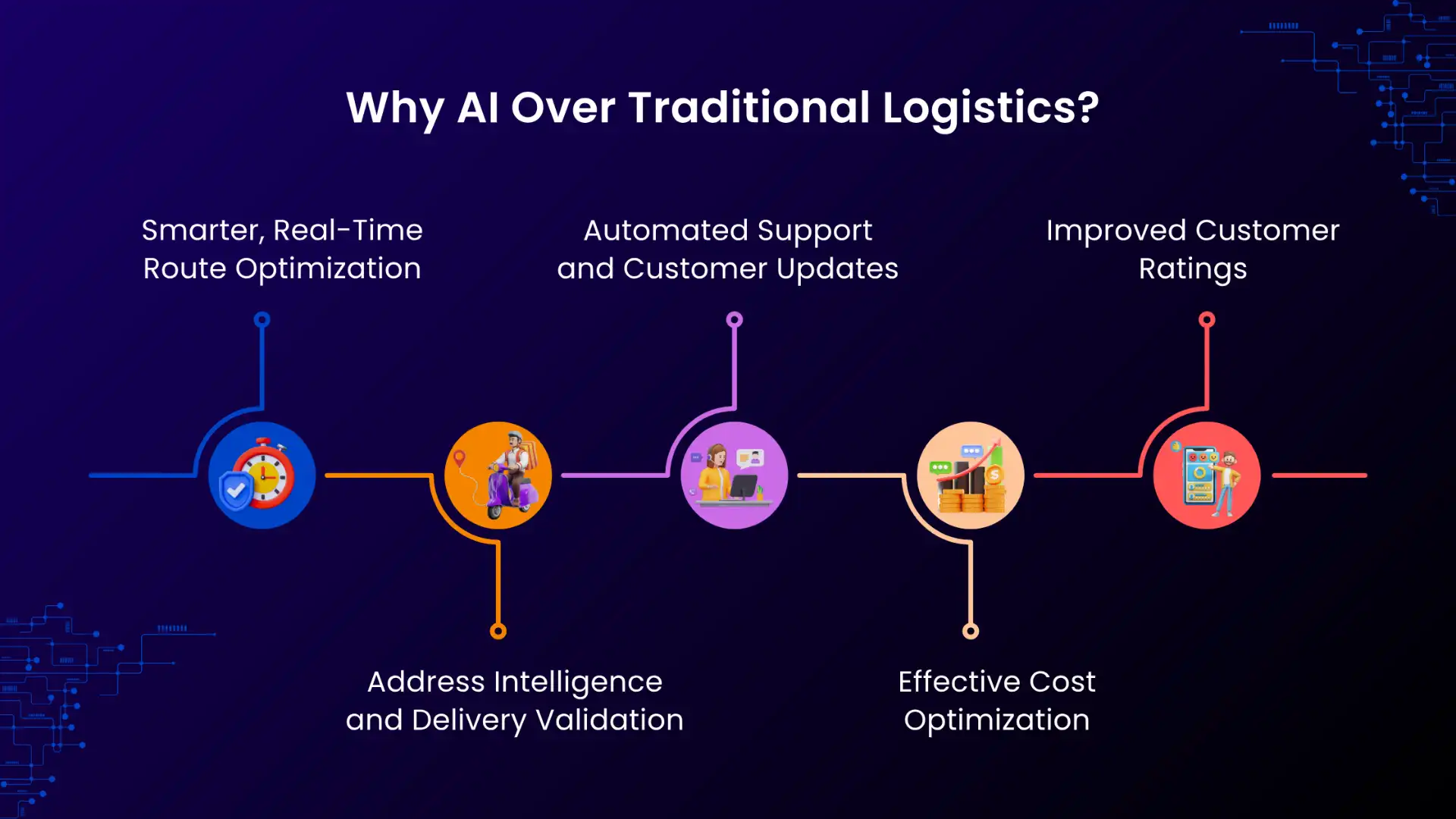
Traditional Logistics vs AI-Based Logistics
While this blog highlights the efficiencies of artificial intelligence in eCommerce logistics, one needs to understand how it is different from traditional methods. Here’s the difference:
Conclusion: The Future of AI in eCommerce Logistics
eCommerce efficiency depends a lot on technology these days, and AI in today’s world is not just an integral part of the IT sector but also entering and creating an impression in the business sector. The power of data analysis improves supply chain visibility, delivery optimization, and order fulfillment for an eCommerce business. Hence, sellers have clarity and time, which can be utilized for business strategy and product development. Now, go ahead and choose your preferred multichannel ecommerce software which allows you to bring all your sales and marketing together.
AI is transforming the business - Chat with us and explore how AI is redefining eCommerce logistics and supply chain management.
Get in Touch

.webp)
.webp)


