
If we ask any seller about the major issue they face in ecommerce operations, it would definitely be inventory management. This is because, if it is not managed properly, it delays the order processing. So it is an important element of the ecommerce processes that helps the efficient working of other elements. In 2025, there has been a great shift in the methods of managing inventory, and now they have become smarter.
In this blog, we will go through the basics of inventory management and then see what options Amazon sellers have. Stay reading and find out how you can make your inventory management smarter!
An Overview of Amazon Inventory Management
We all know that Amazon has a big reputation in the ecommerce domain. It fulfills orders and manages inventory efficiently by utilizing its resources, such as the warehouse and logistics. It deploys Amazon inventory management software to optimize the stocks of sellers.
What Makes Inventory Management Important?
1. Maintaining Accurate Inventory Levels
If inventory is not dealt with properly, it leads to issues of stockouts or overstocking. This not only affects warehouse management and increases warehouse fees in case of overstocking.
2. Inventory Type Storage Decisions
Every product has a pace of getting ordered; thus, its life in the warehouse also varies with other products. A good inventory management system lets the sellers know which products are ordered more and stay in the warehouse for a short period. It helps them figure out which products should be stored in what quantity to reduce the warehouse fees.
3. Impacts Revenue
Poor Inventory management leads to improper inventory levels that significantly increase the warehouse fees. This has a great impact on the revenue, which ultimately leads to low profitability.
4. Stepping Stone to Order Fulfillment
If sellers want to fasten shipment, they must optimize inventory with efficient inventory management software. It is because if the inventory is managed effectively, the time taken to process the order will be less.
5. Building Trust with the Customers
Suppose a shopper likes the product, and it is not in the inventory. Also, due to a lack of real-time inventory tracking, it could not be updated on the online store. By the time the buyer reaches the payment page, the order is shown as out of stock, which disappoints the sellers. Hence, inventory management is important to keep the customers happy and satisfied.
Major Roadblocks in Amazon Inventory Management
1. Manual Inventory Management
Most of the sellers still use the manual method of inventory tracking, which is not just time-consuming but also makes errors. This is the major challenge, as slow stock management delays the order fulfillment process. The errors also make the order processing inaccurate, which may impact deliveries and ultimately lead to unhappy customers.
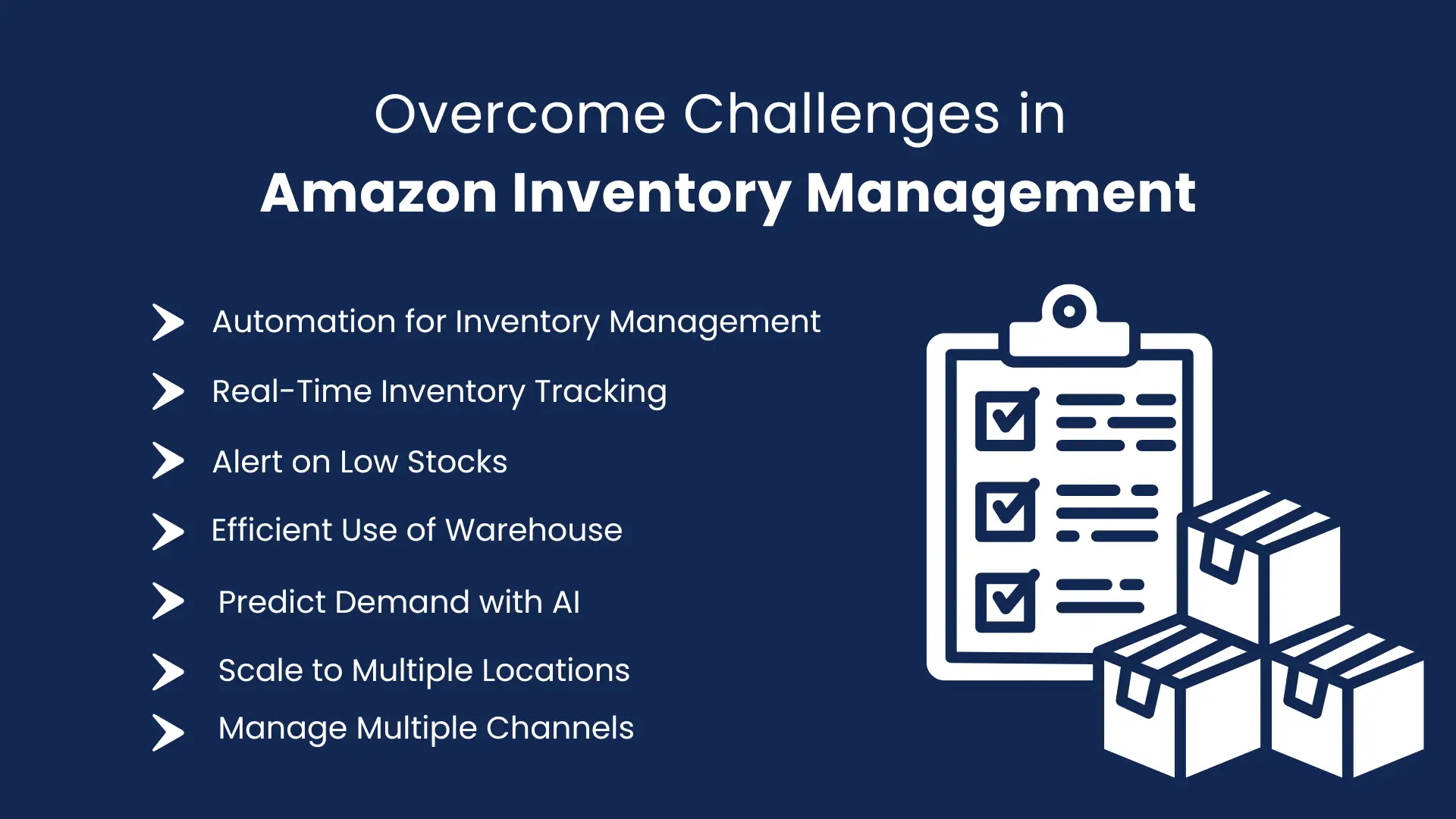
Solution: An automated inventory management software can easily solve this problem.
2. Lost Sales Opportunities & Prospective Customers
Every time a customer visits an online store, it is an opportunity for the sellers to make more customers. If it does not get the same product due to inventory mismanagement, the seller does not lose a single sale, but the customer is not likely to come back again. This way, it is a total missed opportunity to make a long-term customer relationship.
Solution: Real-time inventory tracking that updates stocks on the portal.
3. Canceled Orders due to Stockouts
Sometimes, the seller has to cancel orders due to insufficient inventory, which is a major challenge in inventory management. This is a major challenge for the sellers as it affects customer satisfaction negatively.
Solution: An inventory management software that can provide stock alerts on a timely basis.
4. High Fees for Storing Inventory
Not just managing inventory is a big challenge that impacts the eCommerce business, but also storing inventory is a big hurdle. Amazon’s fulfillment centers charge huge fees to the ecommerce sellers, which impacts their overall revenue.
Solution: Use techniques that make the best utilization of warehouses.
5. No Demand Forecasting to Meet Customer Expectations
One of the best ways to maintain stocks is to have an effective inventory management software that can do real-time inventory tracking. Since many sellers do not opt for the same, they are not able to predict demand, which hampers inventory management.
Solution: A tool that utilizes AI and other latest technologies to meet future demand requirements.
6. Multi-location inventory management
If an online ecommerce merchant wants to scale globally, it has to manage inventory at various locations. Amazon’s inventory system helps the sellers in this case, but it is quite costly, and not every seller can afford the same. Also, multi location inventory management requires expert help for efficient order fulfillment, which is a big challenge for sellers.
Solution: An inventory management system that manages inventory at different locations.
7. Multi-channel Inventory Management
If a seller is not limited to one channel for its business and sells products on various platforms and sales channels, managing inventory becomes a challenge. Sellers require special tools like an efficient multichannel inventory management software to manage their inventory, as it is not possible to do this manually.
Solution: Look for a 3PL solution that manages inventory across multiple channels in real-time.
What are the Amazon Inventory Management Options for Sellers?
1. FBA (Fulfillment by Amazon)
Amazon sellers send their products to the local Amazon warehouse to store them. Fulfillment By Amazon offers sellers not just to store products but also to handle order fulfillment. Sellers generally use it when they want to leverage the Amazon inventory management system.
2. FBM (Fulfillment by Merchant):
If the sellers do not want to fulfill orders through Amazon, they can utilize their warehouses for inventory management and order fulfillment. Since the sellers manage stocks and order themselves, it is called Fulfillment by Merchant. It is generally used by sellers when they gain experience and want to cut costs.
3. 3PL (Third Party Logistics)
This is a great option for inventory management and order fulfillment in case the sellers do not want to opt for FBA or FBM. They can leverage third-party logistics for efficient inventory tracking and order management.
Best Solution for Amazon Inventory Management
Looking at the above challenges and the options available, it is up to the sellers to find the best solution that suits their needs. If we compare all three options - FBA, FBM, and 3PL, a mix and match of all three could be the best. Let us see how it helps solve the inventory challenges:
1. Low Fees
If the sellers are looking for cheaper alternatives, 3PL can be a good choice. It offers inventory storage and order fulfillment solutions at a comparatively lower price than Amazon FBA. This helps them reduce operational costs and gain more profit. However, if they are new in the eCommerce sector, they can go with Amazon, or if they have their own resources, they can choose FBM.
2. Better Control with Real-Time Inventory Tracking
If sellers require better control, they can go for FBM or 3PL. They can track inventory in real-time, which helps maintain the stock level according to demand. This helps avoid stockouts situations.
3. Easy to Scale
In the sales season or when sellers grow with time, they need resources that can help them scale faster without impacting order fulfillment. Third-party logistics helps them with these resources for scaling. Even Amazon offers
4. Choose with Specific Country
Each country has many 3PL providers that are more reliable and even have lower fees. Sellers can leverage them for order fulfillment, each for a different country. This way, they can utilize the best 3PL in the country, which is even popular among customers. Amazon also has a global presence, so sellers can leverage it for worldwide fulfillment.
Integrate Amazon with Sales Channel through MapMyChannel
Amazon is a great option for inventory management if the sellers are looking for efficient inventory management. It offers greater scalability, which they can use for different countries. However, managing it for various sales channels and marketplaces can be difficult. Do not worry! MapMyChannel is here to ease your inventory management. We integrate fulfillment channels with the sales channel so you can extract the maximum from it. Our efficient automation helps you manage operations faster, and our dashboard helps manage everything in one place. Now, ease your inventory management by connecting the fulfillment channel with MapMyChannel and scale your business with uninterrupted growth.
If you need assistance of integrating your sales channel with Amazon, please get in touch with us. Our ecommerce fulfillment team will consult and help to reduce the manual error, inventory expansion, help with customer retention and improve user experience.
Get in Touch

.webp)

.webp)


