
Introduction
Inventory management has always been one of the biggest challenges that eCommerce brands face. Maintaining a balance between product availability and storage costs becomes harder as product collections expand, customer preferences evolve, and demand varies across the different sales channels that a brand sells on.
Traditional inventory management methods may work well for smaller businesses. However, today's dynamic retail environment is highly competitive- consumer preferences can shift overnight, and supply chain disruptions have become frequent and common. Against this backdrop, Artificial Intelligence (AI) has emerged as a powerful solution, modernizing inventory management. AI inventory management allows brands to proactively prevent inventory issues rather than react to them after they occur.
This blog dives into an investigation of how AI Inventory Management works and ten practical strategies that will assist ecommerce brands in streamlining their inventory control.
What is AI Inventory Management?
AI inventory management uses Artificial Intelligence technologies to track, oversee, and optimize inventory at all stages of the supply chain.
Traditional inventory systems primarily record stock fluctuations, but AI-powered processes continuously analyze real-time inventory data across multiple sources. AI inventory control uses these findings to make recommendations or automatically execute inventory-related actions such as forecasting future demand, optimizing warehouse allocation quantities, and identifying problem areas within the system.
For example, suppose there is a sudden increase in online fashion searches and winter jackets start selling earlier than expected. An AI-powered inventory system can recognize this trend, predict the upcoming demand before it occurs, and recommend stocking up to prevent shortages.
A traditional inventory management system is static, i.e., its foundation is built on some predefined rules that took significant time to update. AI, on the other hand, keeps referring to new datasets and is dynamic. As market conditions change, the algorithm becomes progressively accurate, enabling firms to adapt more quickly to ever-changing customer demand.
How AI is Better than Traditional Inventory Management?
Benefits of Integrating AI in Inventory Management
Employing Artificial intelligence in inventory management results in gains visible across inventory planning, warehouse operations, and customer satisfaction.
1. Better Demand Forecasting
Demand estimation is one of AI's leading abilities. AI considers multiple factors in parallel, namely, seasonal shifts, weather patterns, local customer behavior, and new market trends.
More accurate forecasts help businesses in:
- Purchasing the right quantity of inventory
- Limit prediction inaccuracies
- Optimize inventory rotation
- Minimize overstocking
2. Reduced Stockouts
A Shortage of popular products impacts revenue by reducing sales and eroding customer trust. AI demand forecasting regularly tracks inventory levels alongside estimated demand, allowing brands to stock up on products well before shortages happen.
3. Lower Inventory Holding Costs
Overstocking increases storage costs, insurance expenses, and capital depreciation. Excess inventory also locks up productive capital in storing items. AI optimizes stock levels by suggesting quantities of product that sellers must purchase. These recommendations are based on expected demand rather than blind guesswork.
4. Faster Inventory Decisions
Traditional inventory management often involves manually checking reports and spreadsheets. AI lowers this effort through automatic recommendations, alerts, and restocking suggestions. AI -based Inventory management software makes quicker, more informed policy choices using real-time data.
5. Better Warehouse Efficiency
Artificial Intelligence also improves warehouse processes by allocating optimal product locations, planning the most efficient picking routes, and revealing operational roadblocks. As a result, brands can offer faster order fulfillment and capitalize on lower labor costs, improved inventory accuracy, and increased warehouse productivity.
6. Improved Customer Experience
Inventory availability directly affects the customer experience. When customers regularly find products in stock and receive orders within the stipulated period, there's a higher chance of customer retention. AI enables exactly this through accurate inventory, limiting delays, and facilitating reliable order fulfillment.
7. Smarter Purchasing Decisions
AI evaluates a brand's sales performance, delivery wait times, past customer trends, and market demand to suggest optimal time and inventory renewal. This reduces emergency purchasing, decreases procurement costs, and strengthens supplier planning.
How Can Businesses Implement AI for Inventory Management?
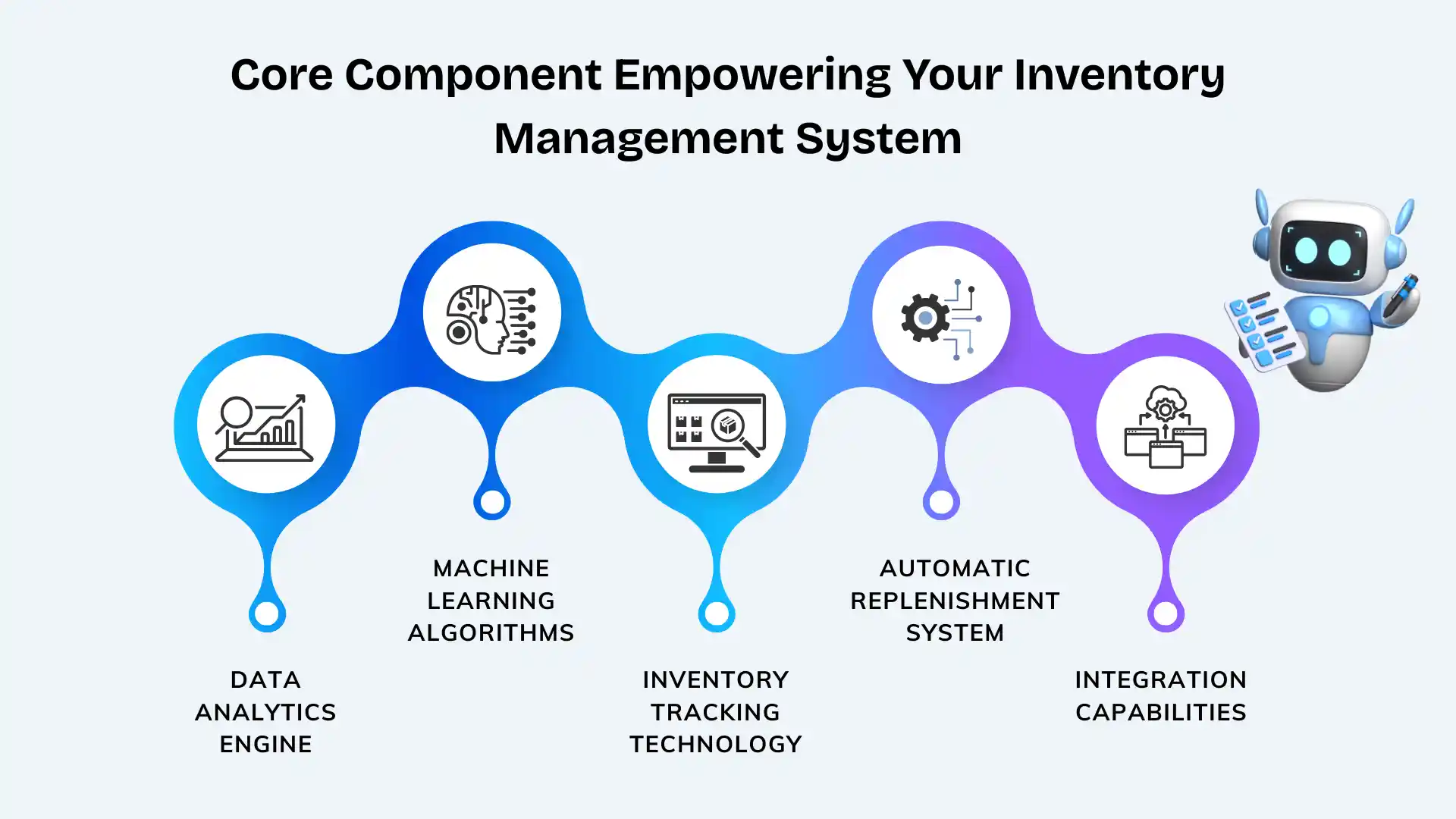
Artificial intelligence is transforming inventory administration. It has facilitated a move away from reactive stock control. Rather than just tracking inventory, AI helps brands forecast demand, automate restocking, and improve supply chain operations. Every eCommerce brand must adopt AI for Inventory optimization in the following 10 ways:
1. AI demand forecasting
Demand estimation forms the very foundation of successful inventory administration. AI models review past sales, customer behavior, seasonal shifts, advertising campaigns, and weather or economic settings to deliver more accurate demand estimates.
For Example, An online furniture retailer can use AI to estimate a rise in demand for outdoor furniture during the spring season and update stock levels well in advance. This forward-thinking approach reduces both understocking and overstocking.
2. Automate Inventory Replenishment
Manual reorder processes are tedious, time-consuming, and may cause lags. AI makes restocking simple by regularly tracking stock levels, supplier fulfillment times, and estimating demand. When inventory reaches a pre-established threshold or when AI predicts that it is going to run out soon, the inventory management system automatically starts recommending or triggering order requests. This limits human effort while maintaining availability of products.
3. Identify Slow-Moving and Dead Stock
Unsold products or slow-moving inventory locks up cash, space, and productive capital. AI analyses purchasing trends over time and identifies products with declining sales. Businesses can now make informed decisions regarding bundling, targeted promotions, price adjustments, and reducing future planned inventories for the same products, etc. Actively managing slow-moving inventory through artificial intelligence enhances inventory turnover.
4. Optimize Safety Stock Levels
Maintaining a buffer stock is critical. However, relying solely on buffers that are not updated to market trends results in overstocking or stockouts. AI calculates the optimal buffer stock by considering demand variability, supplier reliability, and sales patterns. Rather than applying the predefined buffer across all products, it suggests safety levels tailored to each SKU. This real-time analysis helps brands align product availability with inventory expenses.
5. Detect Inventory Anomalies in Real Time
Inventory discrepancies are caused by unintended data entry mistakes, defective goods, missing stock, or sometimes theft. Stock fluctuations are constantly monitored. This model also highlights suspicious activity, namely, unforeseen inventory losses, unusual sales spikes, or discrepancies between physical and recorded stock. Timely detection allows the brand to investigate issues before they escalate into costly issues.
6. Improve Warehouse Layout and Picking Efficiency
Warehouse efficiency directly affects order delivery speed and operating costs. AI reviews order history, item demand, and picking routes to suggest the best warehouse for product placement. Regularly bought items can be stored closer to packing stores, cutting down travel time for warehouse staff. Smart inventory management also adjusts warehouse allocations in real time in conjunction with demand, improving productivity during peak sales.
7. Optimize Multi-Channel Inventory Allocation
Many eCommerce brands sell on multiple sales channels including their own site, online marketplaces, social commerce platforms, and physical stores. Managing inventory across so many channels manually can lead to overselling or uneven stock distribution. AI provides a single comprehensive view of inventory and smartly allocates products based on channel performance, regional demand, and sales speed. This allows customers to have access to products regardless of where they shop.
8. Strengthen Supplier Performance Management
Reliable suppliers are critical to maintaining healthy inventory levels. AI analyzes brand performance using the following indicators:
- Delivery timelines
- Order accuracy
- Pricing trends
- Order fulfillment rates
These findings help businesses identify reliable suppliers, anticipate delays, and diversify sources when required.
9. Enable Dynamic Inventory Planning
Consumer demands can shift rapidly due to trends, promotions, etc. Conventional inventory systems usually become inefficient because they rely on periodic reviews. AI regularly updates its estimates through dynamic analysis of real-time sales and operational data. Brands are hence empowered to align their inventory planning to changes in market conditions. Predictive inventory analytics helps brands respond quicker to market changes while minimizing overstocking instances.
10. Generate Actionable Business Insights
AI converts operational data into impactful business intelligence. A user-friendly dashboard reveals top-selling products, seasonal trends, differences in local demand, profitability by product category, restocking efficiency, etc. These findings will facilitate smarter buying, pricing, product marketing, and expansion decisions, enabling brands to improve profitability while exercising better inventory control.
Why AI Inventory Management Is the Future
Due to the prevalence of quick commerce, customers now have higher expectations for product availability and order fulfillment. Simultaneously, ecommerce businesses face challenging roadblocks caused by supply chain blocks, shifting demand, rising storage costs, and expanding product categories.
Traditional inventory systems are not built to handle this level of complexity. Smart inventory management empowers brands to make quicker, evidence-based decisions by combining forward-thinking data modelling with smart automation. Instead of reacting to problems after they occur, organizations can now forecast inventory needs, thanks to AI systems, and limit operational challenges.
Inventory management will become even more connected in the coming days. AI will work alongside technologies such as warehouse robotics and computer vision to offer dynamic inventory visibility throughout the entire supply chain. These technologies will allow for automated stock counting, autonomous warehouse operations, and an even more accurate demand estimation.
Adopting AI is the move to make if firms want to remain competitive in the e-commerce marketplace. Brands that adopt AI today will be ahead in the race to deliver the smooth shopping experiences that their customers expect alongside upscaling their business.

AI Driving Futuristic Growth of eCommerce Businesses
If you have reached this section in the blog, you are equipped with the complete information on AI-powered inventory management. This is not just a good-to-have addition in your business; it is a MUST-HAVE if the business has to be at par with the evolving world. What looks like the future is the present, and adapting to the same is necessary to beat the competition and be ahead of time. Sellers must remember that only satisfied customers are repeat customers. And AI will not just streamline the ecommerce inventory management but also ensure customer satisfaction. Before AI implementation, you will have to automate the inventory management process, that too requires an application capable of integration. MapMyChannel can solve this problem for you. It allows you to integrate sales channels with 3PL and ERPs for better business management and streamlined inventory tracking. The application is packed with features, specifically designed for e-commerce acceleration. Wait no more and integrate your online business with MapMyChannel and enable automation of operations.
Get in Touch

.webp)

.webp)


