
Real-time inventory sync refers to consistent updates of the stock data for sellers, so they have an all-time access to the status of their inventory. There are different technologies in the market that can be used to fetch this data. Also, there are different integration software that allows sellers to connect this inventory data to different platforms while selling across multiple channels. Sellers need a streamlined inventory management system during sales, and there is no better way to explain this than with an example. Here’s a case study:
An ecommerce seller listed some 500 products across Amazon, Walmart, eBay, and Shopify. As soon as the sale kicked off on these sales channels, there were around
- 240 orders on Amazon
- 70 orders on Walmart
- 160 orders on Shopify
- 15 orders on eBay
In this case, sellers without real-time inventory sync will be beating around the bush with numbers, leading to overselling. On the other hand, if the stores are integrated with real-time inventory synchronization, they will know the exact numbers, and hence, no overselling is possible. On top of that, they will be able to maintain the supply chain better during crucial times. This blog is framed such that all your queries related to real-time inventory tracking will be answered. So, make sure to give this blog a thorough read.
Why is Real-Time Sync So Important?
Sales make real-time inventory management important due to the following reasons:
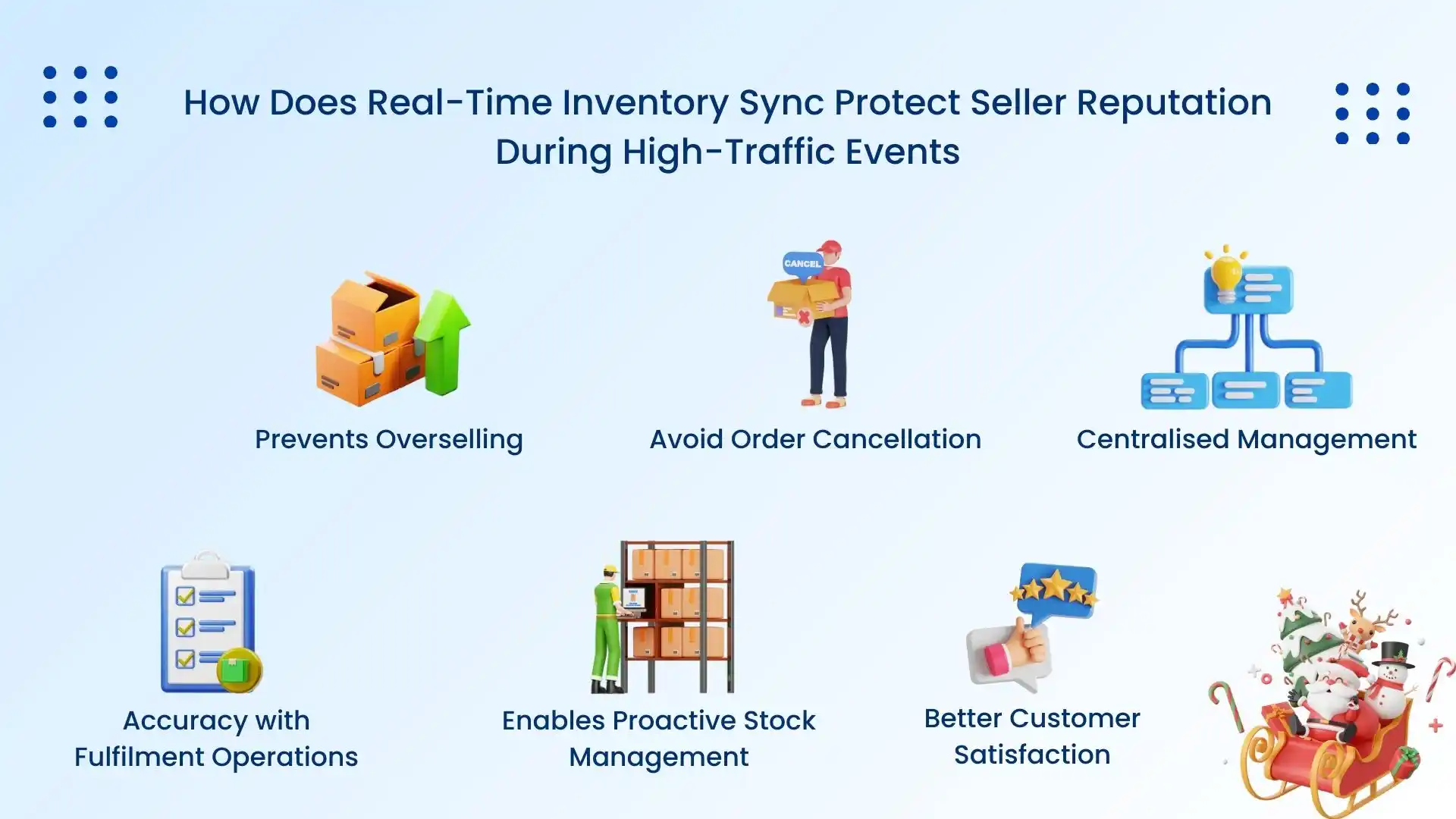
- Avoid Stockouts: An out-of-stock sign directly implies a lost sale, and who wants to lose the same during the peak season? Stocks going out is common during the sale season, hence inventory control is much more important than on regular days.
- Better Order Fulfillment: Fulfilling orders is only possible if the processing is efficient. The same will start with order confirmation from inventory availability. With centralized inventory management, sellers can reduce picking errors and speed up the entire fulfillment process.
- Accuracy: Customers are provided with the correct stock data when centralized inventory management is put to use. With the accuracy of data, sellers can fulfill not just the orders
- Avoid Cancellation: When sellers are aware of the availability of their stock, overselling tends to decrease. Hence, they do not have to turn down orders placed on their platform or even cancel them.
- Streamlined Multi-Channel Selling: Selling on different sales channels is only feasible if the inventory is tracked in real-time. Also, the same has to be integrated with all the channels for the customers as well.
- Operational Efficiency: Automated inventory updates allow sellers to operate with efficiency as they are not busy with manual counting or data entry. So, the business performs better when the owner is actually involved in strategizing not just basic operations.
- Better Supply Chain Management: Supply Chain management is directly related to inventory control. Businesses with better stock management and real-time sync are able to regulate their supply chain in a much more efficient manner than those who work on a manual basis.
How Will Real-Time Inventory Management Software Prevent Overselling?
With real-time tracking, sellers can avoid overselling due to instant updates across all sales channels. Customers are hence updated, and sellers can act accordingly. Inventory management software with real-time tracking gives way to unified stock visibility, which connects all the sales points to a centralized system, allowing sellers a view into the stock numbers. Also, certain smart software comes with a buffer stock feature, paving the way towards better availability of products even when the supply is yet to arrive. Especially during the sales, this feature works wonders for the sellers.
Why Does Every Second Matter During the Sale Rush?
As soon as the sale starts, customers start comparing and making purchases based on decisions taken in a matter of minutes. These days, customers are really impatient, and hence every stockout is not one or two sales lost; it can turn into a massive loss.
With a huge amount of options available across the internet, customers keep jumping from one brand to another. As soon as your store shows ‘Out of Stock’, the customer runs to another brand and makes a purchase. Avoiding stockout calls for centralized inventory management. Also, if the delivery is delayed due to your supply chain issues, consumers tend to cancel their orders and quickly jump to other platforms for their needs.
How Does Fair Stock Distribution Across All Channels Lead to e-Commerce Business Efficiency?
eCommerce business performance depends on the quick service and its ability to fulfill orders in the least time possible. When the stocks are distributed across different sales channels in a proportionate manner, operational efficiency is optimized. Here’s how it works:
- Cost Optimization: Every business knows where it drives its maximum sales. So, storing the inventory on the platforms with maximum sales should be a priority. Paying storage fees for channels driving slow sales eats up cost while providing low ROI. The right software can even help the seller here by providing data and analytics reports, hence saving costs.
- Maximized Sales: When everything is stored in the right place, customers can directly reach out to the sales platform to order their preferred products. If not, customers will face issues due to stockouts, while sellers will struggle with dead inventory.
- Better Customer Satisfaction: Customer satisfaction is directly related to stock availability and fulfillment speed. When everything in business is streamlined with automation, customers have their products available and delivered on time.
Final Word…
Real-time inventory sync is not just another good-to-have automation tool. It is what your business requires at all times, and with all the year-end sales coming ahead, it's high time to get one for your business. Now, just inventory management software will be too much to buy. So, subscribe to something that is more versatile, some application that was designed just to take away these day-to-day issues from your business. An application that serves with order management, inventory management, data, and analysis support, automation, and even business management is something that will work best in this sales season. So, get your business the perfect technology partner and build a business that scales.
FAQ
What is real-time inventory management?
Real-time inventory management refers to updating the stock availability instantly every time a product leaves or enters the warehouse to prevent overselling and underselling.
How to manage steel inventory with real-time tracking?
Sellers can make use of an integrated system like RFID/barcodes, IoT sensors or a dedicated software to keep track of steel inventory in real-time.
How does real-time inventory tracking improve operational efficiency?
Operational efficiency is instantly boosted by real-time inventory tracking due to quick fulfillment processing, reduced storage cost, and better visibility. Also, the supply chain can be managed in a much better way to keep the flow maintained for the business.
Get in Touch

.webp)
.webp)


