
There were times when eCommerce sellers kept a track of orders, inventory, and delivery in physical mode, using a pen and a register. The next 5 years saw innovation, and they could record the data in Excel sheets on their computers. Further series of technological development brought automation of 3PL fulfillment services. Cut to 2025, we have AI in 3PL helping the sellers to track, update, and innovate their logistics. While this might seem quite daunting from a distance, the concept is pretty straightforward if broken down into pieces. This blog is going to do exactly the same for you in an interesting manner. So, let’s get reading!
Defining 3PL Logistics
3PL stands for third party logistics, which refers to the outsourcing of the supply chain operations like order fulfillment, inventory management, transportation, and consumer updates, to a third party logistics provider. The service provider makes sure that confirmed orders are delivered without errors using the best route in the least possible time. Here’s everything a 3PL service provider would do for you:
- Warehousing
- Order Fulfillment
- Transportation
- Inventory Management
- Technology Integration
- Reverse Logistics
So, it keeps the seller free of fulfillment-related issues, and they can lay more emphasis on actual business strategies.
The Future Of AI 3PL Logistics
What looked like the most tedious task to ecommerce sellers is now automated with the use of integration applications. These applications have seamlessly aligned different online selling channels together to a centralized dashboard that allows for data synchronization for fulfillment support. This is serving the purpose for 3PL services, but there is always a scope for more and better.
This is where AI (artificial intelligence) comes into play. AI gives way to that improvement through operations optimization, multichannel order management, and centralized inventory management. There are multiple ways in which sellers can incorporate AI into their eCommerce operations, which will not just save their time but also help with resource and cost optimization. AI in 3PL services brings seamlessness, effortless delivery, and assured customer satisfaction. Let’s discuss how in further sections of the blog.
Key Areas Where AI is Helping 3PL Providers
There are certain areas where AI can help a 3PL service provider to perform better and improve its service.
1. Inventory Management Powered by Digital Intelligence
One of the most crucial tasks for an eCommerce seller is inventory management. It requires consistent effort to update the records and align them with the sales channel to confirm the orders. With AI on the scene, sellers can optimize their inventory using historical data, real-time demand, and pattern recognition. AI-based algorithms can analyze and forecast the requirements of the product restock, and it can enable the cycle of product with automated restock order placement with the supplier. All this together can streamline AI-based inventory management for better business performance.
2. Demand Forecasting for Better Preparation
Demand can fluctuate and hence disrupt the sales strategy for sellers. AI is able to understand the consumer behaviour on the basis of data and seasonality. This will help the 3rd party logistics provider to inform the sellers regarding their upcoming sales and prepare them for whatever is coming. This data is much needed for not just busy times of the year but also during the low times, so that there is no overstocking, leading to stuck capital and a lack of cash flow.
3. Delivery Route Optimization for Cost Cutting
There are multiple ways in which a third party fulfillment partner can help sellers with cost-cutting and optimization. It can figure out the best and cheapest way to transport and finally deliver the products to the consumers. Also, it can put up different orders in one container that need to go on a similar route, which helps with cost optimization. Resources involved in the fulfillment and delivery can also be optimized by the 3PL fulfillment companies using AI-based software.
What Makes AI-Based 3PL Fulfillment a Must for eCommerce Marketplace?
3PL fulfillment is opted for by the eCommerce sellers for the support that it provides to the business, but further advancements into the actor cannot be ignored, so here are the benefits of an AI-based 3PL shipping service provider:
1. Faster delivery service
Order picking and routing are both automated by AI-powered warehousing systems. As a result, items are handled less manually, processed faster, and delivered with fewer delays.
2. Error Elimination
The possibility of human error during order entry, picking, and shipping is decreased by automation and networked technologies. This results in fewer returns, more satisfied clients, and less time spent fixing errors.
3. Better Decision Making
3PL logistics software provides teams with real-time dashboards and predictive analytics to assist them in making quick decisions regarding resource planning, routing, and inventory. Data-driven decision-making is effortless with compatible software and eCommerce 3PL.
4. Scalability and Flexibility
With growing businesses, software and applications need to grow. AI is the technology that fosters the scaling of an ecommerce business. It gives flexibility for adapting to new updates and developments in the world of online selling.
5. Higher Customer Satisfaction
Customers around the globe have higher demands in terms of services, and AI incorporation into the business can allow sellers to provide better service supported by real-time updates, faster deliveries, and fewer stockouts.
Roadblocks for 3PL eCommerce ahead of AI Incorporation
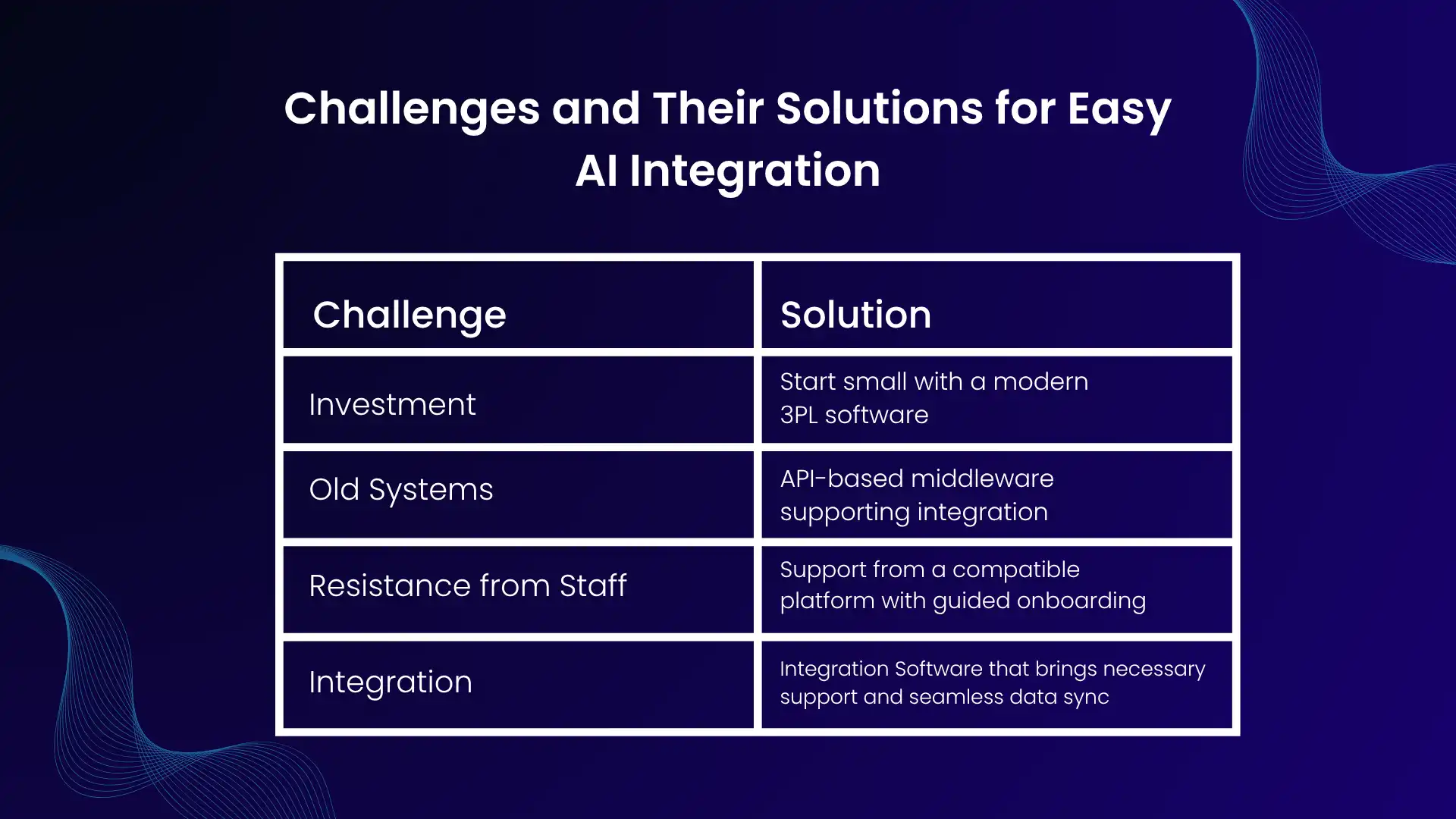
Nothing in this world comes without hassle, not even AI in eCommerce. Hence, sellers need to face challenges even here, but we won't give out challenges without their solution, so here it is:
1. The Investment Issues
Justifying a full-scale transition is frequently challenging due to financial limitations, particularly when the return on investment isn't instantaneous. The answer is to start small. Numerous contemporary 3PL solutions packages include subscription-based, modular choices that let you gradually automate important activities. This lowers financial risk and enables you to scale IT adoption in tandem with business expansion.
2. Older Systems
Old technologies and outdated systems can face hurdles with integration into the latest development. The answer is to pick platforms that allow middleware connectors or open APIs. Without requiring a complete tech replacement, these enable you to connect your existing systems with contemporary technologies, preserving continuity while opening up new efficiency.
3. Resistant Resources
There are cases when the existing human resources do not wish to change the way they work, and there is a level of resistance from their end. Rather than pushing them towards adoption, they can simply look to train them and take it slow through an intuitive platform that offers clear UX, guided onboarding, and strong support. Just the right support, and every team can work wonders.
Artificial Intelligence is your Way to Go…
AI is everywhere you notice, even sales channels these days have features supported by AI and ML algorithms. There is no reason for you to step behind. There can be challenges, but after this blog, you have answers to them as well. Just look for the right API Integration application that offers inventory management, notification update, and order fulfillment support as a head start, so that updates and further incorporation of new technology are easy.
Get in Touch

.webp)
.webp)


