
More often than not, sellers on the Amazon marketplace are simply working as retailers who do not produce anything of their own, but supply goods from wholesalers to end consumers. This business model enables sellers to earn marginal profits without incurring the costs and risks associated with production and manufacturing. Fulfillment of orders in this case can be accomplished in two ways: Fulfillment by Amazon and Dropshipping. To choose the best option between Amazon FBA and dropshipping, a clear comparison is necessary. This blog is written to paint a clear picture for you to choose the preferred side in the dropshipping vs FBA.
What is Amazon FBA?
Amazon allows its sellers to send their stock to the fulfillment center. From here, the inventory is stored in the warehouse and managed by Amazon’s expert systems. Under Fulfillment by Amazon, the sales channel manages everything from storage and packaging to final shipment and customer service. When the order is placed with the seller, the product is safely packed by Amazon and shipped to the customer from an Amazon fulfillment center. There are certain pros and cons of this service from Amazon mentioned as follows:
Pros and Cons of Amazon FBA
Pros
- Sellers can conveniently send their inventory to Amazon, and the rest is handled by the sales channel itself.
- On-time fulfillment is not even a concern for the seller when Amazon is taking over the responsibility of fulfillment.
- With the Prime Badge on the products, customers are able to trust the products more with authenticity and better customer service.
- Reverse logistics is also handled by Amazon, so end-to-end services are streamlined when orders are fulfilled by Amazon.
- Scaling the business is much easier when order fulfillment is done by Amazon.
Cons
- Amazon charges a standard fee that needs to be paid; it reduces profits if not managed optimally.
- Amazon has levied certain restock limits (to avoid dead stock), so the sellers might not be able to send as much inventory as they want.
- Sellers have limited control over the packaging, branding, and customer service.
What is Dropshipping?
Under dropshipping, sellers do not need to store or ship their stock anywhere. When the customer places an order with the Amazon business, the same is communicated to the supplier. From here, the supplier has the responsibility of fulfilling the order and taking it to the customer after packing the product safely. There are certain pros and cons of this dropshipping mentioned as follows:
Pros and Cons of Dropshipping?
Pros
- The initial cost of starting the business is fairly low, as the seller does not have to buy the stock.
- Sellers can easily offer a wide range of products to their customers as they are not the ones producing them.
- Scalability is high, since the order fulfillment is taken care of by the supplier
- Testing new products is much easier here since no substantial investment is involved.
Cons
- Profit margins are much lower since the supplier takes up most of the earnings.
- Competition is intense as there is no barrier to entry, and anyone on any day can enter this space to sell.
- The dependency on suppliers is really high, which can lead to delays in fulfillment and inconsistency in the delivery of products.
- The control on business is nearly none as the products are stored with the supplier, and they are responsible for fulfillment as well. The seller just works on advertising and marketing, while having no control over the end product reaching the customer.
- Tackling customer queries is another challenge here since the seller is largely unaware of the order status and other details.
Amazon FBA vs Dropshipping: Comparsion Table
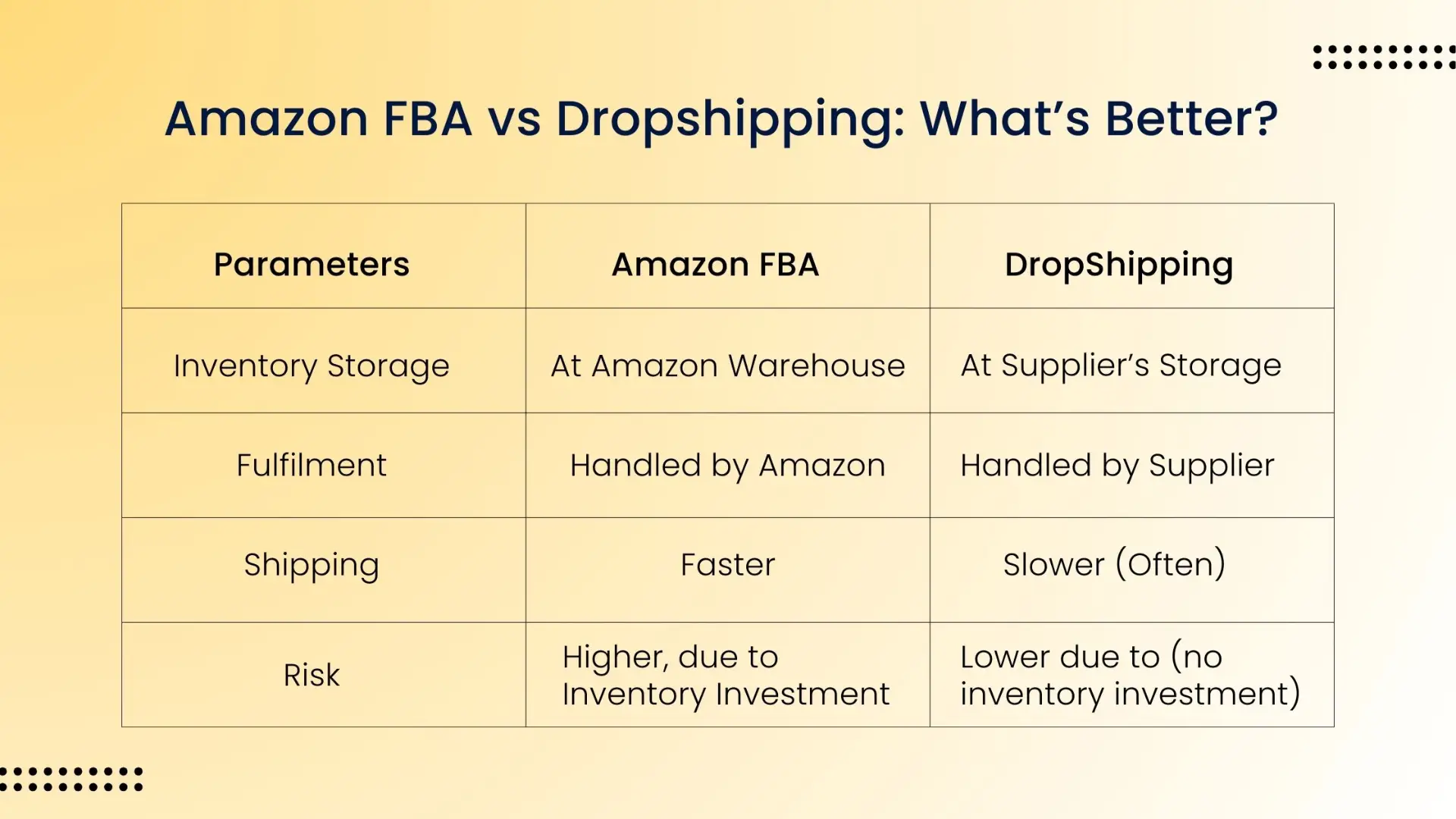
What is the Difference Between Amazon FBA and Dropshipping?
This section of the blog is to draw a clear distinction between the two terms. This answers your query about the suitability of Amazon’s logistics and dropshipping:
Conclusion
The winner in this case is situational. Sellers who are well-known in the market should go for Amazon FBA, while sellers who are testing new products and finding their niche can go for dropshipping in the initial stage of their business. Then again, once they know their strength and have discovered the right products for the market, procuring large lots and sending them over to Amazon is the best idea. This way, they can even use the same for the fulfillment of orders on multiple channels. But for this, Multichannel Fulfillment by Amazon is the way to go. Sellers can integrate their sales channels with MapMyChannel and then choose any 3PL, Amazon MCF, as the 3PL fulfillment partner to fulfill orders while keeping the stock with one channel for centralized inventory management. This way, order fulfillment will be automated, and the seller can work on further expansion of the business.
Whether you choose FBA or dropshipping, managing multiple channels doesn’t have to be complex. Explore how MapMyChannel can help you grow across marketplaces.
Get in Touch

.webp)
.webp)


