
Running a cutting-edge online business means catching the target group of customers in the marketplaces they love to shop at. However, expanding business to Amazon, TikTok, or eBay can make shipping orders a logistical puzzle. That's when a third-party multichannel fulfillment solution comes in to save the day.
Instead of living with the mess of shipping orders from the garage, sellers can leverage giant fulfillment centers to preserve their time.
The two biggest fulfillment services in the domain: Amazon MCF and Walmart MCS. This quick guide breaks down Amazon multichannel fulfillment alongside Walmart's new setup to help sellers choose the perfect logistics partner for their growing brand.
What is Amazon Multi-Channel Fulfillment (MCF)?
Amazon Multi Channel Fulfillment (MCF) is a variation of the conventional Fulfillment By Amazon. It's a shipping solution that lets sellers utilize the Amazon Fulfillment Center to store, pack, and fulfill orders placed outside of Amazon, like their own website or Woo Commerce shop.
If a brand's products are already fulfilled by amazon, the seller can use that same pool of stock to handle off-Amazon sales. Businesses do not even have to actively sell on Amazon to use it. Think of it as hiring Amazon's massive warehouse team to act as a private shipping department.
What is Walmart Multichannel Solutions (MCS)?
Walmart Multichannel Solutions (MCS) is Walmart’s direct answer to Amazon's logistics network. This service allows merchants to use the Walmart Multichannel Solutions (MCS) system to ship orders that happen on external websites, including competing spaces like Amazon, eBay, Temu, and TikTok.
To use this service, products must first be stored within the Walmart Fulfillment Services (WFS) network. Walmart then uses that inventory to pack and deliver orders placed on other sales channels. It is a powerful way for brands to tap into Walmart's massive supply chain to fulfill orders across the entire internet.
Amazon MCF vs. Walmart MCS: Key Differences
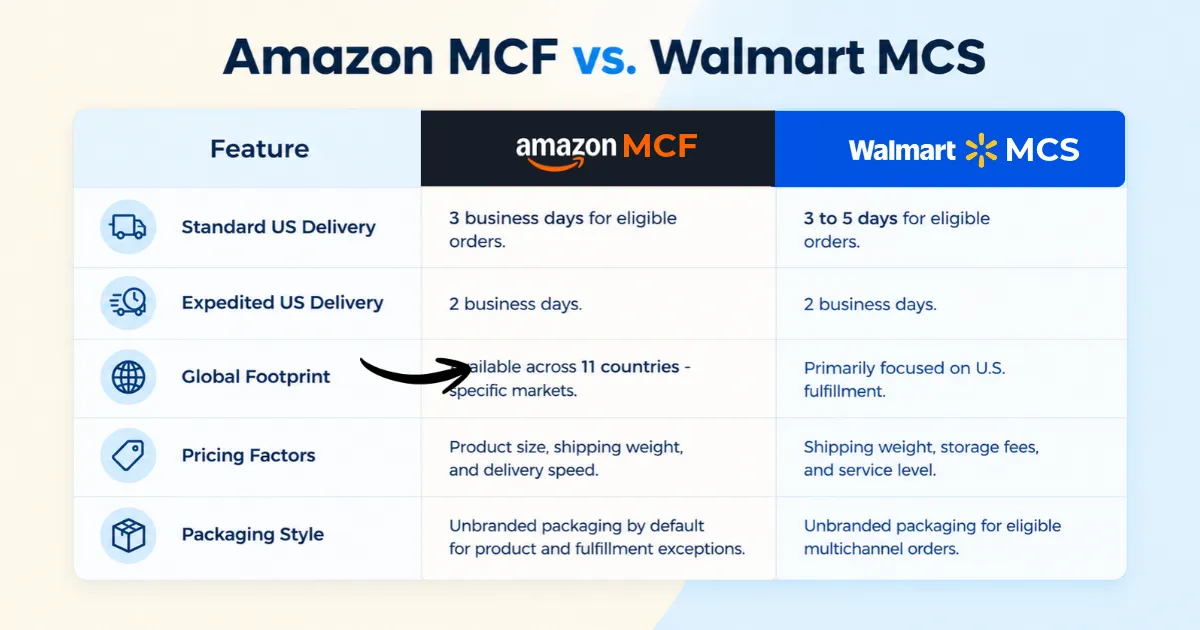
To help see how these two logistics systems stack up side by side, here is a quick overview of their core operational features:
1. Fulfillment and Storage Costs
There is no single winner when it comes to pricing because all fees are based off the physical characteristics of each sellers' individual products.
Example: Selling lots of small, light, phone covers in multi-packs may be cheaper with one carrier. But when sellers ship slow-moving, heavy coffee tables and they sit in their warehouse for months, storage fees will completely change the math. Businesses must always model costs using their actual catalogue of items.
2. Delivery Speeds
Both platforms offer fast shipping, but their standard timelines appear a little different on paper.
Although it increases the satisfaction of customers, shipping quickly can cost sellers more, so businesses must compare the extra cost against their profit margin.
3. Network, Geographic Reach, and International Capabilities
4. Supported Channels
This is where multichannel ecommerce platform dynamics get exciting: both networks are now entirely channel-agnostic. This means they do not care where the sale happened; they just ship the box.
5. Marketplace Integrations
eCommerce platforms like Shopify and BigCommerce require a way to directly connect with a brand's warehouse network for a smooth exchange of order information.
During upscaling, sellers need to utilize the central multichannel ecommerce integration platform that connects their front-end stores directly with their back-end systems.
6. Packaging and Customer Experience
No seller would ever want a customer to order a handmade product on their standalone website and then receive it in a box with a giant corporate logo stamped on it.
7. Tracking and Order Visibility
Modern shoppers expect immediate tracking updates the second they buy something.
Connecting this data to a central dashboard ensures that the customer service team always knows the exact status of a package.
Final Thoughts
From picking and packing an item, to shipping to the customer - ensuring an order is complete, accurate, and shipped on time - is just the start of the journey. To expand with ease, sellers need seamless ecommerce automation that will perfectly connect the dots for product specifics, pricing, and inventory levels across the vast internet reach. Whether a business chooses the boundless global reach of Amazon, or the domestic but highly competitive network of Walmart, success is based on keeping data unified and synchronized. Market leading warehouse logistics paired with the right software, sellers can eliminate manual backend roadblocks, protect seller metrics, and prioritize what really matters - manufacturing great products.
Get in Touch


