
Running an e-commerce business is no less than running a Marathon. It is not a 100-metre race; it needs consistency more than speed. Only the right strategy, paired with the right skills, can help the runner reach the finish line. Your online business also requires consistency and not one-time speed to reach success. One of the most promising strategies for a digital business is to go for 3PL fulfillment rather than an in-house one. Your acquaintance with the topic won't make a difference to the worth of this blog for you. It has something for every e-commerce seller to improve their business performance, so they reach the finish line faster and cross the ribbon.
3PL in a Nutshell
Don't be scared of the fancy words; this will be really easy to understand. First off, the full form: 3PL stands for Third-Party Logistics. It is basically the outsourcing of fulfillment operations through which the seller gets to lay complete focus on other e-commerce business operations. Third-party logistics take care of:
- Warehousing
- Inventory Management
- Picking and Packing
- Drop Shipping (Depending on provider)
- Final Delivery
- Shipment Tracking
In a Nutshell!🥜 It does everything related to the fulfillment and delivery of goods.
Cracking the Definition of 3PL Integration
Again, this is pretty simple; integrating 3PL refers to the automation of delivery services. Now, how does that happen! eCommerce integration with 3PL allows the seller to connect its sales channel with a fulfillment service provider to automatically fulfill the orders. Not just this, sellers can seamlessly manage their inventory and warehouse with this linkage. The primary benefit of the same is efficient fulfillment of orders, avoiding errors and delays.
Why Do You Need 3PL for eCommerce
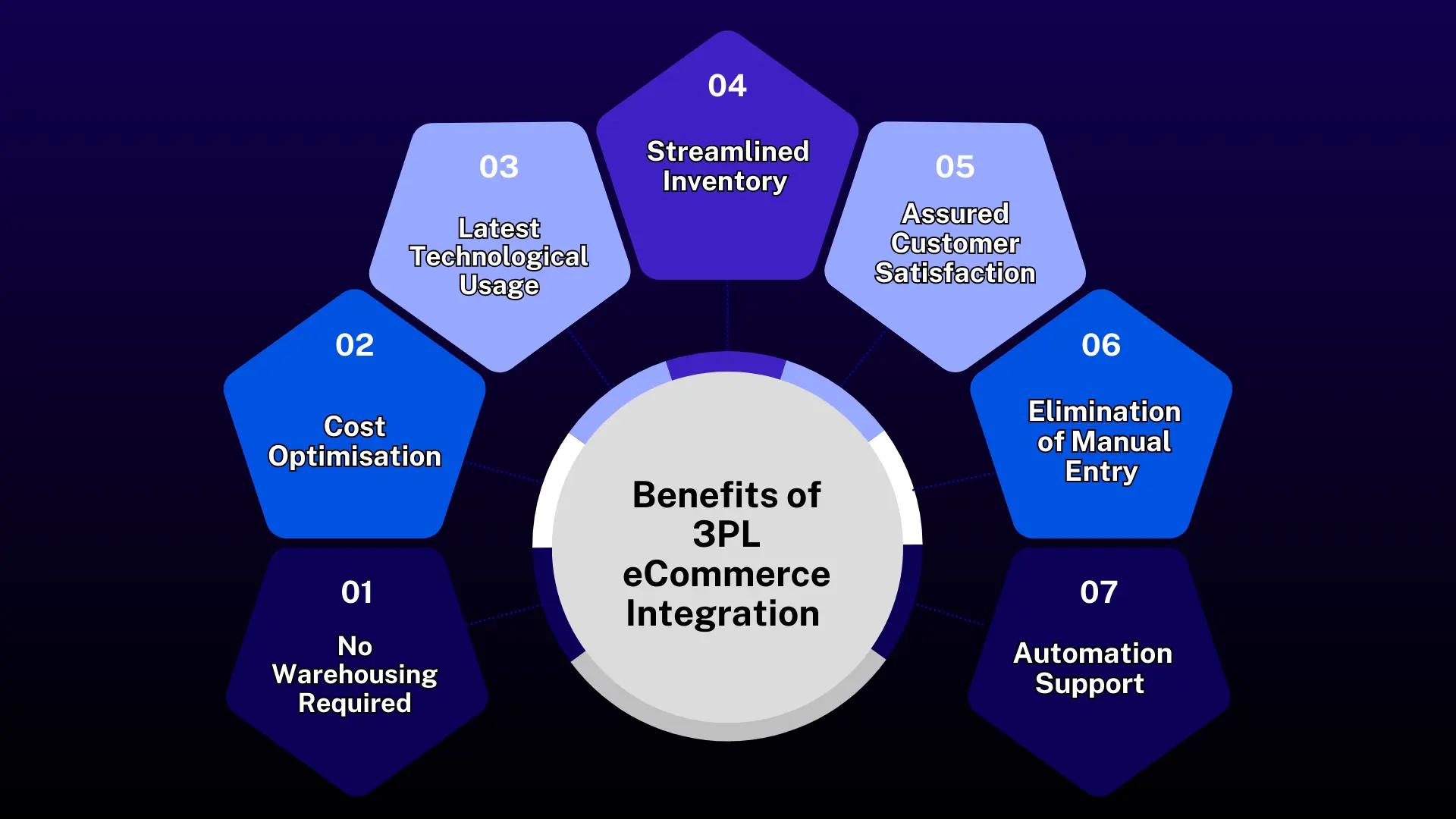
3PL integration is not just good-to-have, it is a must-have for e-commerce businesses to maintain consistency and fulfill orders efficiently. Your business needs it because it:
Saves Cost
While many people believe that third-party fulfillment adds to a company's cost. In reality, it saves the cost for the company. The service providers come with field expertise and the latest technology that helps with efficient delivery, avoiding mistakes that not only dissatisfies customers but also leads to loss. It also saves the cost of additional software used by the sellers.
Helps with Inventory Management
Inventory management is much simpler with this integration. Most of the software comes with a stock management system that allows real-time tracking and restocking of inventory once it reaches a minimum level. Also, sellers are able to maintain a buffer stock that prevents overselling.
Updates the Customers
Tracking orders is much easier with 3PL integration, as the software automatically updates the seller and buyer with the status of the order. Hence, the sellers are not bothered by queries related to the order. They simply focus on business management.
Supports Scaling
Business scaling is supported by integration, as sellers get the opportunity to serve a much wider audience in comparison to in-house fulfillment. Geographical expansion is much simpler with 3PL service providers fulfilling the orders. There is no constraint on location for the seller.
Simplifies Decision Making
Decision-making is much simpler with such integration software, as it provides data and analytics regularly. With this, sellers can connect to their customers’ point of view and make sales accordingly. Data-driven decisions are much more effective, so sellers can make the best out of the software.
Streamlining 3PL Partnership with Best Practices
There are certain best practices that need to be considered by the sellers while integrating their sales system with 3PL. Here’s what the seller needs to make sure:
Have a Clear Objective
As a seller, setting up clear goals is important so that the business has a direction. The same is the case here; the seller needs to have a clear view of their requirements from the 3PL integration solutions. They can be looking for inventory management, order fulfillment unit, or order tracking service, but they need to look after their business needs and see if the solution will provide the service.
Update in Real-Time
Sellers need to keep an eye on the selling of goods and the processing of orders. To get that information in real-time, they need a compatible software that not just fetches data but also delivers updates on order fulfillment, inventory levels, and shipping status. They can give their consumers accurate information. This real-time response enhances both operational effectiveness and customer happiness.
Implement Security Measures
Security of data has to be ensured by the seller before they think of integration. Especially, the data of the consumer needs to be safeguarded, in order to avoid any mishappening. The same can be avoided by access controls, encryption, and secure communication protocols. Sellers can guarantee the security of data owned by the brand only by prioritising safety. Make sure the integration solution offers a specific testing environment for certification and trial runs (like MapMyChannel).
Collaboration
When sellers are looking for effortless integration, there has to be teamwork and transparency in the brand. Frequent updates, feedback loops, and cooperative problem-solving improve the efficiency of the integration and foster a solid, fruitful collaboration. Sellers can contact experts to solve their queries on a regular basis.
Different Types of 3PL Integration Options
There are multiple ways in which sellers can integrate their 3PL for e-commerce fulfillment. Here’s the list of options:
Direct Integration
Businesses can increase processing efficiency by modernizing, digitizing, and automating their operations through direct interaction with a 3PL. This ensures that transactions and communication are sent on time.
eCommerce Integration With 3PL
Businesses can develop more user-friendly and effective order processing by integrating an e-commerce store with a 3PL. Since they can now offer their goods at more places, serve a wider audience, they need EDI/API/B2B integration. It also helps with business expansion.
Inventory Management
Inventory management includes monitoring and maintaining the stock of products for sales. E-commerce integration with 3PL offers the digital business up-to-date inventory levels, so the seller knows when each product needs to be restocked.
Shipping and Delivery Methods
API integration for shipping and delivery of goods makes the process much more efficient and simple. This allows the seller to have access to more accurate information almost every time they need it. Also, demand forecasting becomes much easier.
Parcel Delivery Tracking
3PL API integration keeps both the seller and its consumers updated on the shipment status during delivery. Additionally, they can provide the consumers with an expected delivery time, thereby keeping customers better informed.
EDI vs. API Integration With 3PL
EDI integrations make data exchange simple. The ERP system generates a sales order upon receiving an e-commerce order. Thereafter, the 3PL's partner system receives the order for fulfillment, and hence the fulfillment is done.
In the case of API, data transfer between the e-commerce channel and the 3PL is done via the cloud. The ability to transport data even while one end of the exchange is offline makes the cloud an important tool for data transmission.
3PL API Integration: Highs and Lows
The best way to analyse something is by comparing its pros and cons. Here is table that presents the pros and cons of 3PL integration via API:
Challenges of 3PL Integration
3PL for e-commerce seems really important, which it is, but some challenges hinder its incorporation. Here’s what all:
Data Quality and Consistency
Data is the key player in the success of the integration process. However, sellers face serious issues with data consistency and quality many times. There may be differences in the order information or the source of data, which can cause a major issue. When data is not completely updated, the dependability of integration is questionable.
Security Concerns
The elements of security and privacy cannot be ignored when it comes to third-party data integration. Data breaches are more likely to occur when data is transferred and combined across platforms. Additionally, companies must take caution when handling and processing user data during integration due to the strict privacy laws. Any mismanagement of data can lead the business into a serious mess.
Resource Requirements
It is not that easy to integrate different platforms or systems. Third-party integration can be a challenging procedure that calls for in-depth knowledge of the systems, data structures, and other technological methods. For this, a substantial amount of resources is needed, including both technical infrastructure and committed staff. It can cost a lot of time and money for the seller.
Roadmap to Smooth 3PL Integration
Understanding the entirety of topics comes to an end here, as sellers can integrate their sales channels with 3PL service providers using the following steps:
- Define Targets
Sellers need to define the target for the rightful implementation of 3PL linking. As mentioned earlier, the seller needs to have its predefined goals and according to those goals, this entire process will work. Also, the business needs to keep in mind that it has capacity needs, budget constraints, and IT requirements that need to be in line with goals and their fulfillment.
- Evaluate and Select
Now, the goals are determined, hence the selection of the right tools and integration software becomes much easier. Just the ones that align with the seller's needs need to be considered. Check if they provide trials, so you can have a firsthand experience to finally determine if it is fit for the requirement.
- Map Detailed Integration Points
Once the selection part is done, sellers need to carefully map the integration points. From system connections and data flow to operational procedures, sellers need to mark every point where integration will be done. Also, the different processes like inventory management, order fulfillment need to be streamlined for simpler delivery.
- Business Management
Now, once the complete integration is done, sellers have to manage the integration. Let’s be real, changes are never easy but they are needed. Hence, working with integration might take time, but it will instantly give the e-commerce business the boost that the sellers might be looking for. Also, business management will eventually become streamlined with the right 3PL integration solution.
Find how MapMyChannel changed the fulfillment dynamics of Rays Country Ham
Final Word…
3PL integration done through APIs drives a smoother experience for both sellers and customers. How? Where everything from order confirmation to final fulfillment and tracking is automated, the sellers are able to sell and fulfill effortlessly. Apart from this, customers get their orders on time, not just this, they get support of the shipment tracking feature that updates them on the order status and expected delivery time. Both parties are happy and the e-commerce business is drawn towards the path of success.
FAQs
What is 3PL integration?
3PL integration refers to linking third-party logistics with the sales channel for streamlined fulfillment of orders.
What is a 3PL and how does it work?
3PL refers to third-party logistics, which works like an outsourced delivery unit for e-commerce sellers to execute seamless delivery of goods.
Why do companies use 3PLs?
Companies use 3PLs to streamline the fulfillment process and automate the delivery for timeliness and accuracy for content customers.
What is 3PL fulfillment?
3PL fulfillment refers to the fulfillment or delivery of e-commerce orders by a 3PL service provider rather than in-house delivery.
Get in Touch

.webp)
.webp)


