
Introduction
When a company sells their products across multiple websites, marketplaces and various fulfillment centers, they struggle to manage their inventory efficiently. The sale on a channel must reflect the inventory levels across all other sales channels. If not, businesses risk overselling products, running out of inventory, and receiving negative customer experiences. That’s where inventory management software becomes valuable.
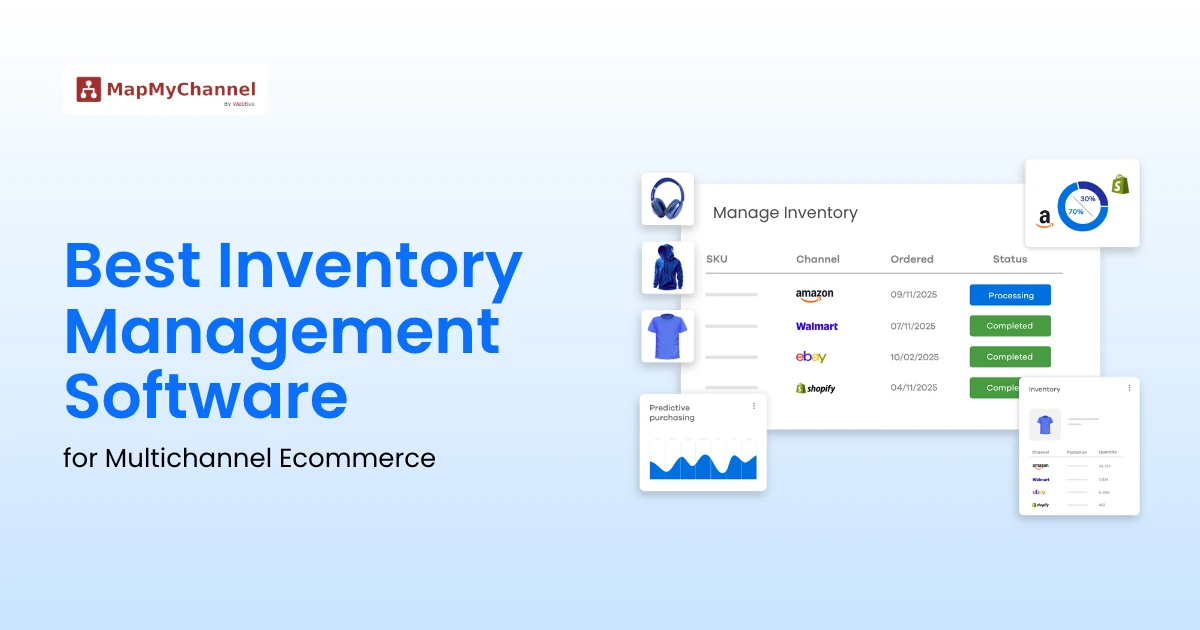
It provides one centralized dashboard of products, orders, inventory and sales channels. For any multichannel e-commerce business, the right system helps increase inventory accuracy while reducing dependence on manual work. This blog explains what the best inventory management systems are, what to look for when choosing one and the top 10 solutions for e-commerce inventory management.
What is Inventory Management Software?
Inventory management software is a business solution that helps businesses track and control products they purchase, place in storage, sell, and restock. Instead of having multiple spreadsheets to record inventory levels across different sales channels manually, businesses can manage inventory from a centralized system. This system is crucial for smooth business operations as multichannel selling grows and inventory is distributed across multiple marketplaces, a physical location and a warehouse. Modern eCommerce Inventory Systems for eCommerce automatically adjust stock as orders are placed, fulfilled or returned.
What Are the Different Types of Inventory Management Software?
Inventory systems are categorized based on the stock updating method used:
1. Manual Inventory Systems
Stock is manually recorded using a spreadsheet, paper or basic platform. This approach can work well for small operations but becomes very time-consuming and inefficient with business growth.
2. Periodic Inventory Systems
Stock is physically counted and updated at set times, daily, weekly or monthly. This can work well if the volume of stock is fairly low.
3. Perpetual Inventory Systems
Stock levels are updated in real-time as ordered, received, returned or transferred. This is best suited to an ecommerce business that is expanding and processing more orders.
4. Multichannel Inventory Systems
These systems connect various ecommerce stores, marketplaces, warehouses and fulfillment locations allowing sellers to manage stock from one place.
For a growing multichannel ecommerce store, a cloud based perpetual system with multichannel integrations is often the best bet.
Key Features of Inventory Management Software
A robust inventory management software should simplify day-to-day stock management rather than creating another difficult system for sellers to manage. Such a system is marked by the below given key features:
- Real-time inventory sync across marketplaces, websites and internal business records.
- Multi-location inventory management for businesses with multiple warehouses or fulfillment centers.
- Order synchronization to bring orders from sales channels on a centralized dashboard.
- Low stock alerts and reorder points to avoid stockouts.
- Purchase order management so that sellers can buy easily from suppliers to restock.
- Barcode scanning to improve warehouse receiving, picking, packing and counting.
- Data backed inventory forecasting so demand is met by adequate stock-up of required products.
- Reporting and analytics allow sellers to get better insights into best performing products, and channels.
- Kitting and bundling for sellers offering product combinations.
- Integrations with ecommerce stores, marketplaces, accounting software, shipping providers and fulfillment services.
How to Choose Inventory Management Software for Your Ecommerce Business
Choosing the right Inventory management software depends on how an ecommerce business operates. The number of sales channels, SKUs, warehouses and orders a business plays a major role in determining which solution is the right fit.
Small volume sellers with one Shopify store may need inventory management with low-stock alerts. A growing business selling on Amazon, Shopify, Walmart, other marketplaces may need real time inventory sync, multi-location management, demand forecasting, automatic purchasing etc.
Consider some important criteria before choosing:
- Sales Channels: Make sure the system supports all marketplaces and ecommerce stores that your business sells on.
- Warehouse requirements: If the business operates multi-location, make sure the system supports multiple locations and inventory transfers.
- Automation: Check if the system supports automatic updation, alerts generation and order purchase.
- Ease of use: The system should be easy to use without your team requiring heavy technical learning.
- Scalability: The system must be equipped to scale as your business expands.
- Reporting: Warehouse, sales, slow moving products and restock requirements must be condensed into a report, periodically.
- Integrations: Does the system support all your ecommerce, shipping, accounting and fulfillment tools?
10 Best Inventory Management Software for Multichannel Ecommerce
An effective inventory software simplifies storing inventory, order, warehouse and sales data from across multiple ecommerce channels. Find below the top 10 ecommerce inventory management solutions, each with a unique set of features to satisfy both small size and medium size ecommerce business:
1. MapMyChannel
MapMyChannel is a multichannel integration platform for businesses selling across multiple marketplaces. MapMyChannel connects sales channels with inventory, orders, third-party fulfillment, and ERP solutions on a single centralized dashboard.
MapMyChannel helps sellers automate inventory management to eliminate inefficient manual product updates, allowing sellers to update inventory details on their sales channels automatically:
- Real-time inventory synchronization
- Multi-location inventory management
- Inventory buffer for reserving stock
- Order sync from multiple channels
- ERP/3PL integration
- Automated inventory synchronization across ecommerce platforms
Best For: Sellers looking for efficient multichannel inventory sync, managing various ecommerce sites from a central source.
2. Linnworks
Linnworks connects and manages inventory, orders, warehouses, listings, and shipments through a single interface. Through real-time synchronization of the product data , the platform also makes it easy for sellers to get sales reports for a specific SKU – to let them know if and when to restock.
- Inventory replenishment
- SKU forecasting & reports
- Automated replenishment
- Purchase order management
- Multi-warehouse tracking
- Real-time Inventory tracking
Best For: eCommerce businesses looking for automated order management, forecasting, and restocking on top of other functions.
3. Cin7
Cin7 is an inventory management platform for product-based businesses selling through multiple storefronts, marketplaces, and warehouse locations. The platform provides real-time visibility into available inventory, and sellers can also automate inventory replenishment based on customer demand. Key Features:
- Real-time multichannel inventory
- Multi-location inventory tracking
- Demand forecasting
- Automated re-stocking
- Warehouse stock visibility
- Inventory transfers
Best For: Rapidly growing businesses with multichannel sales operations that need for inventory forecasting and automated purchasing.
4. Extensiv
Extensiv is software focused on warehouse and inventory management. It is ideal for an e-commerce business that works with a 3PL provider. The software helps sellers allocate inventory based on sales channel, bundle products, count inventory using barcodes, etc.
- Inventory allocation
- Multi-warehouse management
- Barcode scanning, bundling and kit creation
- Per-channel inventory allocation
- Real-time stock management
Best For: Ecommerce brands that primarily use warehousing and 3PL services and want to optimize inventory allocation can make best use of this software.
5. Brightpearl
Brightpearl is a retail-specific software solution designed for multichannel sellers. They provide inventory and warehouse management along with order and demand management, automation, and accounting features. Mid-to-large retailers hence, get a more comprehensive view of their business with the below features:
- Multichannel inventory and warehouse managing
- Multi-warehouse stock management
- Demand management and forecasting
- Automatic replenishment
- The software integrates with accounting software
- Real-time reports
Best For: Mid-size and large retailers that require inventory management plus integrated accounting and retail operations.
6. Zoho Inventory
Zoho Inventory is an inventory management solution for small and growing businesses. Merchants can manage inventory for multiple warehouses, utilize barcode scanning, track serial & batch inventory, manage sales across several channels and get automated reordering reminders. Some highlighted features are:
- Multi-Warehouse Management
- Serial and Batch Tracking
- Barcode Scanning
- Re-Order Points and Automation
- Multichannel Sales
- Inventory Transfers
Best For: Small and growing ecommerce businesses that need affordable and straightforward inventory management with room to expand.
7. Sellbrite
Sellbrite connects products to multiple sales marketplaces, simplifying product listings, inventory, and orders. Inventory can be updated automatically across connected channels. Some features that facilitate these functions are:
- Multi-warehouse Inventory
- FBA inventory management
- Centralized product catalog
- Bulk inventory management
- Automatic inventory sync
- Marketplace order fulfillment
- Marketplace order management
Best For: Marketplace and FBA sellers that want a simple way to manage products and inventory across multiple channels can employ this software.
8. Sellercloud
Sellercloud is designed for ecommerce businesses managing large product catalogs, multiple warehouses, and numerous sales channels. Sellercloud inventory software keeps your whole inventory on track, reserving products for specific order. Some highlights:
- Inventory reservation and allocation
- Multi-warehouse inventory management
- Predictive purchasing and kits
- Kitting and bundling
- FBA replenishment
- Channel-level inventory control
Best For: Larger ecommerce businesses needing advanced inventory control, purchasing, and allocation.
9. Finale Inventory
Finale Inventory was created for multichannel ecommerce businesses for the core of their stock, and a warehouse operation center. It manages multi-location management, barcode-built warehouse tasks, acquisitions, and inventory processing.
- Multi-location inventory
- Barcode scanning
- Purchase order management
- Kitting and bundling
- Automated replenishment
- Multichannel inventory synchronization
Best For: E-commerce organizations looking for a reliable inventory management system for their stock and multiple channels will find this solution best suited for their requirements.
10. Ordoro
Ordoro combines inventory and order management together through an automation of eCommerce routine operational tasks. Ordoro manages real-time stock, and provides notifications for low-stock products. There are certain additional functions that Ordoro supports:
- Low-stock alerts
- Purchase orders and goods receipts
- Kitting and bundling
- Multi-warehouse management
- Real-time stock synchronization
- FBA inventory tracking
Best For: The requirements of expanding eCommerce businesses that need a single streamlined platform with order and inventory management features.
Conclusion
The best inventory management software depends on the size and scale of your business. There are multiple softwares offering this functionality in the market today, for example, MapMyChannel, Zoho Inventory, Linnworks, Cin7, etc.
MapMyChannel is an excellent budget friendly application specializing in multi channel inventory management. Before selecting an inventory management software, consider your sales channels, future growth, automation needs etc. The right inventory management software can reduce manual work, prevent stockouts, and give your ecommerce business greater control over its inventory.
Get in Touch

.webp)

.webp)


