
eCommerce businesses these days start and grow rapidly, but after some point in time, handling operations becomes increasingly difficult for sellers. Also, the sellers are piled up with these tasks so much so that they would have no time for marketing, branding, and advertising of their organization. After a period of time, growth comes to a halt, and sales stagnate to a point where there is no change for the better. This is where ERP (Enterprise Resource Planning) integration comes into play. This integration assists the ecommerce business owners in managing their operations efficiently. Here are the benefits, strategy, and best practices for the same. Stay hooked!
What is ERP Integration?
As the name suggests, ERP integration refers to integrating the ERP system with eCommerce businesses for simplified business management. It allows the sellers to create a powerful system that automates and manages the standard business processes like finance, customer relationship management (CRM), Supply Chain Management (SCM), HR, and 3PL.
NetSuite is a best-in-class ERP system joined by more than 43000 people through different integration applications. To elaborate further, it is an AI-powered, cloud-based business management solution that allows sellers to automate core business processes while providing them with real-time visibility into operations. NetSuite ERP integration brings in a multitude of benefits, to be discussed in the next section.
Benefits of eCommerce ERP Integration
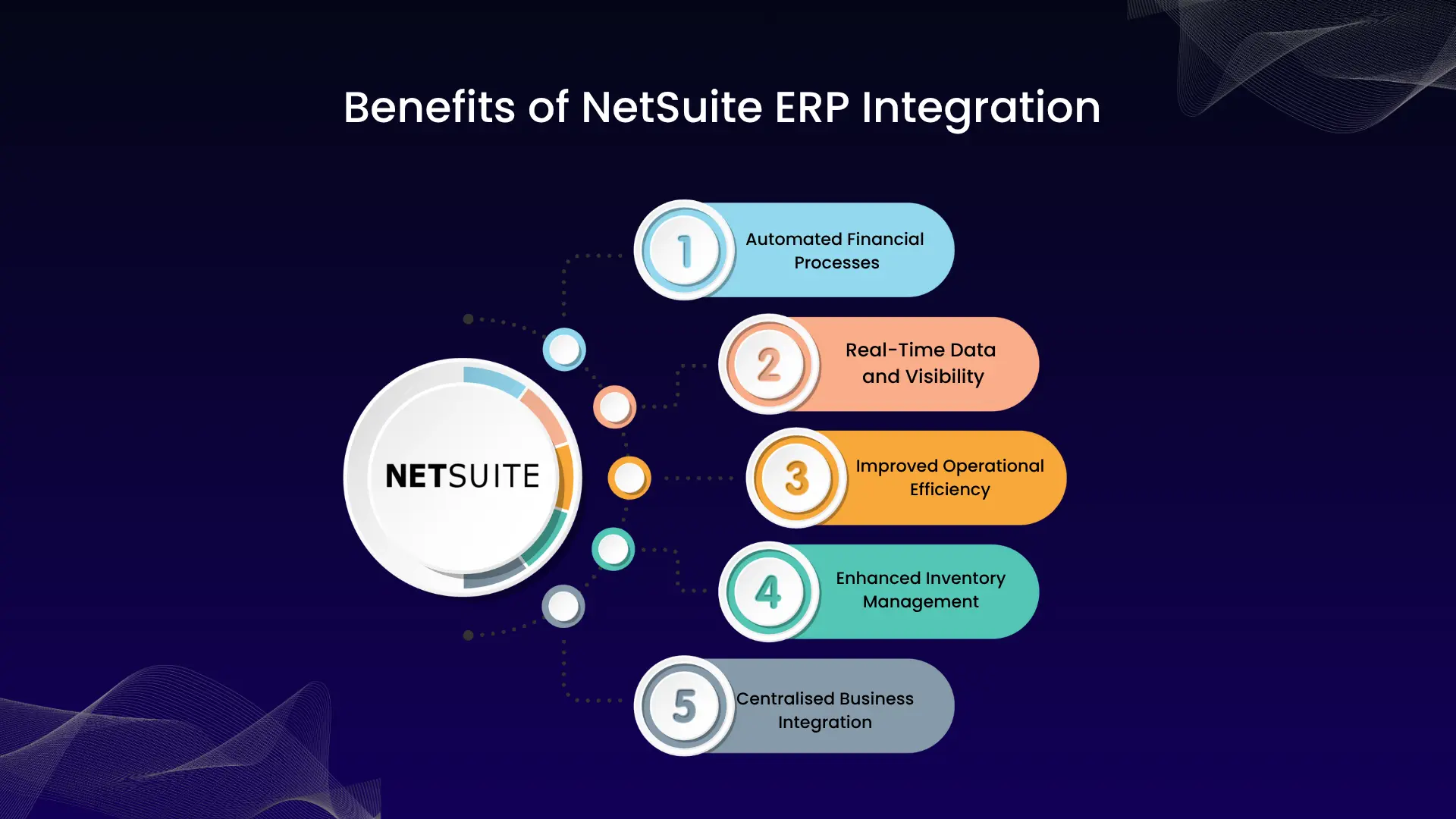
eCommerce ERP integration with NetSuite offers an immense pool of benefits to sellers. The following is the list:
Elimination of Manual Entries
Employees frequently find themselves entering the same data into several applications when systems function independently. In addition to wasting time, this raises the possibility of mistakes that could have an impact on everything from financial reports to inventory counts inside. By enabling direct communication between various systems, ERP integrations reduce the risk of errors. Also, automated data entry boosts accuracy and reliability for decision-making.
Real-Time Data Synchronization
ERP software integration allows sellers to sync the data in real-time, so there is a unified stream of data that is well packed with information to draw conclusions. As sellers sync their data, the business becomes flexible and proactive to act according to the changes in the market trends and supply chain discrepancies.
Automated Financial Processes
ERP and ecommerce integration enables automation of financial processes that allow sellers to manage their money better. Also, the order processing gets faster due to automated verification of financial transactions. In addition to this, recognition of revenue is simplified with an ERP integrator.
Inventory Visibility
Keeping a track of inventory becomes really simple with ERP-integrated solutions, as it tracks the same in real time. Apart from this, it can help with the optimization of the stock with AI-based inventory monitoring. All this together allows the business owner to minimize carrying costs and deliver orders on time, since no products need to be looked for before fulfillment.
Flawless Order Management
Managing orders is the most critical job of an online seller. ERP ecommerce integration simplifies this critical job like a cake walk. From order confirmation to final delivery, it automates and smoothens every single step. Henceforth, the delivery is faster and the errors are reduced to a least.
What is the Role of ERP Systems Integration?
Understanding the Role of ERP systems would require you to understand the features where e-commerce integration with ERP helps:
Accounting
Transform your general ledger, maximize AR, automate AP, and simplify tax management with NetSuite cloud accounting software's integrated AI capabilities. Obtain a comprehensive understanding of financial performance and cash flow.
Financial Management
Daily financial transactions are sped up, forecasting and budgeting cycle durations are shortened, compliance is guaranteed, and the financial closure is accelerated with NetSuite financial management solutions. Our cloud-based, AI-powered technology provides real-time insight into any company's financial performance, from overall to transaction-by-transaction. You can manage your entire company with a single solution by integrating NetSuite financial management with other business apps, such as order management, inventory, CRM, and commerce.
Global Business Management
In addition to providing real-time financial consolidation and visibility, NetSuite One World assists businesses in managing worldwide operations, including numerous currencies, tax laws, and reporting needs across regions and subsidiaries.
Inventory Management
Sellers need to make inventory management automated. Also, they must maintain low inventory costs while fulfilling customer delivery requirements. NetSuite provides features for managing the supply chain, identifying reorder points, tracking inventory across different locations, and optimizing buffers.
Order Management
Simplify order processing by getting rid of manual bottlenecks, avoiding mistakes, and creating a seamless transition from order fulfillment to sales quotes. The outcome was prompt billing and payment.
Warehouse Management
Utilize RF-device-directed put away and picking jobs to streamline warehouse operations. These tasks are powered by advanced features such as wave management, cartonization, cycle count planning, real-time inventory updates, and shipping system integrations, as well as customizable, user-defined strategies.
Best Practices of NetSuite ERP Integration
Bringing something new to the business requires certain planning and understanding. Here are certain ERP integration best practices that need to be considered while integration:
Planning and Strategizing
Sellers need to plan their objectives before integration so that the NetSuite ERP can be aligned with the same for better outcomes. With a predetermined goal, sellers can give their business a direction. They need to make sure that the integration goes step by step, rather than a complete transformation, so that sudden changes do not impact the business.
Implementation and Execution
To implement the integration smoothly, sellers must prioritize security and make sure that the data shared is safe. Sellers need to automate the processes involved in the business to further simplify ERP integration and enable a smoother flow of information. Make sure that the data across different channels and platforms is standardized so there are no discrepancies.
Make Sure to Maintain
Sellers who wish to grow exponentially need to maintain their business by providing their employees with training to work on different software that comes with time. Also, regular audits are the key to streamlined integration logs and data mapping. Continuous improvement and optimization of processes bring efficiency to the business, for which NetSuite integration is implemented.
NetSuite ERP Integration: The Ultimate Business Support
Sellers need support once their business reaches a certain level, and NetSuite ERP integration provides the exact help they are looking for. It will provide the business with the assistance of automation and centralization if the right integration software is employed. An API-based integration works the best in this case as it enables smooth data flow and better communication of sales channels with NetSuite software. Now, there’s nothing to wait for, go ahead to integrate your business NOW!
Get in Touch

.webp)
.webp)


