
.webp)
Let me guess! You are struggling to manage multiple business processes simultaneously, so you got an Enterprise Resource Planning software - NetSuite. It helped you handle:
- Accounting
- Finances
- Global Business
- Enterprise Performance
- Inventory
- Order Processing
- Supply Chain
- and Warehouse.
Everything worked smoothly for a while, then came a point when you were struggling to manage the different sales channels, the ERP software, and 3PL fulfillment became increasingly complex, especially when these systems were not fully integrated.
What was brought into the business to solve different problems became an issue itself. This is where ERP ecommerce integration steps in. While it may seem complex, it is actually quite straightforward, and this blog will break it down into simpler parts for easy understanding.
Understanding ERP Integration
By definition, ERP integration is connecting your NetSuite application with sales channels for easier management and unifying business operations. The primary goal is to bring different business-related operations together on a centralized dashboard. So, tracking inventory, managing orders, and fulfillment is much easier with an e-commerce ERP system.
ERP eCommerce Integration Explained
ERP for e-commerce focuses on streamlining processes and automating business. It starts from the order confirmation and ends with the final delivery of goods (return management if applicable). Throughout this process, the sales data, inventory level, and finances are tracked by the ERP and centralized with e-commerce integration solutions.
With each step progresses, the ERP system automatically updates and shares information with the automation software, so the seller does not have to switch between multiple platforms for information and updates.
ERP eCommerce integration empowers businesses to scale efficiently and focus on delivering consistent value and sustainable business growth.
Why Businesses Are Integrating ERP with eCommerce Platforms?
Everything becomes simpler with automation in hand. Now, let’s explore how ERP ecommerce integration services help sellers:
1. Operational Efficiency
Manual processes reduce speed and increase the risk of errors. Tasks like manual data entry are time-consuming and often compromise data accuracy. With eCommerce automation, sellers can optimize workflows, reduce manual effort, ensure consistent accuracy, and streamline overall processing.
2. Meeting Customer Expectations
Customer expectations are straightforward: fast fulfillment and efficient query handling. With smart ecommerce solutions and supporting effortless ERP integration, sellers can achieve both. Order processing is simplified, fulfillment data is synced without errors, and the order status is updated automatically, which can reduce customer queries.
3. Competitive advantage
While the business processes are streamlined and the customer experience is enhanced, the path to success is cleared. It is giving the e-commerce business an advantage over competitors in the industry. Also, without the technology, businesses are losing out on power and capacity.
4. Scalability and Flexibility
Scaling operations is extremely challenging for sellers without ERP ecommerce integration tools. Manual efforts can nowhere compete with the work of automation in terms of both scale and flexibility. Integration allows sellers to expand into new markets without compromising efficiency.
5. Real-time Inventory Management
Stock management requires accurate real-time data. To avoid stockouts or dead inventory, the e-commerce ERP solution continuously tracks inventory levels and provides sellers with accurate data for better planning and optimization. This enables sellers to run business operations.
6. Sharper Insights and Reporting
ERPs like NetSuite have useful insights for sellers, based on the data extracted from sales and the business. The same can be used to bring out useful information for demand forecasting, customer inclination, and shopping patterns. With integration, the execution of plans and study of data is simplified. Since sellers are not consistently employed in relentless processing.
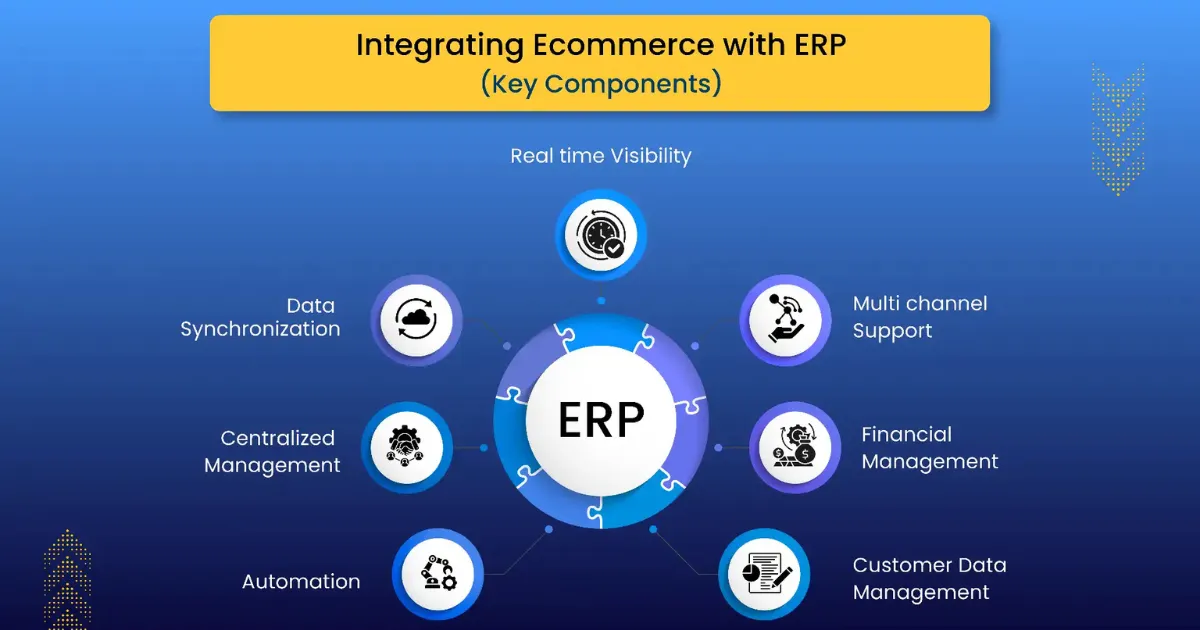
What Are the Core Components of an ERP–Ecommerce Integration?
Everything smart has some constituent parts that make it special and effective, so does ERP integration. Here are the components that come together to make ERP–Ecommerce Integration:
1. Combined Data Sources
Integration links ERP and e-commerce systems so data stays consistent. Product details flow to the online store, and customer accounts sync both ways. Orders move into ERP for processing, with updates sent back. This ensures accurate, unified records instead of mismatched duplicates.
2. Integration Method
Businesses can link ERP and e-commerce systems in different ways, each with its own pros and cons. APIs offer real-time control but need expertise. Middleware suits complex setups but is slower and more costly. iPaaS is faster, easier, yet less flexible. So, sellers need to be careful as to what kind of integration they choose for the business.
3. Account and Order Sync
Account synchronization keeps ERP and e-commerce data aligned. New online customers appear in ERP, existing ones see pricing and terms, and credit limits apply at checkout. Orders sync automatically, with updates, tracking, returns, and refunds flowing back to ensure accurate records.
4. Report Development
Integration enhances reporting by centralizing data. Finance teams view revenue across channels instantly, while operations track fulfillment metrics in real time. Customer analytics improve as purchase history and account details combine, helping businesses identify top buyers, spot trends, and make faster, smarter decisions.
By unifying business operations through ERP eCommerce integration, organizations can reduce errors, enhance customer experiences, and create a scalable foundation for long-term success.
The Role of Technology in Modern ERP Systems
Let’s now understand the role played by technology in ERP components and e-commerce business growth:
1. Cloud Computing
Cloud-based ERP enables businesses to use software online instead of locally installed systems. This approach significantly reduces upfront costs and IT work. Instead, businesses operate on a subscription that includes updates, security, and scaling. It’s particularly beneficial for small and medium-sized enterprises without extensive budgets or in-house IT teams.
2. Artificial Intelligence and Machine Learning
Artificial Intelligence (AI) and Machine Learning (ML) are components of ERP systems rather than being separate tools. These technologies quickly process large amounts of data, give detailed insights, and suggest actions. With accurate, centralized data, businesses can act faster and make smarter decisions.
3. API (Application Programming Interfaces)
APIs connect the ERP system with other software applications, data sources, AI agents, and business platforms. This grows the capacity of the ERP system beyond its core functions, with added features, seamless data sync, and automation for processing different functions. It brings much-needed flexibility to the business.
Final Word…
ERP integration into the business is not yet another addition; it is a function that supports without you having to notice. It helps bridge the gap between sellers and customers who desire a high-quality shopping experience. Effective selling requires businesses to focus on more strategic areas and put effort into something other than order processing and inventory management. Let the integration handle all these daily tasks while you feed the business with thought, creativity, and active participation. On second thought, you can simply use the time to rest and spend time off! It's all on you, but go get that integration today.
Get in Touch

.webp)
.webp)


