
Introduction
The global e-commerce landscape is shifting rapidly, opening up new sales channels for domestic brands. As a platform connecting cross-border factories to global consumers, AliExpress has shifted its business model to actively onboard domestic retailers. Through the new localized program, US sellers can easily start selling on AliExpress.
Whether it's an established U.S. seller looking to expand beyond the domestic market or a growing business exploring multichannel e-commerce, AliExpress can help you reach customers in new markets. The platform helps businesses reach global consumer demand while using local warehouses or 3PL partners to fulfill orders. This blog outlines the registration steps, fulfillment processes, and automation workflows sellers need to manage operations successfully and scale.
What is AliExpress for U.S. Sellers?
AliExpress is an online retail service launched in 2010 by the Alibaba Group. As a subsidiary of Alibaba Group, AliExpress functions as a business-to-consumer (B2C) marketplace. It lets independent sellers reach customers worldwide directly.
The platform has grown into one of the world’s leading e-commerce marketplaces. As of March 2024, its global app audience surpassed 8 million users, and quarterly web traffic regularly crosses hundreds of millions of visits. Unlike most traditional e-commerce models where the host platform sells its own private-label products, this marketplace acts only as a bridge. AliExpress ensures that independent merchants receive full infrastructure support without competing directly with the marketplace operator.
Why Do U.S. Sellers Choose AliExpress?
1. Large Global Customer Base
Expanding a business to AliExpress instantly introduces the product to a massive audience of 400 million users in 220 countries. This international reach lets domestic brands cross-list inventory and easily find international buyers without running complex regional advertising campaigns.
2. Large Marketplace Audience
The platform’s transaction volume spans global economies. United States alone accounts for nearly 20% of the platform’s total Gross Merchandise Volume (GMV). This makes it a high-intent channel filled with shoppers actively searching for localized product options.
3. Growing Presence in the U.S.
AliExpress has significantly increased its corporate investment within the domestic market. By running highly visible marketing campaigns and hiring premier global brand ambassadors, it is rapidly increasing customer awareness among American shoppers looking for unique, cost-effective items.
4. Dedicated U.S. Seller Programs
AliExpress Features encourages domestic merchants to have access to dedicated, localized onboarding options. Sellers can select between two options designed to balance their autonomy with structural assistance:
- AliExpressLocal Direct: A highly supportive model that offers hands-on assistance, merchandising, dedicated marketing campaign setups, and automated consumer communication structures.
- AliExpressLocal Marketplace: A completely self-serve model giving merchants full access to product pricing, promotional structures, and direct Minimum Advertised Price (MAP) enforcement rules.
5. Integration and Automation
Modern application tools—such as the native AliExpress Open API framework—allow external software networks to link with your dashboard safely. This eliminates slow, error-prone manual inventory uploads by enabling seamless cross-channel bulk data syncing.
How to Become an AliExpress Seller in the US?
Requirements for selling on AliExpress
To complete the specialized AliExpress onboarding process, US sellers must prepare the following standard verifications:
- An active Business Registration (U.S. business is legally registered).
- An Employer Identification Number (EIN) and other tax or business information
- Valid identity and contact information for the business owner
- A dedicated business banking account that matches the legal credentials of the seller's entity.
- Trademark Registration numbers or official authorization letters if listing protected brand names.
Steps for Registering as a Seller
- Start Your Seller Registration: Visit the AliExpress seller registration portal and select the seller onboarding application for the U.S.
- Create Your Seller Account: Provide a business email address and other account details. Select the legal tax residency country and verify the account.
- Submit Your Business Information: Submit the business registration documents, address details, and tax documentation for audit validation.
- Select Your Product Categories: Define the primary product categories through the standard classification catalog.
- Complete Your Store Setup: Access the AliExpress Marketplace dashboard to upload your business logo, adjust brand information, product details, and define the return policies your business will follow.
How U.S. Sellers Can Fulfill AliExpress Orders?
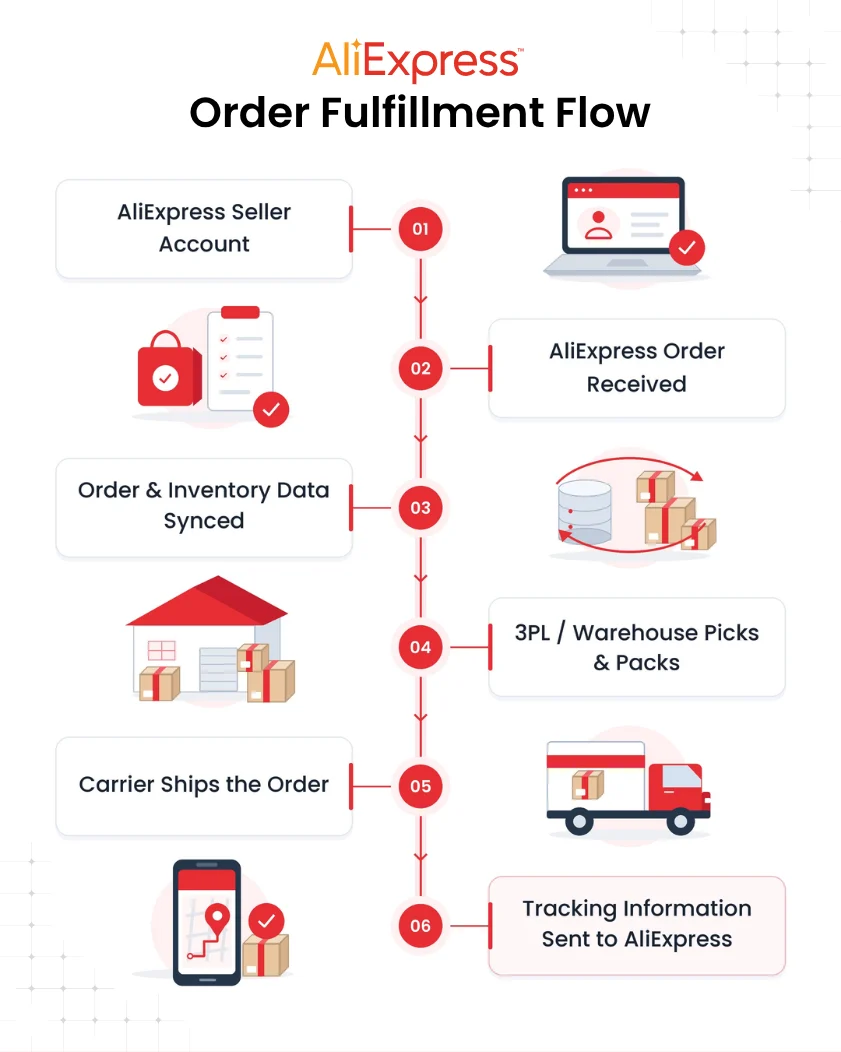
1. Receive and Process AliExpress Orders
When a customer places an order on AliExpress, the seller’s order moves from the account into the fulfillment workflow. For sellers, manual updates risk order errors and slow shipping times; automated integration reduces manual data entry.
2. Fulfill AliExpress Orders Through a 3PL
U.S. sellers store inventory and fulfill AliExpress orders using a 3PL provider. A third-party fulfillment partner helps sellers pick, pack, and ship orders from the warehouse to the customer. It improves the delivery process and reduces shipping costs.
3. Keep AliExpress Inventory in Sync
To maintain inventory accuracy, merchants must avoid overselling. Inventory management software automatically updates product stock across other sales channels and keeps AliExpress listings accurate.
4. Update AliExpress Shipment and Tracking Information
Customers expect immediate shipping validation. When you connect with a fulfillment partner, tracking numbers must push back to the platform instantly to notify customers and complete the transaction.
Accurate and timely tracking updates also give customers better visibility into their order status.
5. Manage AliExpress Customer Service and Returns
Maintaining positive ratings requires answering consumer queries quickly. The platform provides internal helper chatbots to manage simple order updates, but U.S. sellers should regularly monitor their dashboards to handle technical disputes or return requests directly.
How MapMyChannel Simplifies Selling On AliExpress
Manually tracking AliExpress orders alongside other sales channels is labor-intensive. A dedicated multichannel management software acts as an operational bridge for a seller's entire catalog. MapMyChannel offers a multichannel integration that syncs order and fulfillment details across sales channels in a single, comprehensive dashboard.
MapMyChannel provides real-time inventory to reduce human error and automatically updates stock levels across all connected channels. The Order management functionality transfers incoming orders directly into the existing 3PL integration. This lets warehouse teams print labels and ship products immediately without the seller checking multiple storefronts.
Conclusion
Expanding your brand to sell on AliExpress in the U.S. offers a strong growth opportunity without building a separate marketplace from scratch. By combining a large international customer base with support for domestic sellers, the platform lets U.S. brands reach new customers and expand their market presence. Selling on a new marketplace can seem challenging at first, but automated workflows and inventory management can significantly reduce operational complexity.
With a well-integrated, automated backend, sellers can maintain efficient shipping, keep inventory synchronized, and scale with greater confidence. As more U.S. businesses explore opportunities on AliExpress, now is a good time to register your storefront, optimize your product catalog, and reach a broader segment of global e-commerce customers.
AliExpress Seller FAQ
What's the Difference Between Alibaba and AliExpress?
Alibaba Group launched both platforms. But Alibaba operates as a business-to-business (B2B) platform for bulk business orders; AliExpress is a business-to-consumer (B2C) retail marketplace that helps sellers offer products directly to customers worldwide.
What is the Most Sold Item on AliExpress?
Some product categories on AliExpress see high order volume, including fashion accessories, wellness electronics, smart home gadgets, etc.
What Is the Commission Fee for Sales on AliExpress?
Standard transactions carry a category-specific commission fee ranging between 5% and 8%. However, introductory incentives under specialized domestic seller programs may offer lower entry fees.
What You Shouldn't Sell on AliExpress?
AliExpress prohibits selling counterfeit products, restricted items such as weapons, and certain high-liability products, including unregulated skincare products. Selling prohibited items can result in legal penalties, product seizures, or store suspension.
Get in Touch

.webp)
.webp)


