
Introduction
As ecommerce businesses scale, managing inventory becomes more complicated. Expanding into new marketplaces, launching additional warehouses, and partnering with fulfillment service providers can help businesses grow their distribution network, but introduce new internal complexities.
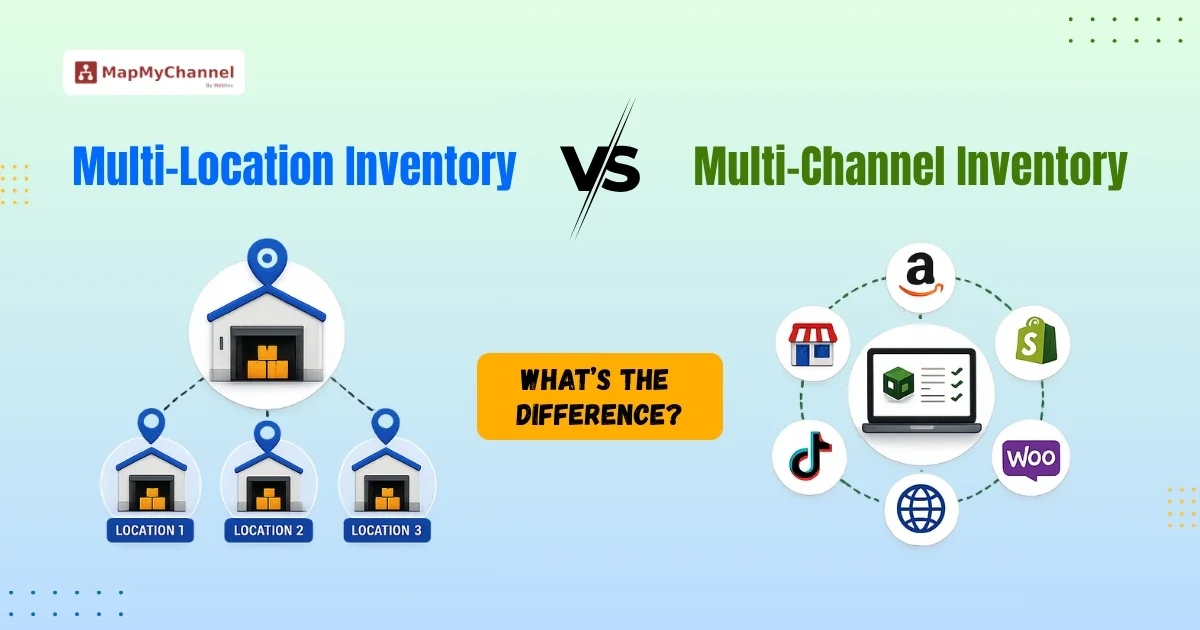
This is when multi-location inventory and multi-channel inventory come into play. While the goal of both is to improve accuracy for your inventory, they solve different aspects of the problem. Multi-location inventory analyzes the stock held at several locations, whereas multi-channel inventory examines inventory accuracy across a variety of channels of sale.
Understanding the differences between these two is crucial for preventing over-selling and over-stocking, optimizing fulfillment, and ensuring that your business can effectively scale your inventory management processes.
What Is Multi-Location Inventory?
Multi-location inventory management means keeping track of the inventory you stock at different physical locations (think warehouses, brick-and-mortar stores, distribution facilities, and third-party logistics (3PL) providers). Businesses no longer consider stock as a single pool: they need to keep an eye on what’s stocked at each site and where customers are, to deliver an optimal ordering experience.
For example, a business may store inventory in its New York, Texas, and California warehouses. If a customer in Los Angeles makes an online purchase of an ottoman and inventory is available in a California warehouse, it’s more efficient to direct the fulfillment partner to ship from California rather than New York.
A real inventory management system should provide visibility into inventory at various levels, monitor stock, carry out replenishment tasks, and dispatch products.
Multi-location inventory also supports demand planning, which can benefit a company immensely. Demand is never uniform; customer interests will differ from region to region. A retail store stocking for hotter climates would stock seasonal winter wear, but for countries having relatively moderate temperatures, this stock wouldn’t seem appropriate. Multi-location inventory gives greater power in this domain.
Benefits of Multi-Location Inventory -
- Better visibility into inventory across warehouses
- Faster fulfillment through location-based order allocation
- Reduced shipping and logistics costs
- Improved warehouse utilization
- Better stock planning and replenishment
- Reduced chances of stockouts and overstocking
Example - A sporting goods company stores bicycles in three warehouses:
- Chicago: 300 bicycles
- Dallas: 220 bicycles
- Miami: 180 bicycles
When a customer places an order, the system identifies the nearest warehouse with available stock and routes the order accordingly. This improves delivery efficiency while reducing unnecessary shipping expenses.
Businesses using multi-location inventory software can automate these processes and manage inventory movements without relying on manual tracking.
What Is Multi-Channel Inventory?
Although multi-location inventory deals with where the inventory is located, multi-channel inventory is all about where a product is sold.
It is highly unlikely that sellers and retailers rely on a single sales platform, as most brands sell through multiple marketplaces, including Amazon, eBay, Shopify, Walmart Marketplace, or their own websites. If 40 different marketplaces use individual inventory, it can be overwhelming and difficult to control.
Multi-channel inventory provides visibility into accurate product levels for each sales channel, ensuring the correct stock levels are shown for each one. As one channel sells product, it can automatically update the other channels via inventory.
Example: For a company with 500 face serums available and the following sales take place:
- 80 sold on Amazon
- 45 sold on Shopify
- 25 sold on eBay
Without multi-channel inventory, other marketplaces will receive incorrect stock levels, increasing the risk of over-selling. A multi-channel inventory platform will upload the inventory availability to all channels, providing a single view of stock levels. This is critical in seasons, sales, and time periods when stock levels fluctuate constantly. Instead of updating each marketplace separately, a centralized dashboard is updated.
If selling from Amazon and eBay, solutions such as MapMyChannel integrate sales channels, reducing the manual process and automating stock updates. This provides sellers accurate stock levels and avoids cancelled orders, resulting in a positive customer experience.
Benefits of Multi-Channel Inventory -
- Real-time inventory sync
- Minimizing overselling
- Increasing customer satisfaction
- Consolidated view of inventory
- Facilitating new marketplace launches
- Achieving higher inventory accuracy
Example: Suppose an electronics store offers the same wireless headphones via Amazon, TikTok, Shopify, and eBay Marketplace. It currently has 150 headphones in stock, and a customer buys 15 pairs via Amazon. Once the sale is confirmed, the inventory is updated across all linked sales channels to reflect available stock as 135. Customers will be able to see their availability there also when they shop on Amazon, eBay, Walmart, or Shopify, without fear of purchasing product that is already gone.
Multi-Location Inventory vs Multi-Channel Inventory
Both multi-location and multi-channel inventory boost your inventory management, it targets different types of operations.
Example: A furniture company storing merchandise in warehouses in Texas, California, and Florida uses a multi-location inventory system to optimize movement between stores. If that same company sells through Amazon, eBay, and Shopify stores, it also requires multi-channel inventory to ensure each selling platform displays real-time inventory counts.
Which Inventory Management Approach Is Right for Your Business?
The requirement depends on how your business operates.
Scenario 1: Businesses That Only Need Multi-Location Inventory Management
Some businesses sell through a single website or physical stores but manage inventory across multiple warehouses.
Example: A furniture distributor may receive all customer orders through its own website while fulfilling products from five warehouses nationwide. Since the company sells through a single sales channel, synchronization is not the primary challenge. Instead, it needs visibility into inventory across warehouses to improve fulfillment and stock planning.
Scenario 2: Businesses That Only Need Multi-Channel Inventory Management
Businesses selling through multiple marketplaces but using a single warehouse mainly require multi-channel inventory.
Example: A fashion brand stores all products in one fulfillment center but sells through Amazon, Temu, Shopify, and Walmart Marketplace. The main challenge is ensuring every sales channel displays accurate inventory. A multi-channel inventory solution automatically updates stock levels whenever an order is placed.
MapMyChannel helps businesses manage marketplace inventory synchronization and maintain consistent stock information across connected channels.
Scenario 3: Businesses that need both multi-channel inventory and multi-location inventory management
Businesses selling products through multiple sales channels and storing inventory across multiple warehouses would require both management systems.
Example: A home décor brand selling through its website, Amazon, Flipkart, and retail stores while stocking products in warehouses across Delhi, Mumbai, and Bengaluru requires both capabilities. When an order is placed, the system selects the best warehouse for fulfillment, deducts stock from that location, and instantly updates inventory across every sales channel. This ensures accurate stock visibility, prevents overselling, and enables faster, more efficient order fulfillment.
Together, the two management systems provide a single, accurate view of inventory while ensuring that customers receive their orders quickly and businesses avoid stock discrepancies.
Common Challenges Without Proper Inventory Management
An inventory management system centralizes a business's inventory to help it make smarter inventory decisions. Without a proper inventory management solution, a business can face the following challenges:
- Inventory Inaccuracies: A business may not have a clear picture of inventory on hand in real time. Inventory of a product on hand in one store might have already been sold at another store.
- Overselling and Stockouts: Having the wrong kind of inventory can cause businesses to oversell a product, canceling orders and irritating customers.
- Lack of Warehouse Visibility: When multiple warehouses have products available, a business may not know what's where and the best place to ship an item.
- Manual Updates: Manually updating a store in multiple marketplaces can be cumbersome and prone to mistakes.
- Overstock and Understock: Having an inaccurate view of inventory can cause stores to stockpile items that aren’t selling well and run out of the items everyone is clamoring for.
How Multi-Location and Multi-Channel Inventory Work Together
Although they solve different operational challenges, together multi-location and multi-channel inventory management systems provide an approach to managing your inventory. Businesses can connect warehouse management and sales channels to establish a single source of truth.
Example: A home appliance brand has four warehouses but sells products through Amazon, eBay, and Shopify.
Customer Places Order → Multi-Channel Inventory Receives Order → Multi-Location Inventory Checks Warehouse Stock → Selects Best Warehouse to fulfill the order → Pick, Pack & Ship → Updates Inventory Across Amazon, eBay & Shopify
Integrating your warehouse inventory with your marketplace inventory helps businesses save time and boost the customer experience. Businesses looking to automate this workflow can use MapMyChannel, which connects marketplace activities with the fulfillment process, allowing sellers to manage their inventory and automate order management.
How to Choose the Right Inventory Management Solution
Choosing the right inventory management solution depends on your business needs. Consider the following factors:
1. Consider your Sales Channels
Businesses that sell across many platforms need to understand:
- Support for multiple marketplace integrations
- Automated inventory updates
- Real-time inventory levels
- Centralized order management
2. Consider your Warehouse Network
Businesses with more than one warehouse should factor in:
- Location-based inventory management
- Warehouse performance reports
- Stock management across warehouses
- Order routing to warehouse
3. Check Integration Capabilities
Your inventory software must integrate with the ecommerce platforms you use, your marketplaces and any fulfillment partners you work with.
Example: If you use Amazon Multi-Channel Fulfillment (MCF) to fulfill orders and sell on eBay, you will want an inventory management software that automatically synchronizes inventory and facilitates all orders in one place.
4. Be ready to scale
Choose the software that can scale with an ever-increasing order volume, new geographical locations, and more sales channels, as your brand expands.
Conclusion
Managing inventory across multiple warehouses and sales channels requires the right strategy and technology. While multi-location inventory improves control over stock stored in different locations, multi-channel inventory ensures accurate availability across marketplaces.
Businesses that combine both approaches gain better visibility, smoother fulfillment, and fewer inventory errors. With a reliable inventory management system, companies can automate inventory synchronization, improve warehouse operations, and scale ecommerce operations more efficiently.
FAQs
What is the main difference between multi-location and multi-channel inventory?
Multi-location inventory handles stock housed at physical locations, such as stores and warehouses. Multi-channel inventory, on the other hand, handles product availability on marketplaces like Amazon, eBay, and Shopify.
Can a business use both multi-location and multi-channel inventory?
Yes. Numerous businesses, especially those selling online, rely on both. They might need products spread out between numerous warehouses for quicker shipping and list those same products across a handful of marketplaces to reach a wider customer base. A central inventory management system enables you to link them together.
How does inventory synchronization prevent overselling?
When orders come through or inventory levels are adjusted, automatically refreshes inventory counts across any linked selling channels. It updates product availability, giving every channel the latest information so your customers only see what’s actually in stock.
Is multi-channel inventory software useful for small businesses?
Absolutely. While the concept of inventory and marketplace management may seem complex for a smaller enterprise, having a system to reduce manual efforts, streamline updates, and improve accuracy can make scaling your sales incredibly easier.
How does MapMyChannel help with ecommerce inventory management?
MapMyChannel facilitates connection between your marketplaces and fulfillment systems to data like product availability and update orders. For merchants using eBay in conjunction with Amazon MCF, for example, MapMyChannel can keep inventory from running out and also help you get a handle on selling on multiple marketplaces.
Get in Touch

.webp)

.webp)


