Originally started as an online bookstore, Amazon has become a go-to online marketplace for a gazillion buyers across the internet. Walmart, on the other hand, started as a brick-and-mortar store in the United States. The trust built by the brand allowed it not just to enter the online selling space but also to flourish in a comparatively shorter time span. There is a continuous debate around these two, trying to conclude which platform is actually better. This blog is going to put a full stop to this debate for once and for all. Let’s quickly dig into it.
Amazon and Walmart Marketplace Overview
Amazon
Amazon Marketplace, launched in 2000, is a leading e‑commerce platform that allows third‑party sellers to list and sell products alongside Amazon’s inventory. Today, independent sellers account for more than half of all physical goods sold on the site, highlighting its strong third‑party focus. Through Seller Central, merchants manage listings, inventory, and orders while choosing between
Fulfillment by Merchant (FBM), where sellers manage logistics themselves.
The platform operates on a commission model, with referral fees typically ranging from 8% to 15% per sale, and offers advertising tools such as Sponsored Products to boost visibility. By combining seller control with Amazon’s vast customer base, trusted brand, and logistics network, Amazon Marketplace provides businesses with a powerful channel to grow online sales.
Walmart
Walmart Marketplace is a rapidly expanding e‑commerce platform where independent sellers showcase their products alongside Walmart’s own inventory.
Recent platform data highlights the scale and growth of the marketplace:
255M+ customers shop with Walmart online and in-store each week
Zero monthly or setup fees, with sellers only paying referral fees
Access to 4 global markets: U.S., Canada, Mexico, and Chile
While the marketplace has traditionally featured U.S.-based sellers, Walmart is now making a significant effort to attract merchants from the U.K. and the European Union. This expansion extends not only to the U.S. marketplace but also to Walmart’s growing international platforms in Canada, Mexico, and Chile.
To support this initiative, Walmart has established a London office dedicated to helping U.K. and European businesses launch successfully on its marketplaces. Selling through Walmart provides access to a large and loyal customer base, along with an online retail environment designed to deliver both value and convenience.
Without extending the text much, let’s get to the real comparison where the two sales channels would be compared on different parameters:
Marketplace Competition
Amazon
Walmart
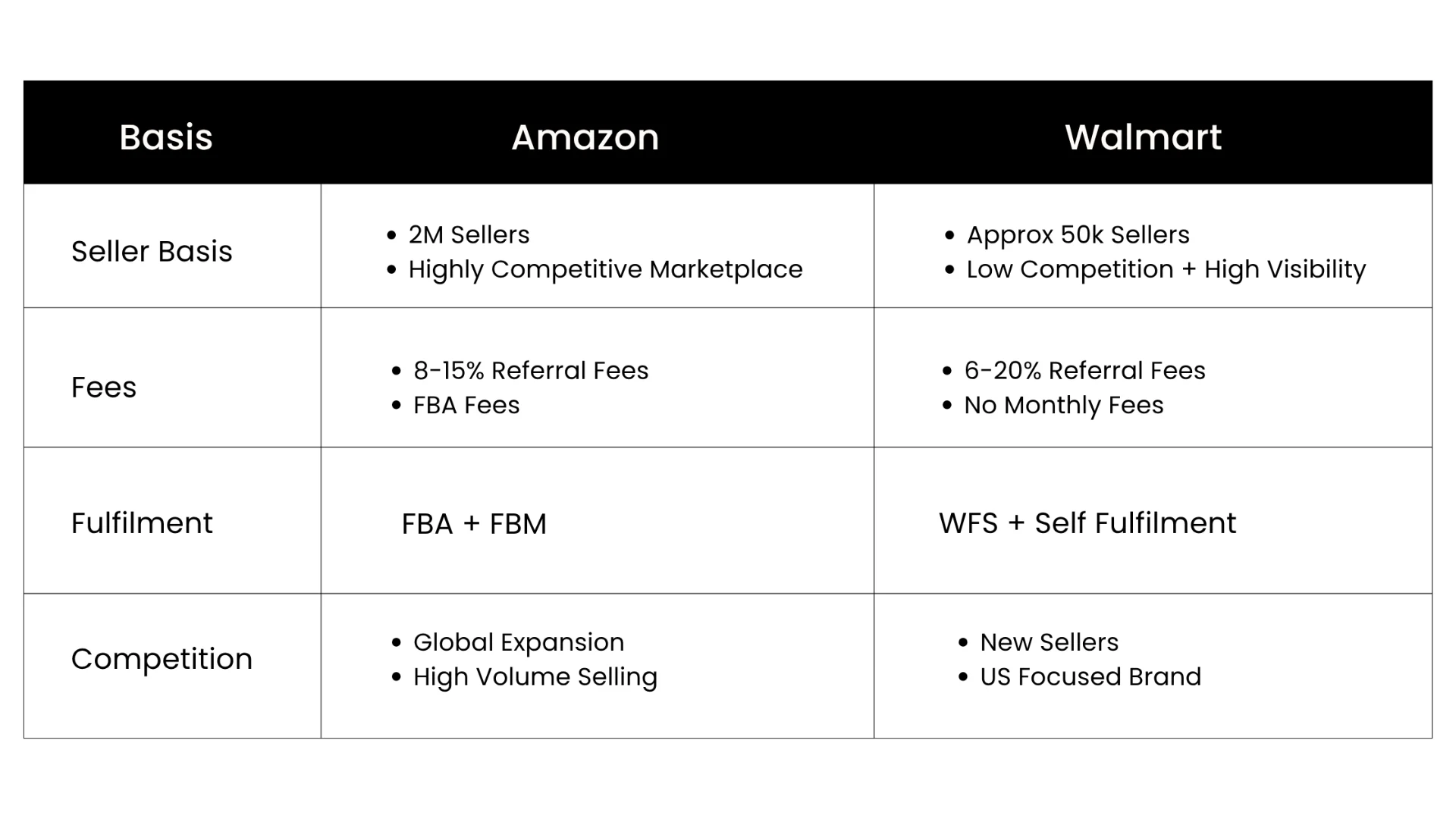
Amazon Marketplace hosts over 2 million active sellers competing for visibility among a global customer base. Success requires sharp strategies in keywords, competitive pricing, and marketing, as algorithm-driven search and the Buy Box intensify competition.
Walmart Marketplace has about 150,000 active sellers, far fewer than Amazon, creating more visibility opportunities. Backed by $82.1 billion in online sales and a strong retail presence, it offers sellers a growing platform with less intense competition.
Closing Fee: Sellers are charged approximately $1.80 per item for products sold in the categories: Books, DVDs, Music, Software & Computer/Video Games, Video Game Consoles, and Video Game Accessories.
Shipping / Fulfillment Fee: Paid by the seller to have their orders fulfilled through Amazon FBA, based on the order's size tier, maximum dimensions, and unit weight.
Weight Handling Fee: A separate, higher fee is charged by the sellers based on size and weight.
Storage Fees: Amazon charges storage fees based on product size and time of year, with higher rates typically applied during peak months (Q4).
Fulfillment Services Fees: Walmart charges fulfillment fees, which vary based on product size, weight, and handling requirements.
Selling Fees: Typically6% to 20% of the selling price, depending on the product category, paid by the merchants to get their items sold on the platform.
Storage Fees: Walmart charges monthly storage fees based on inventory size and duration. Fees typically increase during peak seasons (Q4), and additional charges may apply for inventory stored for extended periods.
Big & bulky fulfillment fee: For big and bulky products, sellers need to pay an oversized or heavy items fee, depending on weight and dimensions
Advertising Costs: Walmart advertising runs on a cost-per-click model with no monthly fees. Campaign costs usually vary by product category, competition, and bidding strategy.
Traffic and Customer Reach
Amazon
Walmart
Amazon generated $574.79 billion in total revenue in 2023, with a significant portion from eCommerce. Holding around 37%–48% of U.S. online sales, Amazon’s dominance highlights its unmatched scale and continued expansion in global retail markets.
Walmart earned $611.3 billion in 2023, surpassing Amazon's overall revenue, yet Amazon dominates online sales. Walmart’s strength lies in its large physical store network and growing e-commerce, now estimated 6%–7% range of U.S. online sales.
Fulfillment Services
Amazon
Walmart
Amazon offers two fulfillment options: Fulfillment by Amazon (FBA) and Fulfillment by Merchant (FBM). FBA provides Prime eligibility, better visibility, and Amazon-handled logistics, while FBM allows sellers to manage shipping and customer service independently.
Walmart Marketplace offers two fulfillment options: Walmart Fulfillment Services (WFS) for established sellers and self-fulfillment for newcomers. Sellers benefit from Walmart+ perks like free same-day grocery delivery, plus free two-day shipping on orders over $35 without membership.
Customer Trust and Shopping Behavior
Amazon
Walmart
Amazon is largely trusted for efficiency, a wide variety of products, and a technologically sound customer experience. Their fast delivery and wide customer reach are their USP, giving them an edge over other sales channels.
Walmart, on the other hand, is trusted for reliability, lower prices, and quality. Not every product and seller is eligible to sell on the sales platform. It has a really stringent set of criteria for approval.
Sellers Policies
Amazon
Walmart
Amazon enforces strict seller policies covering listings, pricing, and customer service. Merchants must meet performance standards like order defect rate under 1%, cancellations under 2.5%, and late shipments under 4% or risk penalties.
Walmart’s seller policies are simpler than Amazon’s, with clear pricing rules and performance targets: defect rate 0–2%, on-time shipments above 99%, and valid tracking over 95%. Walmart is more flexible in this way.
Advertising Opportunities
Amazon
Walmart
Sellers generally have to invest more into marketing and advertising while selling on the Amazon marketplace. Given the competition and massive listing. Apart from high marketing investment, sellers can also gain visibility with streamlined services and high product reviews.
Walmart offers strong brand visibility with rigorous application requirements. Advertising is less saturated, with only 1.6% of sellers running ads, though its first-price auction model makes campaigns more complex to manage.
The Final Verdict
As a new player in the online selling market, Walmart has kept the processes simpler and costs lower. While Amazon, because of its name in the industry, is charging higher, it is allowing the sellers to deliver in global marketplaces. Expansion is the plan for Walmart, but the current reality for Amazon. Small sellers based in the United States can stick to Walmart, while large enterprises aspiring to sell globally can use Amazon. Every small seller aspires to become large someday, and when that someday comes, they can integrate their business into an API-based integration tool for seamless selling across both sales channels. Because let’s be real, why not sell on both sales channels and get the best of two worlds? With the perfect integration application, sellers can seamlessly manage orders, inventory, tracking, and lot more. So, rather than choosing one, you can integrate them on a centralized dashboard for easier management and automated processing.
Grow your AliExpress sales while making the most of your existing Amazon inventory. WebBee connects your sales and fulfillment operations, helping you process orders smoothly and efficiently.
Start Free Access 🚀
Expand Your Business to AliExpress
One dashboard. Every marketplace. Total control.
You’re Now Part of the Growth Pass
You’ll receive an email shortly with your coupon code and links to all our
apps.


.webp)

.webp)


