
Introduction
For ages, digital commerce has gone through several stages of growth, from the acceleration of mobile to the rise of social commerce. In 2026, the next big thing, possibly the largest to date, is agentic AI transforming how users discover, compare & purchase products, and how they connect with brands.
This shift from traditional ecommerce to agentic commerce not only showcases how users shop, but also how sellers build their product data & customer journeys. There are 3 forces assisting AI and agentic commerce to grow mainly in 2026:
- User readiness led by habitual loyalty in suggestion algorithms & personal assistants.
- Growing LLM abilities that know preferences, settings, & constraints.
- New industry benchmarks that enable sellers, platforms & agents to interact.
This blog discovers the 6 most notable trends shaping the AI landscape in 2026.
What Is Agentic Commerce?
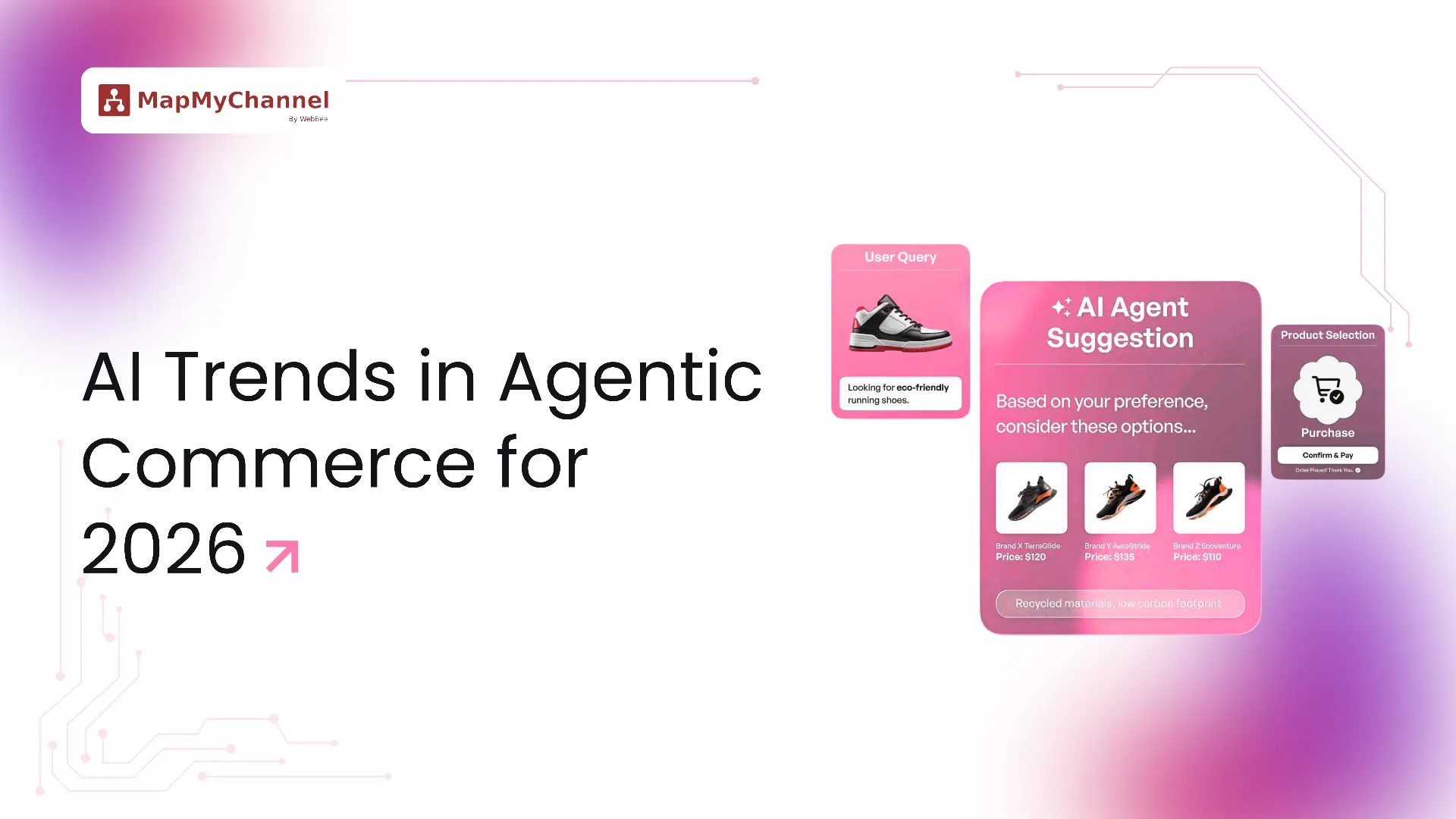
It is an approach in which AI agents represent users or businesses to discover, negotiate & complete purchases, mainly without human intervention. Unlike old e-commerce experiences, which require an individual to manually search for products, compare options, read feedback, & complete checkout gradually, agentic commerce moves much of that process to AI agents.
With this, AI-based shopping assistants anticipatorily collect requirements, scan different sellers in real time, verify items against consumer preferences & limitations, and make purchases on the user’s behalf. This simplified the process.
As autonomous AI systems become more capable, e-commerce is entering a new era where intelligent agents can analyze data, deliver personalized recommendations, generate insights, and automate purchasing decisions through generative AI.
Why Agentic AI Matters for Sellers and Businesses?
- Better User Experience: These AI agents offer immediate, clear, & customized user support by knowing context & handling complex interactions by themselves, enhancing response times from mins to sec.
- Scalability & Adaptability: Agents can quickly scale up to manage higher volumes of projects, making them perfect for growing firms that require to handle more users without a direct boost in overhead costs.
- Autonomous Workflows & Efficiency: It can decide & act across different systems utilizing APIs to do tasks, like managing inventory, or processing returns, saving time for strategic work.
6 AI Trends Driving Agentic Commerce (2026)
1. Rise of Generative AI Platforms in Commerce
Maybe the most prominent trend so far, AI platforms such as Perplexity, ChatGPT, & Gemini are shifting from being smart assistants to complete retail channels. This trend is mainly driven by a quick shift in user behavior. Shoppers easily identify that they can trust ChatGPT & Co. for:
- Product discovery
- Feature comparison
- Price optimization
- Task execution
2. Shift from Search to AI-Driven Product Discovery
Product discovery is shifting from keyword-based SEO to AI-powered suggestions. Despite just scrolling web pages, consumers ask AI to identify the right product depending on customized standards such as price, specifications, and reviews, making traditional SERP less relevant. Businesses should focus on optimizing product data for AI shopping agents to improve visibility in AI-driven commerce experiences.
The e-commerce experience of 2026 will be driven more by intelligent agents than manual browsing.
3. Structured Product Data as the Backbone of AI Commerce
AI agents don’t view visual merchandising; they explain structured data to equate products. So, top-notch, steady product data is important for AI to effectively analyze & suggest products for 2026.
4. AI in B2B Commerce
Agentic AI in B2B automates tough purchasing, inventory renewal, & invoice reconciliation. These agents can connect with vendor systems, handle supply chain procedures, & negotiate prices, going beyond basic automation to proactive purchasing. Autonomous B2B commerce is becoming a major competitive advantage as businesses increasingly adopt AI in e-commerce to transform operations.
The next generation of B2B commerce will be driven by AI agents that negotiate, purchase, and optimize in real time.
5. AI-Driven Autonomous Transactions
The ultimate objective of this is the zero-click checkout. They will handle the complete transaction flow, involving applying rewards, finding the best shipping choices, & tracking deliveries and restocking.
6. Security & Trust as Competitive Differentiators
As agents react on behalf of consumers & access critical financial data, strong governance is vital. Security & privacy controls are not only compliance needs but act as major differentiators; users will trust agents that showcase transparency & high ethical standards.
Real-World Use Cases of Agentic Commerce
Amazon(Rufus AI Shopping Assistant)
In Feb 2024, Amazon launched Rufus, an AI-powered shopping assistant implanted in the Amazon application. Trained on Amazon’s wide product catalog, user reviews, Q&As, Rufus answers free-form inquiries, compares items, & refines suggestions via multi-turn exchange, bringing ChatGPT to retail. It helps users to shorten product-discovery time, lessen decision fatigue, & provide confidence via transparent comparisons.
Walmart (Leveraging AI, GenAI for seller)
Users crave customized shopping experiences, with customization as a core enabler. Walmart has built a Content Decision Platform, matched with its Digital Trust Commitments & Responsible AI Pledge, that acts as a foundational tool to make shopping experiences customized to the individual user. The platform utilizes AI-based technology to know the user & a GenAI-based tool that can evaluate the kind of content they would like to view on the site.
Conclusion
Agentic commerce showcases more than a gradual change in digital e-commerce approach. It signals a move toward Online-mediated transactions, where AI systems boost participation in forecasting & executing purchases. Firms that prepare this groundwork will be the ones AI systems can firmly transact with.
Ready to future-proof your business with Artificial Intelligence? Contact MapMyChannel today to stay updated on the latest AI innovations and commerce trends.
Get in Touch

.webp)

.webp)


