
In today’s world, where there are multiple sales channels for sellers to list their products on, there is no point in sticking to just one. But managing multiple marketplaces can be a pain in the head. This is where marketplace integration comes into play; it brings together multiple sales platforms to streamline the selling process for business owners. In fact, “multichannel ecommerce growth statistics” show that brands selling across multiple platforms experience significantly higher growth and revenue. This blog aims to educate you on multichannel selling through marketplace integrations. From Why to How, know everything you want to know about ecommerce marketplace integration.
Marketplace Integration for Seller Support
Marketplace integration is the process of strategically integrating your online store with other ecommerce marketplaces like Amazon, eBay, Walmart, etc. Marketplace connection allows you to streamline your backend operations and automate several procedures rather than managing each platform independently. With this, listings in several marketplaces are managed by a centralized dashboard. Also, order information, prices, descriptions, and stock are all quickly updated across platforms. Companies that use integrations grow more quickly and require less work to reach a larger consumer base.
Most Enticing Use Cases
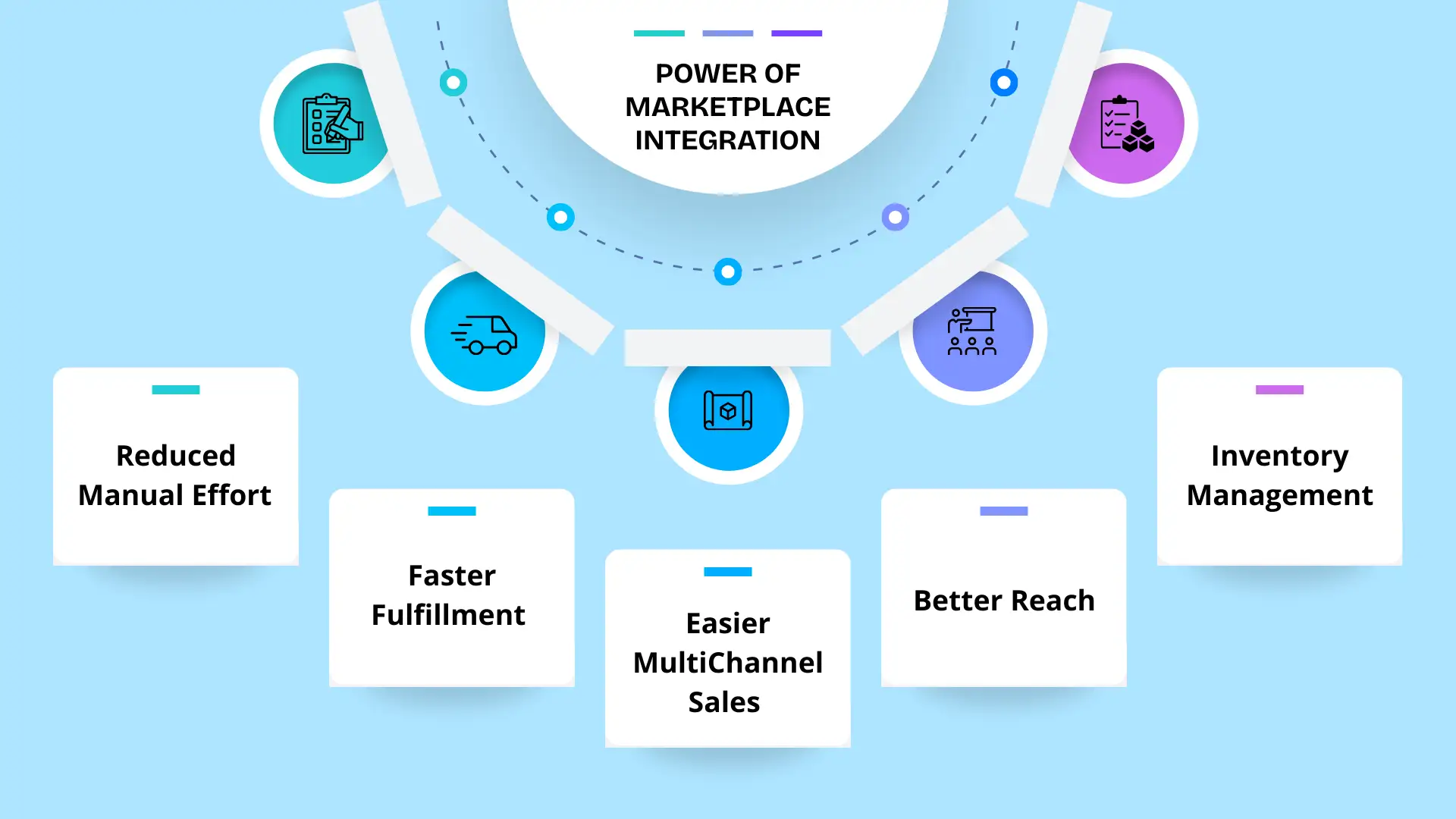
Multichannel sellers get multiple advantages of marketplace integration that benefit the growth of the business. Here’s a brief view of them:
Inventory Management
When selling is done on multiple platforms, the management of inventory is the most difficult task executed by the sellers. Apart from this, mistakes with inventory records can lead to major business loss. With a streamlined online ecommerce system, sellers can manage their stock efficiently without having to switch websites. Also, different warehouses can be interlinked for fulfillment after webstore integration.
Product Listing
Listing the same product on various sales channels is not just tiring but also wastes time. This increases the chances of errors by the seller. As sellers integrate these different channels, listing can be simplified as the product posted on a certain webpage can directly be placed on all the integrated channels for easier and time-efficient execution. This gives the brand much-needed consistency for customer recognition.
Automated Order Fulfillment
Order fulfillment is the trickiest part of online and selling on multiple platforms can create fuss for sellers if the channels are not integrated. Integrations support seamless multichannel fulfillment along with centralized order management. Sellers can find all their orders in progress and on the verge of fulfillment together on the dashboard. Also, most of these operations are automated with linkage, making the process further simpler.
Price, Discounts, and Data Sync
Making changes to these web stores is difficult on its own, and doing the same on multiple platforms further complicates the process. Connecting all of them together allows the seller to make changes on just one channel and reflect the same on all others. This not only saves time but also allows the seller to keep up with the competition. The real time sync allows them to further acknowledge the evolving markets of the world.
Insights & Reports
Data and analytical reports enable the sellers to make decisions that are not just viable but also come with assured results to some extent. With integration tools, sellers can analyse cross-channel sales performance, profit margins, demand for the future, and overall business performance. In totality, they will get all the necessary data that is required for a seller to grow their business.
Sales Growth
When sales channels are not integrated, the seller is just busy handling them, going in different directions. With streamlined operations and automation achieved from sales channel integration, customer satisfaction is assured. With that comes improvement in sales and revenue growth. The seller just has to focus on the business implementation and not divert their energy in multiple directions, leading to revolutionary changes.
How to Implement
Knowing the benefits of integrating various web stores, sellers would want to implement this in their business as soon as possible. Here’s how you can do it:
Select the Marketplaces
The right marketplace is the one where sellers can find their customers. For that, ecommerce business owners need to conduct a bit of research and study the choice of their target audience. Followed by the same, they can list themselves on the online store or marketplace to integrate different channels for better reach and higher sales volume.
Select the Software
The right plug-in software is the key to better business integration. The right software is the one that allows the sellers to sync different ecommerce channels together effortlessly with features like:
- Inventory Management for easier stock maintenance.
- Automated Order Management for streamlined order fulfillment
- Notification and Tracking to update the seller with the order status
- Hold Orders to allow the customer to make changes to the orders
- Data and Analytics that allow sellers to have useful insights into the business
- 3PL Integration to allow sellers to outsource deliveries
- Centralized Dashboard to enable the seller to manage the business effortlessly
MapMyChannel is the ultimate application that comes with all the above-mentioned features. It allows the seller to fulfill the orders via automation and boost business growth through increased sales. As sellers do not have to worry about orders or inventory and they are focused on business performance only.
Connecting Marketplaces
Finally, when the selection of both integration applications and sales channels is done, the integration part is left. With MapMyChannel, this step is really easy to execute:
Step 1: Sign Up with MapMyChannel
Step 2: Sign in with MapMyChannel Account
Step 3: Connect Your Sales Channels
Step 4 (Advised): Connect Your ERP/Fulfillment Partner
As simple as that, sellers can bring revolutionary changes to their business with simple integration software. It is smartly designed, only to cater to the needs of ecommerce business owners.
Marketplace Integration Supporting Business Growth
Marketplace integration brings the much-needed smoothness to business operations. Sellers get support and hence are able to realize the business potential. Also, they are able to bring in expert help and automation, which is the need of the hour and not just another ‘good-to-have’ feature. Now, you are well-equipped with the information required to integrate the marketplaces, from channel requirements to the perfect integration solution. So go ahead and integrate using MapMyChannel.
Get in Touch

.webp)

.webp)


