
The year is approaching its end, but the sale season is yet to start. With the sale season comes the pressure; everything around the business seems like a pile of mess. The orders drop in faster, fulfillment delays are frequent, and customers are stressed on level nine. This pressure is not just overwhelming but also harmful to the brand image. Also, the business might lose its chance to grab new customers. To sum up this issue real quick, sellers might have to face major repercussions if the peak season order fulfillment is not put in place. Well, experts in the house have a solution for everything, and this is just one of those issues. So, let’s explore how sellers can avoid fulfillment chaos with holiday fulfillment planning.
Understanding Peak Season Order Fulfillment
The fulfillment process starts with order placement, which goes through steps like inventory check, order confirmation, picking, packing, and then finally the shipment happens. Though this process is summed up in a sentence here, it is an elaborate process of like ten steps. During peak season, when orders are not dropping but raining, sellers do not have time to follow this elaborate process.
Manual processing leads to more errors, inaccuracies, and simply adds burden on the sole owner of the business. Hence, quality is compromised under the pressure of eCommerce logistics in peak demand. As a result, the customers are unsatisfied and the brand image is diminished. Sellers need a foolproof solution for this issue, which you will be able to figure out in the following section.
Strategies for the Peak Season Fulfillment Coming Up
You must know the strategy to cross them all effortlessly through the perfect strategy. Here’s what you need to do:
1. Integrate the Business with 3PL
Third-party logistics is the ultimate way to go when the order volume is high and fulfillment operations go out of hand. The eCommerce fulfillment partner will simply make sure the process goes smoothly, with accuracy. Also, fulfillment partners hold the expertise and technology to handle larger volumes efficiently. Not just delivery, the right 3PL partner carries out the reverse logistics effectively.
2. Distribute the Inventory
Right inventory distribution among warehouses is essential for cutting delivery times and improving peak season fulfillment efficiency. Place goods closer to areas with the greatest demand if you have several warehouses. This will speed delivery and reduce logistics expenses. Also, inventory management for peak season needs to be managed through 3PL integration.
3. Supply Chain Management
Make sure that your supplier prioritizes the fulfillment of your orders so the business and its customers do not have to suffer. Also, the supplier must be well-prepared for a hike in demand. In case a single supplier cannot do all this, have an alternative on stand-by so you have your stock on time.
4. Automate Order Processing
The best way to make sure that orders are processed efficiently is to automate the same. The orders can simply be placed and passed on to the fulfillment partner without the seller having to put any effort. So, the challenge of human intervention and inaccuracies will be sorted. Also, good automation software comes with inventory management and data analytics support. Allowing the seller to do it all in one place.
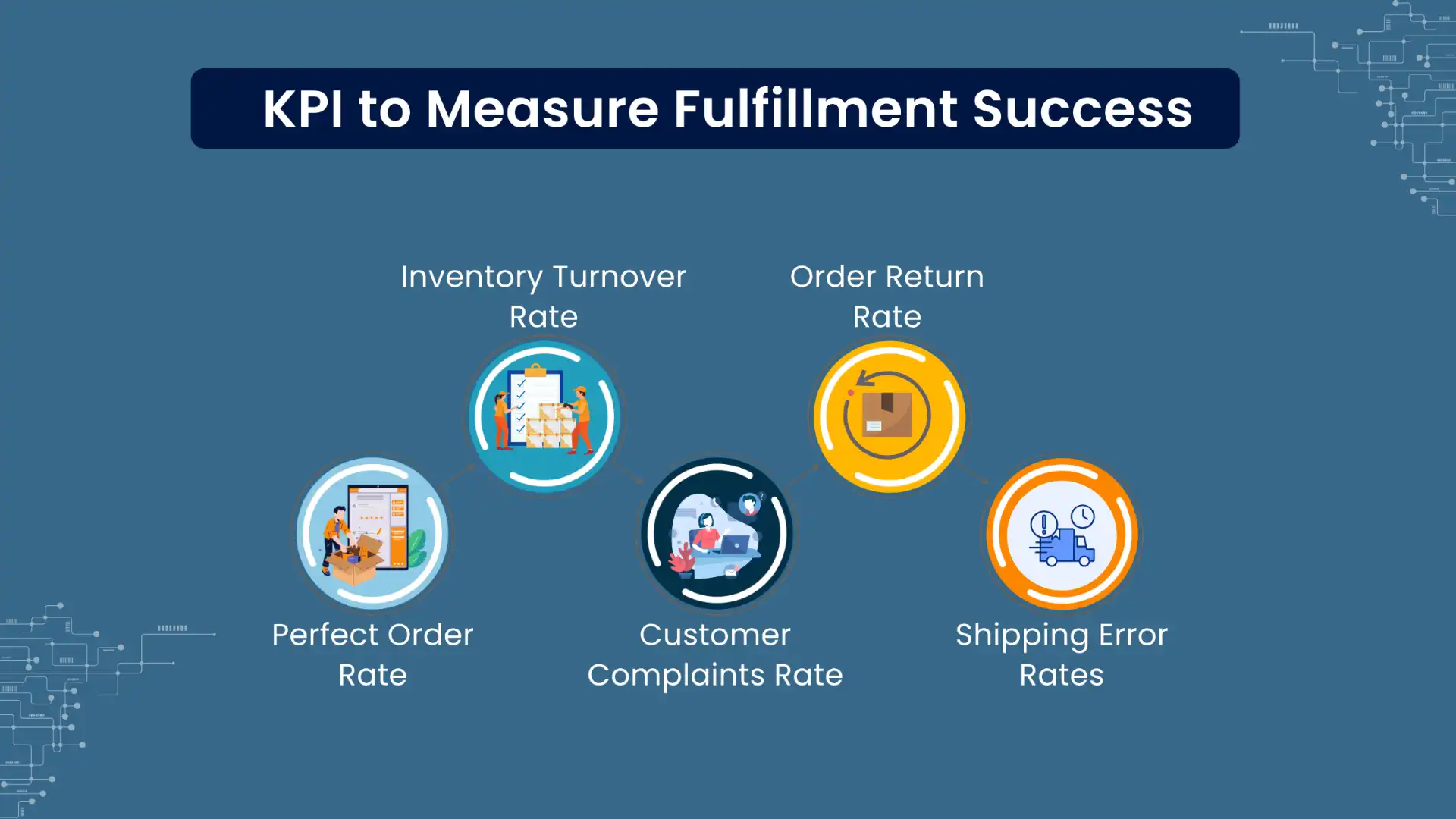
Key Metrics to Measure Fulfillment Successfully
Once the seller applies all the above-mentioned strategies, they need to analyze if the same is effective for the business. For that, here are the ecommerce fulfillment KPI which can be used to know if the fulfillment is being carried out successfully:
1. Order Accuracy Rate
This is the rate at which the orders get delivered to their respective consumers without any kind of discrepancy. Repeated mistakes with order fulfillment bring down customer image and hence maintaining this is much more important than one might think. The Calculation goes like:
2. Order Fulfillment Speed
The speed at which a seller is able to deliver its orders affects not just customer satisfaction but also the overall conversion rate. In today’s world, speed is the key to winning customers, this formula should be on your tips:
3. Inventory Turnover Rate
The rate at which a seller can clear its stock is known as the inventory turnover rate. It gives the seller insight into the stock management and the accuracy of demand forecasting. Hence, sellers are not left with dead stock and have better knowledge of when to restock. Here’s the formula:
4. Pick and Pack Accuracy
With pick and pack accuracy, sellers get to know if the right products are being packed for shipment. This metric protects sellers from expensive logistics mistakes and customer dissatisfaction. The better the rating, the higher the accuracy. Here’s the calculation method:
5. Cost Per Order
This particular KPI holds special importance as the seller gets to analyze the cost of processing an order. The higher the cost per order, the lower the profit margin. If this is higher than a limit, then sellers need to work towards lowering this cost. The calculation goes like:
Common Roadblocks During Peak Demand Fulfillment
There are some common challenges during peak season fulfillment that need to be highlighted in the blog. Here goes the list:
1. Inventory Updates
While there are a number of orders going away and some of them are also coming back, keeping a track of the inventory feels impossible. This leads to loss of product or even sales, in case the item goes out of stock without knowledge of the seller.
2. Limited Storage Space
With the onset of the sale season, sellers want to stock up their warehouse or storage space. But there are cases where sellers can't do the same due to a lack of space. In this case, they have to depend on the efficiency of the supplier, which again is very low in the peak demand season.
3. Demand Forecasting
For a smooth holiday season, demand forecasting is the only way to go. Once the seller has an estimate of the demand, they can prepare the business for the same in terms of inventory, manpower, or supporting tools.
4. Manual Processing
Human intervention makes the fulfillment and other business operations slow. With slow processing, the workload increases, and the chances for errors tend to increase. Slightest errors can lead to massive problems.
5. Fulfillment Pressure
The pressure to fulfill every order on time, with accuracy, is real. The volume of orders might be ten times, so the speed and efficiency of the business have to keep up with the same speed without fail.
6. Unsatisfied Customers
While everything is mismanaged and operations in the business are falling out of place, the service coming from the business can not match the customer expectations. This leaves them unsatisfied, and they might not want to come back.
Final Words…
Buckle up for the coming holiday season with the right ecommerce tools and automation support so nothing holds you back from getting the highest profits, better returns on investment, and a much wider consumer reach. Let the holiday season bring happiness to both sellers and consumers this year. Let go of the stress of fulfillment and choose the perfect integration partner that gives way for Multichannel eCommerce Fulfillment, so your business takes a boom this season.
Get in Touch

.webp)

.webp)


