
Introduction
Within the e-commerce ecosystem, the journey to provide an order to your customers comprises several processes. The customer experience is primarily focused on when their orders will arrive; however, businesses have to manage many different areas, namely, Inventory management, order preparation and processing, shipping, and final delivery of the goods to their end-users.
Understanding the distinction between shipping and delivery helps businesses optimize their order fulfillment, minimize lead times, and improve the customer experience.
What Is Shipping?
Shipping is the process of packaging and transporting an order from the seller’s store location, warehouse, or fulfillment center to the customer's address. This stage starts when the order is packed and released for shipment to a courier partner or logistics provider.
Simply put, shipping begins when your order starts moving. It is an order fulfillment stage that includes packing, labeling, carrier shipping, transportation, and shipment tracking.
Types of Ecommerce Shipping
Today's ecommerce companies offer several options to choose from, depending on the customer's requirements and products.
However, sellers must consider not only the speed but also the cost and reliability for effective ecommerce shipping.
How Shipping Fits Into the Ecommerce Fulfillment Process?
Shipping plays a vital role in the entire fulfillment process. It is the interface between product availability, the warehouse facility, third-party carriers, and the customer’s expected delivery times. Below are the usual steps that constitute a shipping workflow:
- Receiving customer orders
- Checking inventory availability
- Picking and packing products
- Generating shipping labels
- Assigning courier partners
- Tracking shipment movement
- Updating customers about order status
For brands selling on websites, various online marketplaces, and social commerce, the availability of adequate stock in the inventory module is paramount to avoid over-selling. Utilizing Multi-Channel Inventory Management ensures that changes in inventory levels on one channel are reflected on all other connected channels.
What Is Delivery?
Delivery is the final handover stage between the logistics company and the customer, ending when a shipment finally reaches a customer at the specified shipping address. It starts from where the package is loaded into a local delivery network and ends when the product is delivered to the customer.
For instance, a package reaches a distribution center from the warehouse via a courier company. The package is then picked up by delivery personnel, who are in charge of last-mile or local delivery, and eventually hands it over to the client at their delivery address.
Importance of Delivery in Ecommerce
Customers today expect:
- Accurate delivery estimates
- Real-time order tracking
- Flexible delivery options
- Fast and reliable service
- Clear communication about delays
The business may have the best products, the most effective order-placing system, and yet the customer might leave with a bitter experience if the delivery is late or erratic.
Factors That Impact Delivery Performance
Find below the factors affecting order fulfillment speed:
1. Delivery Location and Distance
Local deliveries are often faster than out of state, but within country or international ones.
2. Inventory Availability
A product might be in demand, but with inadequate inventory planning, your eCommerce store could leave the consumer waiting while they sort out stock. Ecommerce Inventory Management solutions keep real-time track of stock levels so you can pack orders quickly.
3. Logistics Partner
The speed of the courier partner, range of services offered, and how they handle the package can impact your eCommerce fulfillment.
4. Order Volume
At times like festivals or sale periods, your business will get overloaded with a huge volume of orders. Your organization should have processes capable of fulfilling such a massive volume using the help of inventory automation & ecommerce automation.
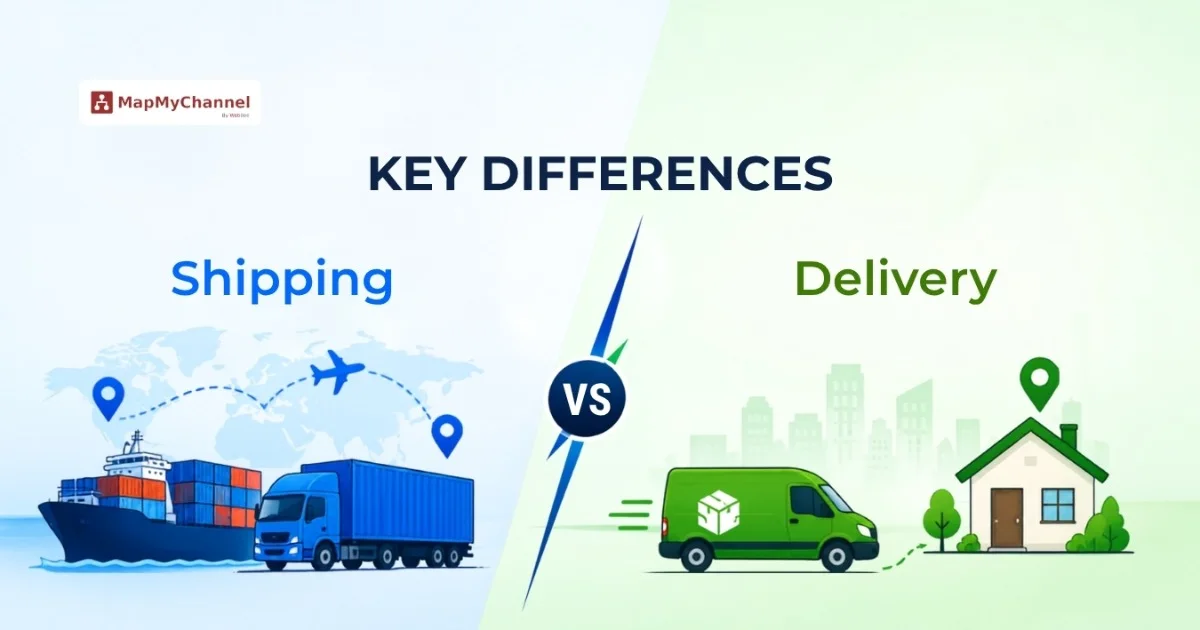
Shipping vs Delivery: Key Differences
Although shipping and delivery are connected, they represent different stages of the ecommerce logistics process.
Shipping vs Delivery: Why the Difference Matters for Businesses
Recognizing shipping vs delivery helps you identify the particular point at which bottlenecks can happen in your logistics.
If it appears that an order is being delayed in the warehouse before being “shipped,” it might be due to Inventory, packing, or shipping problems. It is also possible that the local distribution center has received the delivery order and the item has not yet been marked for “out-for-delivery,” which indicates a possible delivery issue.
All of this helps your e-commerce store make more strategic business decisions to increase efficiency in shipping and delivery processes.
How Shipping and Delivery Work Together in Ecommerce Fulfillment
Shipping and delivery are the final two steps in the eCommerce logistics process. Shipping is all about getting the package to the destination, and delivery refers to the customer ultimately receiving the eCommerce store’s order. Let’s quickly walk through a sample eCommerce order process:
Order Placement → Inventory Check → Order Processing → Packing → Shipping → Transportation → Local Distribution → Delivery → Customer Confirmation
When a customer orders a product from an eCommerce business, their order is processed through the order management system. If the product is available, it goes through the picking and packing process and is passed to a shipping partner. This partner then handles the transportation phase of shipping.
Managing shipping and delivery manually can be challenging as order-increasing businesses. Hence, e-commerce businesses use a multichannel order management system that integrates the entire process to monitor orders from multiple sources, automate their workflows, and monitor shipments through a centralized dashboard.
The Role of Technology in Shipping and Delivery
Today, the use of automation is critical for ecommerce brands to achieve good logistics performance. As order volumes increase and more channels are used to sell goods, manual order management processes can lead to inventory inaccuracies, shipping delays, and poor customer communication. Technology enables companies to improve:
- Order accuracy
- Inventory management
- Shipment monitoring
- Customer communication
- Warehouse management
- Delivery performance
Benefits of automation can be seen when an ecommerce business selling on marketplaces, its own ecommerce site, or social selling, chooses multichannel ecommerce integration. All these channels can be integrated so that orders can be taken, stock can be updated, or shipping information is shared through one platform.
Businesses can connect to an order fulfillment center via 3PL integration to automatically create shipping labels and view shipment status.
How to Optimize Shipping and Delivery for Your Business?
Optimizing shipping and delivery results in happy customers and reduced operational costs. It is important to establish a seamless logistics system in which stock, orders, and delivery are managed collectively.
1. Improve Inventory Management
Accurate inventory information establishes an effective order fulfillment process. If you do not have access to live stock levels or to receive and fulfill orders for which you're out of stock, you will experience delays and order cancellations. Utilize an Inventory Management solution to gain control over your stock position, track stock movement, and achieve precise inventory reporting.
For multi-channel sellers, Multi-Channel Inventory Management provides you with complete control over your stock by integrating inventory data in all online and retail outlets:
- Minimize overselling
- Enhance inventory planning
- Accelerate order delivery
- Enhance customer experience
2. Automate Order Processing
As your online store scales, you can't keep track of each order manually. Automated order processing handles functions like order confirmation, invoicing, inventory updates, and shipments. Your ecommerce automation tool can help you process orders faster, reduce human error, decrease lead time, and handle higher volumes, especially during peak sales periods.
3. Real-Time Order Tracking
Customer satisfaction does not end with placing an order. Customers often want to track their order's ongoing journey; an accurate order-tracking facility helps to reduce support inquiries and create a sense of trust by providing real-time access to Order confirmation, delivery progress, estimated delivery date, and delivery information.
Using a system for e-commerce may also facilitate the direct retrieval of order and customer data, providing you with real-time, actionable information about sales trends, inventory, and customer buying behavior.
4. Reduce Packaging and Shipping Costs
Shipping costs can easily impact your bottom line, so you should investigate packaging designs, shipping policies, and prices from the numerous logistics companies you can work with. Some common strategies for optimizing your supply chain to reduce shipping costs are:
- Use appropriate shipping box sizes and fill them appropriately
- Compare rates of various logistics suppliers.
- Choose delivery methods that suit your customer expectations.
- Minimize the handling stages of the package.
5. Partner with Quality Logistics Providers
The quality of your logistics partners has a bearing on delivery speed, reach, and overall customer experience. Look into these factors when selecting a logistics partner:
- Delivery dependability
- Geographic coverage
- Technology enablement
- Tracking functionality
- Return service support
If your business outsources part of your fulfillment process, you can facilitate tracking across warehouses, shipments, and customer orders by integrating 3PL.
Best Practices for Managing Shipping and Delivery
A balance between the right technology, solid planning, and constant optimization is needed to manage inventory visibility for businesses effectively. Here are a few tips for ecommerce businesses to build a trustworthy logistics operation.
1. Maintain Real-Time Inventory Synchronization
Any mismatch of inventory on different sales channels will inevitably create delays in order fulfillment. Inventory sync can enable a business to avoid overselling or delays in fulfilling orders.
2. Build Centralized Operation Dashboard
Managing multiple marketplaces makes your ecommerce operations complicated. By building a centralized dashboard, your brand can track:
- Order status
- Monitor inventory movement
- Analyze sales performance
- Detect operational roadblocks
- Improve decision-making
This can be especially helpful in multichannel order management.
3. Enhance Customer Communication
Effective delivery goes well with adequate message notification. Businesses should provide updates at all important stages:
- Order Confirmation
- Dispatch email
- Delivery in Progress
- Successfully Delivered
Transparent updates in the fulfillment process help build customer trust and brand reputation.
4. Analyze Shipping Performance
Businesses utilize data-driven decision-making to optimize shipping, and ecommerce brands that consistently monitor key shipping and order fulfillment metrics such as 3 can better manage and improve their processes. Ecommerce fulfillment metrics that must be analyzed:
- Average delivery time
- Shipping costs
- Order accuracy
- Return rates
By tracking these figures, companies develop more actionable plans for enhancing their ecommerce fulfillment processes.
5. Plan for Seasonal Demand
Retailers preparing for sales events, holidays, or promotional campaigns should establish methods to support periods of heavy demand. Businesses should prepare by:
- Maintaining sufficient inventory
- Automating order workflows
- Increasing warehouse capacity
- Coordinating with logistics partners
Conclusion
Shipping and delivery are closely intertwined components of the eCommerce ecosystem. Each one is responsible for a discrete area of the fulfillment lifecycle. Shipping deals with product movement, while delivery focuses on the final leg of the customer experience. To achieve swift and dependable fulfillment for your customers, be sure to focus on streamlining inventory, automating logistics, and real-time order tracking.
Optimizing their shipping and delivery is a top priority for any forward-thinking eCommerce brand and a must for scaling your supply chain.
.webp)
Frequently Asked Questions
1. What is the difference between shipping and delivery?
Shipping relates to the movement of goods from the merchant or warehouse to the destination, while delivery relates to the ultimate endpoint of the product reaching the customer.
2. How can ecommerce businesses improve shipping and delivery?
Ways of improving shipping and delivery include the use of automation, reporting of performance, integration of logistics partners, more accurate inventory management, and improved order tracking.
3. What role does inventory management play in ecommerce shipping?
Inventory management ensures products are available when requested by the customer, therefore avoiding stock issues, increasing the speed of fulfillment, and adding value to ecommerce operations.
4. How does automation help with order fulfillment?
Automation removes manual management of a range of repetitive activities such as order capturing and processing, updating inventory levels, creating shipments and notifying customers.
5. What is the benefit of using a multichannel order management system?
A multichannel order management system allows for the management of order levels, inventory levels, and shipment information across multiple sales channels in one system.
Get in Touch

.webp)
.webp)


