
Introduction
Choosing to purchase products online can influence purchasing decisions; An immediately visible product price at checkout plays an important role on whether a customer buys the item now, later, or opts for a lower priced model. Flexible payment options such as Flipkart Pay Later can change how customers approach these decisions.
Introduced via PayU Finance and integrated into the Flipkart checkout experience, Flipkart Pay Later offers eligible users an alternative to pay later – with a few different options available for the settlement.
The key question for sellers is how this added payment flexibility can influence conversion rates, order volumes and average order values. This blog explores this new Flipkart feature to answer the above question.
What Is Flipkart Pay Later?
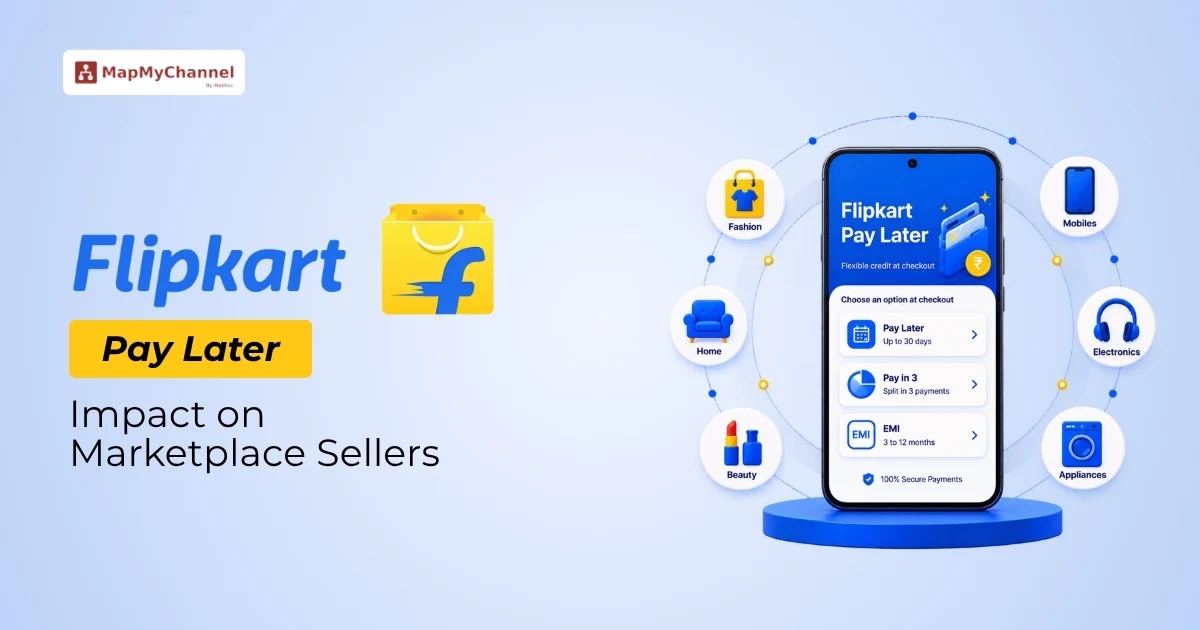
Flipkart Pay Later is a credit based payment option which has been rolled out to eligible customer. It allows customers to defer the full payment towards their purchases using various repayment options. As per Flipkart, with the offering, customers will have access to 3 repayment alternatives:
- Pay Later - Eligible purchases can be paid off up to 30 days.
- Pay in 3 - Purchase cost split into 3 equal payments.
- EMI Plans - Repaid over 3-12 months eligible for higher value purchases.
These offers are suitable for both everyday shopping and planned purchases across multiple categories-fashion, home, beauty, general merchandise, and Flipkart Minutes; EMI options would however apply only on select higher value purchases.
What sellers need to keep in mind is that Flipkart Pay Later is not credit being extended by sellers but is a customer payment option.
How Does Flipkart Pay Later Work?
Flipkart Pay Later is a part of the customer’s checkout journey. If they are eligible for a loan option with EMI, customers may choose it as part of their transaction.
- As part of the transaction, Flipkart’s commerce intelligence along with the customer's transaction history, purchase history, platform behavior combine with the lending and risk management capabilities of PayU Finance. This combination determines the financing options that are available to the customer.
- PayU Finance is the lending partner and Flipkart Finance manages the customer and credit intelligence. From a seller's perspective, the impact is indirect:
Flexible payment → less upfront-cost hesitation → potentially more completed purchases.
For example, If a customer is looking to buy a ₹30,000 refrigerator, the product in itself has already been identified by them; however for ₹30,000 might be too big an amount to be paid out in one go. A loan option could help facilitate the payment. The seller isn’t extending a ₹30,000 loan to the customer. The customer gets the loan from the applicable financing provider. The seller is simply on the marketplace and fulfills the order under seller terms for this purchase.
Why Could It Matter to Flipkart Sellers?
The availability of new Flipkart payment options might even affect a customer’s purchasing behavior, most evidently with products where initial price cost is a genuine factor:
1. Higher Conversion Rates
Some customers may hesitate to purchase because they are unwilling to pay the full price upfront; this is something Flexible Pay could help the customer with.
For example, If say a customer is trying to buy a 12,000 rupee smartphone and decide that paying in installments will work for them rather than paying the full amount up front.If other parameters such as quality of product listing, price, reviews, delivery speed are already approved by the customer then this factor alone could push them from considering a purchase to completing the purchase.
2. Higher Average Order Value
Flexible payment terms may also encourage customers to purchase high value products. For instance, a customer deciding between ₹20,000 and ₹30,000-priced appliances, may choose the latter if there is a viable repayment channel for it, the appliance has higher user ratings or superior features.
Sellers should analyze the average order values before and after introduction of the feature.
3. Increased Order Volumes
Buy Now, Pay Later by Flipkart should not be considered a sales enhancement drive. This update might increase ordering volume for sellers as eligible customers buy what they might have deferred, but demand will still largely be determined by product interest, availability, visibility, price, vendor efficiency etc.
4. Stronger Competition Among Sellers
Expanding payment options provides a new basis for customers to consider the seller competition in a marketplace. Buyers have a growing number of factors to compare one listing to another, such as price, reviews, shipping duration, quality, availability, discounts and payment terms, in order to decide between similar items.
Thus, sellers still have to focus on the basics rather than relying on this update alone.
Which Sellers May Benefit Most?
The effect will probably vary by category. Higher-priced category items might benefit more, as systematic payment repayment plans can make expensive items easier to digest. Mobiles, electronics, home & appliances and furniture seem the most pertinent in terms of Flipkart's updated EMI deal. Products with good listings would likely do better too - once the hurdle of direct payments is cleared, a product which already interests buyers via reviews or strong descriptions might sell better.
Now that the barrier to upfront costs has come down, a seller listing a television at ₹25,000 may fare better than another with a slightly lower price but lower customer reviews along with inconsistent fulfilment of delivery and payment. Sellers with robust supply and fulfillment processes should position themselves favourably to absorb any spike in order traffic.
Possible Risks for Sellers
1. Returns and Cancellations
More complete orders are not necessarily more profitable ones. Sellers should closely monitor return and cancellation rates, especially for high demand SKUs. The impact of a return is particularly significant for higher-priced goods, as each return can affect working capital and inventory.
2. Cash-Flow Uncertainty
This increased order volume could also result in higher storage or fulfillment costs for sellers. Sellers should not assume that a customer's EMI plan determines how quickly they will receive their seller payment.
Therefore, sellers should not assume that a customer’s 3-month EMI is synonymous with a 3-month seller settlement period, and should consult the Flipkart seller settlement terms and order status report to ascertain how – and when – the amount will be received into their account after factoring in returns, refund, fees and other applicable deductions.
3. Settlement Cycle
Sellers should review settlement reports for order value, fees, refunds, returns, deductions, net settlement amounts, and settlement dates.
The launch of a customer credit option should not automatically be interpreted as a change to seller settlement cycles. Any unexpected difference should be verified through Flipkart's seller documentation or support channels.
What Should Sellers Do Now?
Implement these Flipkart seller guidelines that allow heterogeneity in results amongst different businesses:
Sellers should take a data-driven approach and adjust their actions based on their individual products, customers, and performance.
- Keep an active inventory of products: Monitor high demand and, if applicable, higher-cost goods like fast-moving items. Inventory Management will be key for SKUs that gain demand frequently.
- Monitor High-Demand SKUs: Monitor impressions, clicks to your product page, rates of conversion, order amounts, average order value, and returned product numbers.
Example: If you sell a ₹15,000 appliance on the platform, track how many orders it received week after week after Pay Later possibly entered the calculation for your client. Thus, proof rather than estimations can guide a seller's decisions.
- Track Pay Later-Related Order Trends : If you're able to access payment transaction data, monitor changes in higher-value orders, orders frequency and avg order value changes. The idea behind this is to see if the payment option is really attracting a new audience to you.
- Ensure Fulfillment Operations Can Scale : If your orders volume increases, so may increase as well. Review stock allocation, packing, shipment process, logistics handling, customer service and refunds. Sellers should also ensure that their order management processes can handle increased demand without affecting fulfillment speed or customer experience.
- Review Return and Refund Processes : Make sure your team can also handle additional returns and reimbursements without delays or added workload for existing employees. Keep an eye on highly valued and easily returned goods.
- Verify Settlements and Deductions : Check your reconciliation reports and don’t rely on estimates for your Pay Later settlement. Study how your values for order, deduction, refund and nets settlement compare to your current situation.
Conclusion
For customers, the Flipkart Pay Later feature is important because it impacts the buying journey on Flipkart from the customer’s perspective, enabling more purchase choices at the point of checkout for those customers who are eligible for this feature.
For sellers, the importance of the launch lies in the potential impact of this choice-making power on consumer purchasing behavior, and particularly for those with higher ASP (Average Selling Price) products.
Sellers shouldn’t assume Flipkart Pay Later will immediately or directly increase Flipkart sales-and must look for actual, quantifiable impact. This can be achieved through a healthy, well-stocked inventory, closely monitoring high demand SKUs, managing their Flipkart order management process, and examining returns and settlements.
FAQs
Is Flipkart Pay Later available to every customer?
No, the eligibility criteria can differ. Flipkart states its credit decisions are based on transaction history, purchase behaviour, usage on the platform, and also responsible underwriting practices.
Does Flipkart Pay Later guarantee more orders for sellers?
No, it might improve payment friction for select customers but in itself doesn’t promise any additional orders. Factors like pricing, product desirability, customer reviews, competition, etc will drive orders.
Is Flipkart Pay Later the same as Advertise Now, Pay Later?
No. Pay Later and ANPL are distinct offerings. Pay Later is a customer-facing product that focuses on how shoppers can pay for their purchases if they qualify. ANPL is a seller-facing product that supports seller advertising spend - essentially allowing sellers to access advertising campaigns before they have to pay, with payments deducted subsequently from their earnings.
Should every seller enable or promote Pay Later?
Pay Later must not be treated, by the seller, as an in-market promotional program. A superior technique is the way the change in customers impacts the overall value conversion, amount of the deal size, and returns, stock, fulfillment and settlements. So the sellers then can assess that this change is impactful.
Get in Touch

.webp)
.webp)


