
Introduction
Businesses sell on Amazon to expand their reach to the large customer base that its Seller Central boasts. But the resulting increase in order volume also increases the complexity of all marketplace operations. Brands, especially those that are using NetSuite as their ERP source, face gaps in data and inefficient manual workload when upscaling their business to the Amazon marketplace.
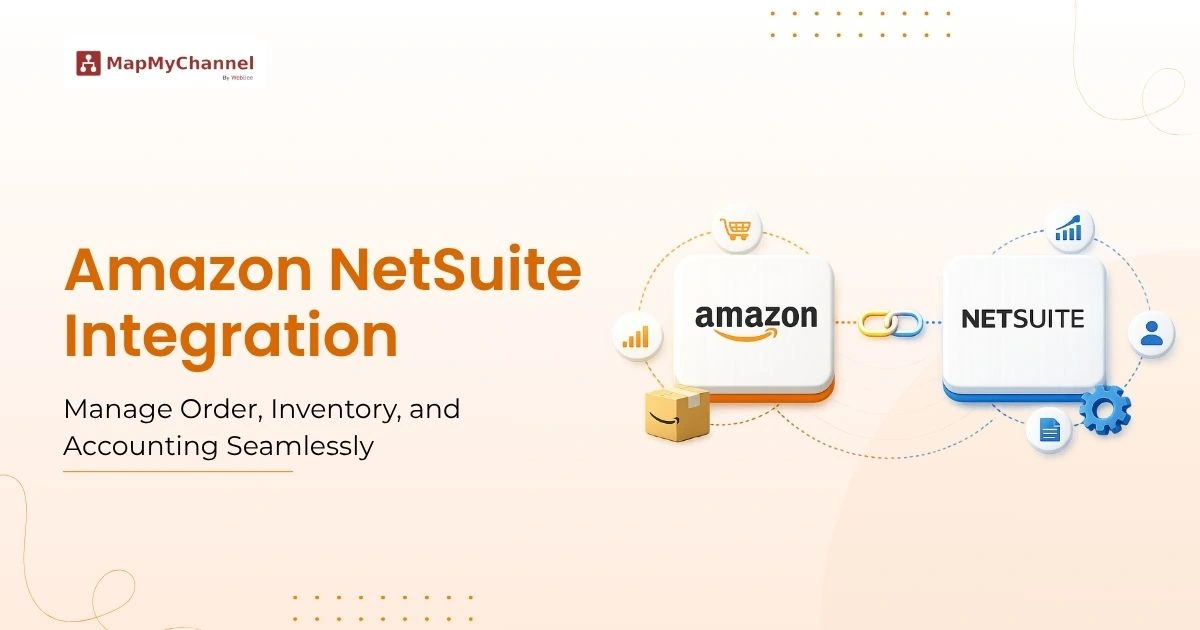
Amazon NetSuite Integration provides the infrastructural facilities needed to simplify order processing, inventory management, tracking and fulfillment, customer queries, etc. The integration simply connects both platforms to allow automated data exchange. Businesses experience massive efficiency improvements in workflow management. There are end-to-end impacts of these operational improvements that have been observed in the customers' shopping experience.
Understanding Amazon and NetSuite
Amazon
Amazon is one of the largest global e-commerce marketplaces. The marketplace has, in its 32 years of existence, served vast numbers of eCommerce brands by bringing together customers from different regions of the world to one single platform. Millions of sellers use the Amazon marketplace to expand their customer reach and diversify revenue streams from just the domestic market.
Opting for FBA (Fulfillment by Amazon) does not mean that businesses are exempt from managing operations. These brands still retain control over all other operations except logistics and customer support. Product listings, inventory availability, order processing, returns and refunds, seller performance tracking, and marketplace fee management are some activities that sellers must manage on their own.
As product range and order volumes increase, manual management of these processes becomes tough. Sellers need automatic updating of accurate data in place to optimize their business workflows.
NetSuite
NetSuite is a cloud-based ERP system that helps brands manage their business processes through a central dashboard. NetSuite, simply put, is a consolidated database that is treated as the single source of truth. Through which operational information can be managed efficiently.
NetSuite provides businesses with tools for:
- Inventory management
- Order management
- Accounting
- Warehouse management
- Customer relationship management
- Business reporting
Without integration, Amazon sales data and data from internal ERP processes exist in silos.
What is NetSuite-Amazon Integration?
NetSuite-Amazon Integration connects Amazon Seller Central to NetSuite ERP through a protected integration that automatically exchanges business data between both systems. The integration acts as an automated data bridge, synchronizing sales orders, inventory, fulfillment updates, etc without manual import of data or spreadsheet-based entries.
Instead of manually entering details from Amazon reports into NetSuite records, ecommerce integration software automatically transfers key information, including orders, inventory levels, customer details, and fulfillment updates. The integration creates a unified workflow where Amazon operations and internal business processes work in conjunction.
Key Functions of Amazon NetSuite Integration
1. Order Synchronization
Amazon order data is automatically synchronized with NetSuite as sales orders. This eliminates errors and delays in sync caused by manual order entry and ensures that customer details, payment information, and product details are accurately recorded.
Depending on the fulfillment model, orders can follow different workflows within NetSuite. Merchant-fulfilled orders usually enter NetSuite as sales orders for warehouse processing, while FBA orders can be recorded differently based on the brand's finance and fulfillment setup.
Example: A customer purchases a computer through Amazon. In the absence of integration, this sale would be manually recorded on NetSuite. With integration, a sales order is automatically created with the buyer's information, items ordered, and payment details. The warehouse team can begin packing the order promptly, eliminating any delay in order fulfillment.
2. Inventory Synchronization
With inventory sync, stock levels are reflected accurately on both Amazon and NetSuite. This helps avoid overselling, eliminates inventory inconsistencies, and allows better inventory visibility and management of product data.
Product details such as SKUs, descriptions, price, and variations are picked from NetSuite and matched to Amazon SKU formats. Accurate product mapping ensures correct recognition of the same product by all sales channels.
Regular inventory sync refers to NetSuite as the primary inventory management system while making sure that Amazon listings always reflect the updated stock availability.
A retailer has 250 units of a product displayed as available stock on NetSuite. If 30 units are sold through Amazon, NetSuite-Amazon integration automatically updates the reduced stock on both systems.
3. Fulfillment Synchronization
Fulfillment synchronization, simply put, is the automatic, seamless exchange of order details between Amazon and NetSuite, providing improved processing visibility for both customers and the seller.
Once the order is packed and shipped, shipping confirmation, delivery partner's details, and the tracking number are automatically sent to Amazon. Constant manual monitoring and updates are no longer required, while at the same time customers can experience better transparency for order delivery.
Suppose an order is shipped by a business. NetSuite records this shipment and generates tracking details. These details are automatically sent back to Amazon. Customers can now track their orders without any manual updates from the seller's side.
4. Financial Data Synchronization
Financial data synchronization automatically transfers transaction details from Amazon to NetSuite for simpler management of accounting.
This synchronization doesn't stop at just recording sales revenue. It also transfers refunds, marketplace fees, and settlement information into NetSuite. Automating the exchange of these financial records streamlines resolution, reduces errors in reports, and minimizes the manual interventions required of the finance teams.
If Amazon deducts marketplace fees from a customer's payment and later processes a refund, the integration automatically records both transactions in NetSuite. This provides finance teams with accurate financial records while limiting manual efforts.
5. Settlement Reports
Settlement reports compile all Amazon transactions, including sales, refunds, marketplace fees, shipping charges, etc. Syncing these reports with NetSuite streamlines accounting and financial reporting by recording every transaction accurately. Rather than manually checking hundreds of transactions separately, finance teams can verify settlement reports directly within NetSuite using the synced financial data.
6. Product Data Synchronization
Product data synchronization makes sure that product information is consistent across Amazon and NetSuite. Businesses can also match product titles and details, prices, varieties, etc between both platforms. This synchronization ensures that listings are accurate, limits the requirement of human intervention, and eliminates discrepancies in product information.
When a product detail is changed on NetSuite, the integration will automatically update the associated Amazon listing with the new detail. Hence, with the integration, customers will always see the most recent, updated product details. The seller need not make multiple manual edits and updates separately on different systems.
Amazon FBA vs Merchant-Fulfilled Orders
How Amazon NetSuite Integration Works
Amazon NetSuite integration usually follows an uninterrupted syncing process that automatically transfers data between Amazon Seller Central and NetSuite ERP. One such typical workflow is shown below:
- An order is placed on Amazon
- Order automatically gets imported into NetSuite
- Inventory level gets automatically updated
- Assigned warehouse picks, packs, and sends order shipment
- Tracking details automatically sync to Amazon
- Financial transaction data from Amazon is sent to NetSuite
This automated workflow limits the requirement of manual data entry while maintaining consistent inventory, fulfillment, and accounting details on both systems.
Ways to Integrate Amazon with NetSuite
Amazon can be integrated with NetSuite and vice versa through many different approaches depending on each brand's technical requirements and operational scale.
1. NetSuite API Connectors
API-based integration allows a sort of direct communication between Amazon and NetSuite using application programming interfaces (API).
API-based integrations allow authorized systems to exchange business data automatically. The specific customization and scalability requirements of each business dictate their choice between direct API integrations or third-party integration solutions.
Through NetSuite API Integration, businesses can automate order imports, inventory updates, product synchronization, customer data transfer, and order tracking. API integration offers flexibility by allowing businesses to customize workflows as per their requirements.
For example, a business can create its own workflow rules in the integration for:
- When inventory should update
- How orders should be processed
- How product information should be mapped
However, businesses would require strong technical resources for development, maintenance, security, and updates for custom API integration.
2. Integration Platforms
Integration platforms provide direct application-ready solutions for connecting Amazon and NetSuite. These platforms work as a bridge between both platforms and facilitate seamless data exchange without requiring businesses to build customized integrations.
Businesses opting for an integration platform can capitalize on centralized monitoring, automated error handling, and workflow management. This method is more suitable for those businesses that process large order volumes or operate across multiple sales channels. Common capabilities include:
- Amazon integration
- NetSuite ERP integration
- Automated workflows
- Real-time inventory synchronization
- Order management automation
- Error monitoring
- Data mapping
Benefits of Amazon NetSuite Integration
1. Improved Data Accuracy
Manual data entry may result in errors like duplicate records, discrepancies in inventory levels, etc. Amazon NetSuite Integration improves data accuracy by doing away with manual updates completely and instead automating information sync across both systems. Accurate data has multiple positive ripple effects in subsequent business operations like inventory planning, accounting and financial reporting, along with customer support.
2. Centralized Inventory Management
Managing inventory separately across Amazon and internal systems increases operational complexity and visibility issues. If inventory levels are not immediately synchronized, businesses run a high risk of selling products that are out of stock, i.e., overselling.
Amazon NetSuite Integration facilitates inventory management for both channels from a single dashboard by maintaining a single source of truth. Some of the benefits include:
- Real-time stock visibility
- Reduced inventory errors
- Improved demand planning
- Better purchasing decisions
Businesses can easily manage inventory because changes made in one system are reflected across connected platforms.
3. Automated Order Management
As Amazon sales increase, manually processing orders becomes inefficient. Integration automatically transfers Amazon orders into NetSuite, reducing the need for manual data entry. This improves:
- Order processing speed
- Data accuracy
- Employee productivity
- Customer service efficiency
Automated order management allows businesses to handle higher order volumes without increasing operational complexity.
4. Improved Amazon FBA Management
Businesses using Amazon FBA must maintain visibility into inventory stored at Amazon fulfillment centers. Amazon NetSuite integration helps sellers monitor:
- FBA inventory levels
- Stock movement
- Shipment status
- Product availability
This allows sellers to plan inventory replenishment more effectively and avoid stock shortages.
5. Faster and More Accurate Fulfillment
Accurate order and inventory information helps businesses fulfill orders faster. Integration eliminates delays caused by checking inventory manually across different systems. Benefits include:
- Faster order processing
- Improved delivery accuracy
- Reduced fulfillment errors
- Better customer experience
6. Better Financial Management
Amazon transactions involve multiple financial activities, including:
- Sales payments
- Marketplace fees
- Refunds
- Adjustments
- Settlement reports
Manually managing these transactions can create accounting challenges. With Amazon NetSuite Integration, financial data can automatically flow into NetSuite, improving reconciliation accuracy and reducing administrative effort.
7. Reduced Manual Work
Manual processes become inefficient as businesses grow. Automation also reduces the need to reconcile reports manually, update customer records, process repetitive inventory changes, or switch between multiple systems throughout the day. As order volumes increase, automation allows teams to scale operations without proportionally increasing administrative effort. Integration reduces repetitive tasks such as:
- Downloading Amazon reports
- Updating spreadsheets
- Entering orders manually
- Checking inventory across multiple systems
This allows teams to focus on strategic activities such as marketing, customer experience, and business expansion.
Common Challenges When Integrating Amazon with NetSuite
NetSuite Amazon Integration simplifies ecommerce operations, but implementation challenges can arise. Inventory synchronization across Amazon and NetSuite acquires critical importance when a business scales operations. Delayed updates or incorrect inventory mapping can lead to inconsistent stock, disorganized SKUs, and discrepancies in customer information. Accurate product mapping syncs records correctly and helps brands experience a smoother integration.
1. Inventory Synchronization
Always keeping a synchronized inventory across Amazon and NetSuite is essential. Updates delayed for even a minute or inventory mapping that has a slight error can result in inventory discrepancies, lost sales, overselling, or inaccurate product availability.
Example: The stock at a warehouse is replenished, but stock updates are delayed by several hours. Amazon continues reflecting the product as out-of-stock. Business experiences lost sales due to delayed updates.
2. Product and Data Mapping
Amazon and NetSuite may have different frameworks in place for identifying SKUs and customer information in their records. Accurate product mapping navigates the bottlenecks caused by these differences by syncing these records correctly across both systems. Duplication or data incompleteness can be prevented.
Example: Suppose Amazon recognizes a product with SKU XYZ-100 while NetSuite uses ABC100 for the same product. Without product mapping, each system will recognize each SKU as representing a unique product rather than the same item. Here, Amazon-NetSuite integration will complicate and not streamline operations.
3. Financial Reconciliation
Without accurate synchronization, checking and verifying the numerous Amazon transactions within NetSuite becomes time-consuming.
Example: Amazon deducts Marketplace fee, Storage fee, Advertising fee, and Settlement from each transaction occurring on the platform. If mapping isn't configured, the finance team spends hours verifying.
Best Practices for a Successful Amazon NetSuite Integration
A well-configured integration is one in which every workflow is validated before mass implementation in a live environment.
- Start by verifying that product mapping is accurate so Amazon SKUs correctly match the corresponding item records in NetSuite.
- Next, review your order workflows to confirm that new Amazon orders are created accurately in NetSuite and follow the usual fulfilment process. Test returns, order cancellations, and shipping updates to check if exceptions are being handled efficiently.
- Validate inventory synchronization to verify that stock levels remain consistent and that inventory changes are reflected across both systems in record time.
- Businesses should also review financial synchronization by checking whether transactions are recorded correctly in NetSuite.
- Monitor synced logs and data transfers regularly, during the initial weeks of the integration going live, to identify issues early. Periodic performance reviews make sure that the integration operates reliably as product categories expand and order volumes increase.
Conclusion
Amazon NetSuite Integration encourages sustainable e-commerce marketplace expansion. The integration facilitates accurate syncing of orders and product stock, fulfilment and financial details between Amazon and NetSuite ERP inventory. Introducing inter-operational transparency, reduced manual intervention, and improved accuracy, this automation streamlines the administrative workflow of any business.
Businesses are now empowered with improved efficiency, more capable of delivering a better customer experience, and a strong core for long-term ecommerce success.
Get in Touch

.webp)

.webp)


