
Choosing where to sell online is an important decision that shapes a seller's daily operations. Sellers often compare Shopify and Amazon when deciding how to build and grow their eCommerce businesses. Both offer significant opportunities, but they work differently. Shopify allows sellers to create their own online stores, while Amazon lets them list products on an established marketplace.
This guide explores the key differences between Shopify and Amazon, including their costs, features, and selling processes. It also explains how sellers can use a multichannel integration strategy to operate on both platforms while simplifying order processing and inventory management.
Overview of Shopify and Amazon
Shopify
Shopify is an eCommerce platform that enables sellers to build their own online stores from scratch. A business owner has full control over everything, including how products are displayed and the store design. Shopify offers a custom web address and direct access to customers' contact details.
However, because Shopify is an independent store, customers won't visit by default until they learn about the business. Sellers are fully responsible for promoting their business, running social media ads, improving search engine rankings, and generating secure sales.
Amazon
Amazon is an online marketplace where millions of independent sellers list their products alongside products sold by sellers and Amazon itself. Selling on Amazon helps businesses to reach a larger customer base through the world's largest online platform.
The biggest advantage for sellers is access to Amazon's built-in customer base. In 2025, over 75,000 independent Amazon sellers surpassed $1 million in sales. New brands can also unlock up to $50,000 in incentives, including credits and other benefits to kickstart their journey with the marketplace.
However, selling on any marketplace means following its rules and policies. Every product detail page follows a standardized structure, and sellers have limited access to customer personal contact information for future marketing. Selling fee structures vary across different marketplaces.
Key Differences Between Amazon and Shopify
Choosing between Amazon and Shopify isn’t just about picking a platform—it is a fundamental choice about the business model a seller wants. Amazon acts as a massive digital mall where merchants can rent a storefront to capture existing shoppers. On the other hand, Shopify serves as a toolkit allowing sellers to build, brand, and own their store from the ground up.
1. Traffic and Customer Reach
Amazon
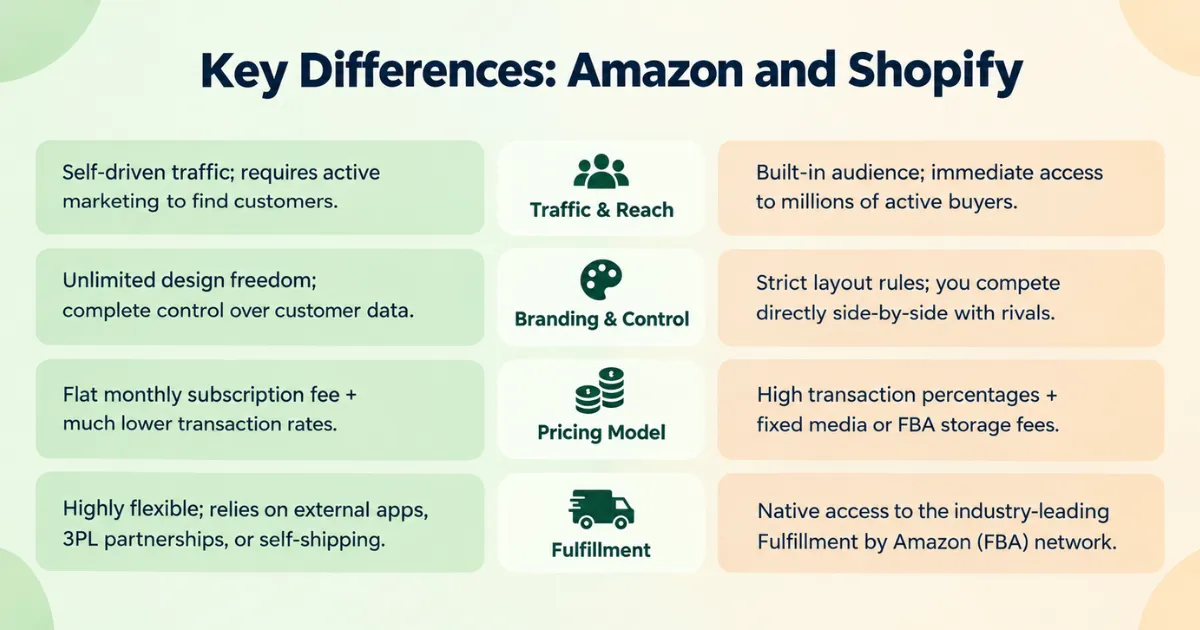
Amazon gives sellers access to a massive audience of over 700 million active global visitors. Sellers can reach shoppers who browse products with high purchase intent. A seller's primary job is to optimize the product listings to improve visibility.
Shopify
A Shopify store starts as a fully personalized, independent, and controlled online storefront. Shopify offers an independent store setup without the customer group. Sellers must attract visitors through SEO, paid ads, email campaigns, and organic social media marketing.
2. Branding and Marketing
Amazon
Amazon standardizes the shopping experience of each business on the marketplace. Amazon restricts customer-seller communication for promotional purposes; sellers can't email and retarget customers, and competitor ad placement is reduced alongside your listings.
Shopify
Shopify gives sellers full control over customer email, purchase history, and on-site behavior. This allows sellers to create branded packaging, personalized promotions, and a distinctive unboxing experience. Sellers can directly connect with customers and get feedback. This flexibility also allows businesses to
3. Selling Fees and Costs
Amazon
Amazon uses a transparent fee structure, and sellers pay a subscription fee (per-item fee and professional plan). Amazon charges referral fees on every sale based on categories. For sellers using FBA, they pay fulfillment fees, monthly storage fees, and long-term storage fees. In April 2026, Amazon increased its fuel and logistics surcharge on fulfillment costs for the US and Canada.
Source: Amazon selling fees and pricing
Shopify
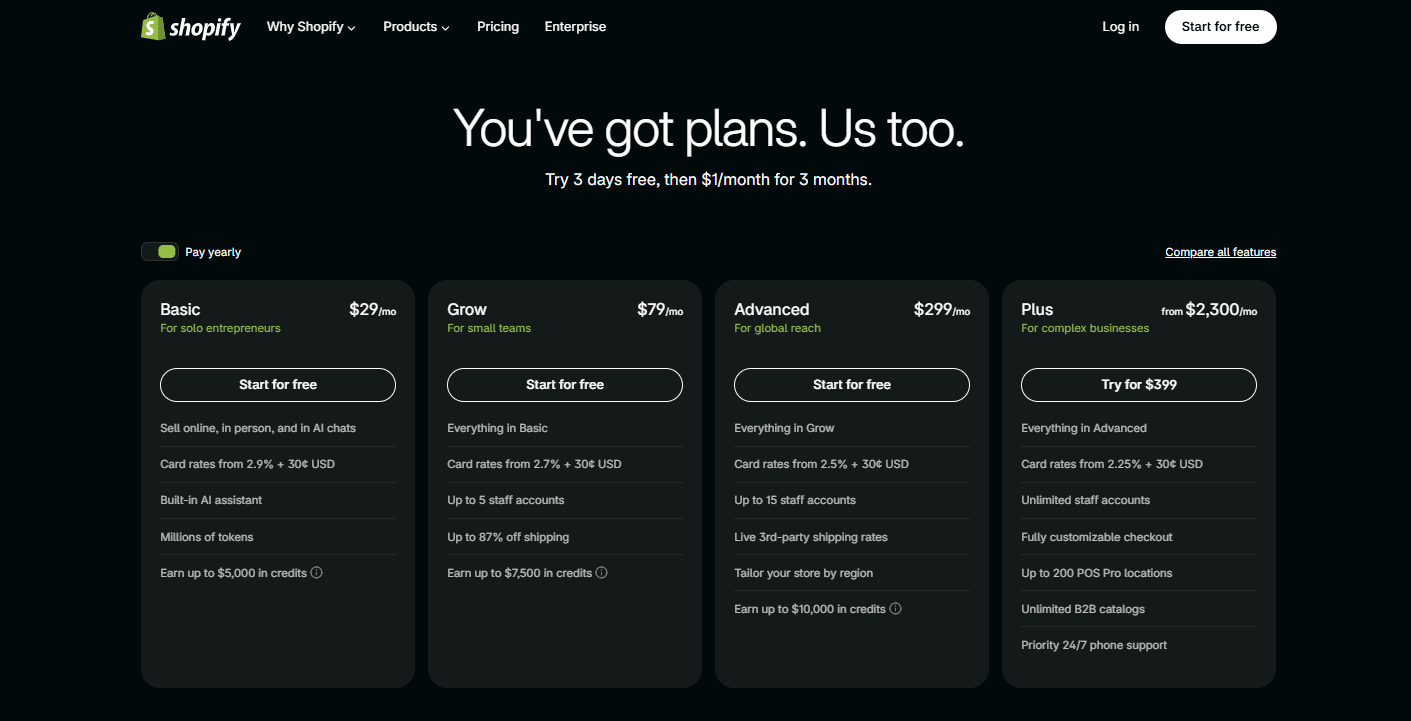
Shopify uses a monthly subscription model for small businesses, Mid-tier for growing brands, and established brands. If sellers use Shopify Payments, they can avoid Transaction fees but still pay payment processing fees. Sellers who are not using Shopify Payments are charged additional Transaction fees.
4. Scalability and Integrations
Amazon
Scaling an Amazon business means expanding into global marketplaces, reaching new customers, and using internal advertising tools. However, sellers must rely on Amazon's platform rules and policies. They can also connect external business systems to support their operations.
Shopify
Shopify offers an extensive app store containing thousands of integrations. As a business grows, sellers can integrate advanced inventory management systems, multi-channel shipping desks, CRM platforms, etc.
5. Fulfillment and Shipping
Amazon Fulfillment Options
- Fulfillment by Amazon (FBA): Seller sends their stock in bulk to an Amazon fulfillment center. The platform handles storage, picking, packing, and dispatching, which automatically grants their orders Prime shipping status.
- Fulfillment by Merchant (FBM): Sellers list their items on Amazon but take full operational responsibility for storage, packing, shipping, and other fulfillment of the products themselves.
Shopify Options
- Seller-controlled fulfillment: Businesses manage their inventory and orders, pack products, and print shipping labels from their own premises or warehouses.
- 3PL integration: Sellers connect their Shopify store to a third-party fulfillment partner that stores their inventory and automatically handles packing and dispatching when a sale occurs.
Businesses can also integrate dedicated partners for services such as print-on-demand services to manufacture and ship custom goods automatically as soon as an order is processed.
Can You Sell on Shopify and Amazon Together?
Businesses do not have to choose between Shopify and Amazon. Brands employ a broader e-commerce strategy: they connect both platforms to expand their market and reach.
To manage both platforms without operational chaos, businesses need a reliable Shopify Amazon integration solution. Manually copying customer details and updating stock between two systems ultimately leads to data errors and delayed processing.
With MapMyChannel, businesses can simplify multi-channel operations by connecting Shopify and Amazon to supported fulfillment partners. It simplifies Shopify and Amazon order management by centralizing order and inventory details on a single, comprehensive dashboard. Every marketplace sale triggers the fulfillment system and is recorded immediately.
MapMyChannel also provides a real-time Shopify-Amazon inventory sync. When an item sells out on the storefront, the system instantly updates inventory levels across connected platforms. This eliminates the risk of overselling, secures brand ratings, and lets businesses scale across platforms with complete operational precision.
Conclusion
The debate between these platforms is not about finding which one is the best platform; it is about choosing the right marketplace for your business. A standalone store gives businesses deep customer relationships and full branding freedom, while Amazon provides immediate access to global customers and a massive sales volume.
Instead of limiting their growth to one channel, businesses can combine the strengths of each platform. Using a centralized platform like MapMyChannel lets sellers capture a global customer group while creating a foundation for their business that they fully own.
FAQs
Can I sell on both Shopify and Amazon simultaneously?
Yes, sellers can operate both channels at the same time to maximize their reach. To avoid manual data entry, they can use a centralized Integrator to automate their workflows and display all order details on a single interface.
Can I use Amazon to drive customers to my Shopify store?
Amazon strictly prohibits directing customers off-platform through direct messaging. However, sellers can place custom branded packaging inserts inside their boxes to connect with buyers and encourage them to visit their independent store for future orders.
How do I manage inventory across both Shopify and Amazon?
Sellers can use a specialized integration app to sync Shopify and Amazon inventory reliably. This automated connection adjusts stock levels in real time across all channels whenever a purchase occurs, preventing the risk of accidental overselling.
Get in Touch

.webp)

.webp)


